
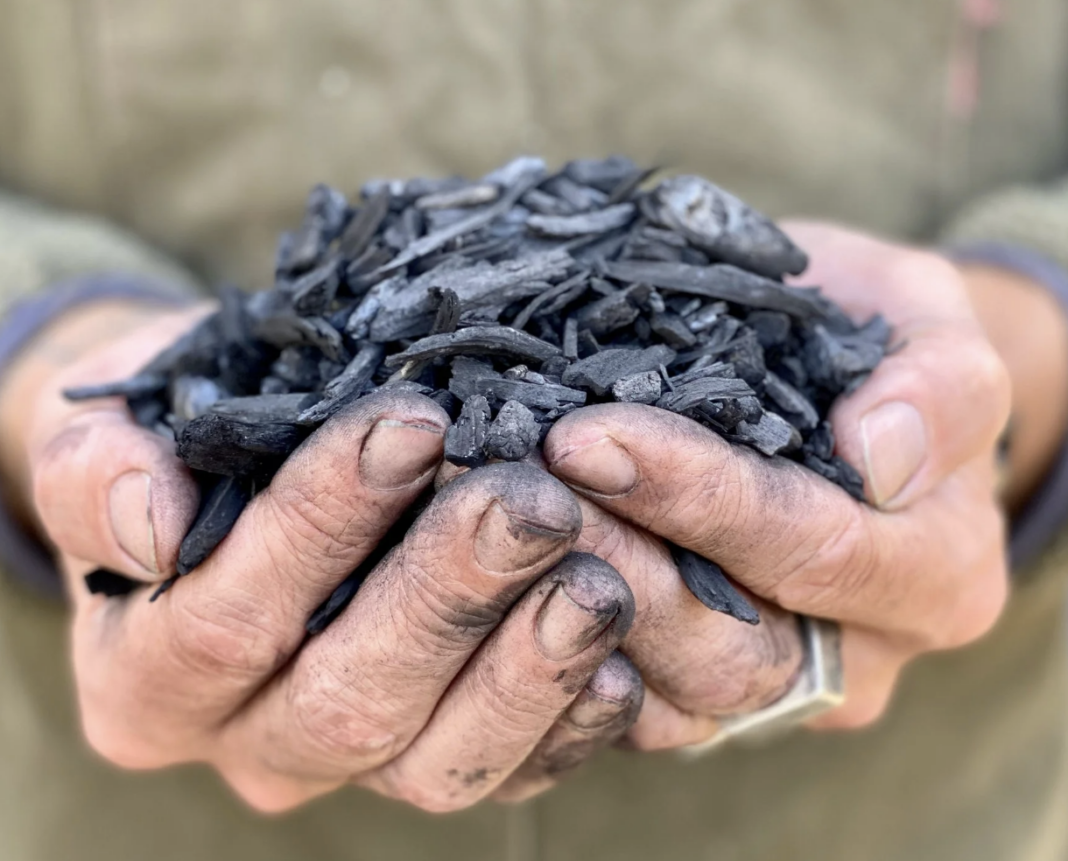

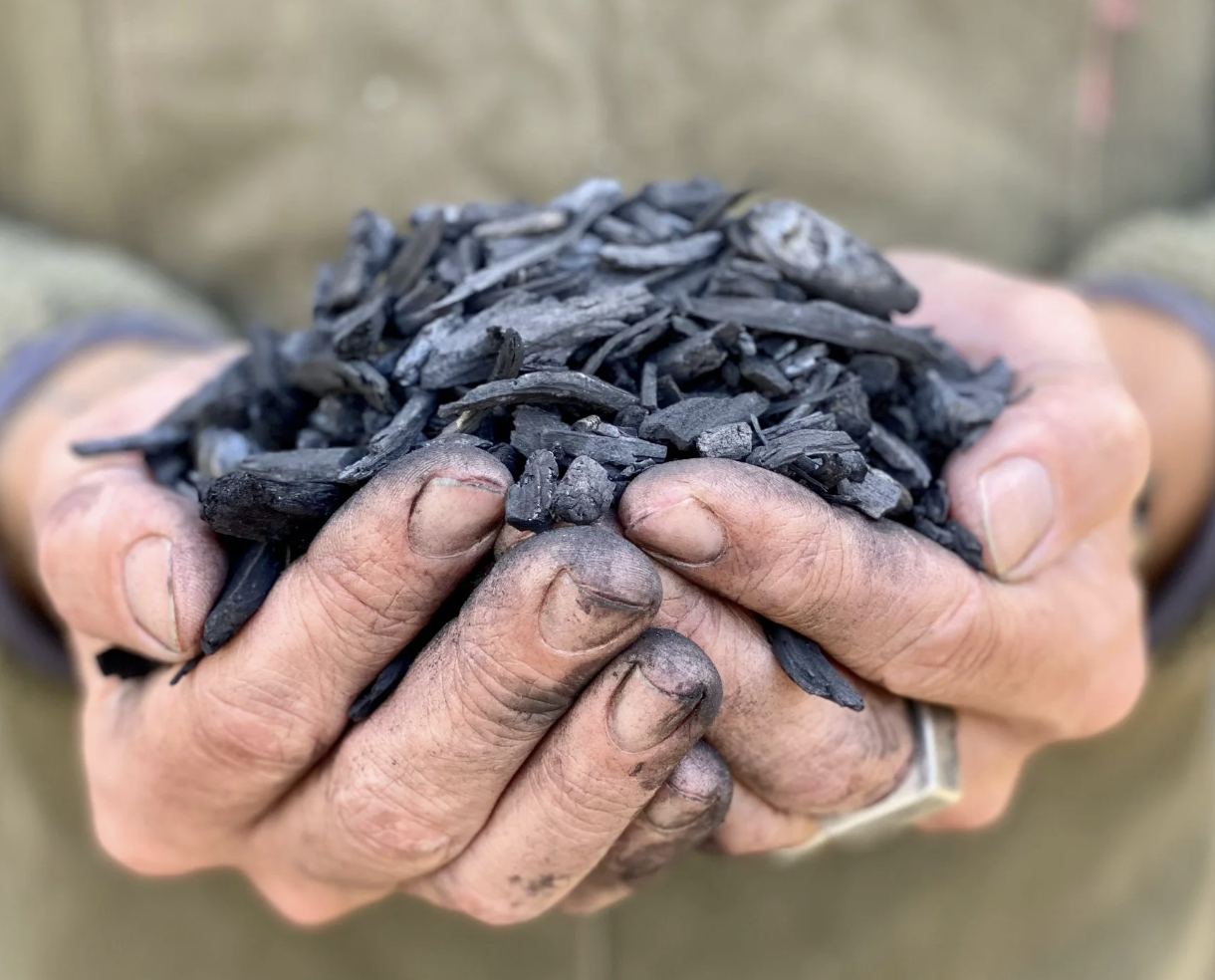
PFAS — often called “forever chemicals” — are among the most stubborn pollutants on Earth. Used for decades in firefighting foams, industrial coatings, and consumer products, their carbon–fluorine bonds make them extraordinarily persistent in soil, water, and living organisms. Worse, PFAS don’t just stay put. Even at low concentrations, they can be taken up by crops and move through the food chain, with short-chain PFAS proving especially mobile.
A growing body of research suggests that biohacking soil chemistry, rather than removing contaminated soil entirely, may offer a practical way forward. One promising tool: biochar.
A study published in Environmental and Biogeochemical Processes (27 November 2025) by Jason C. White and colleagues at The Connecticut Agricultural Experiment Station shows that iron-fortified biochar can significantly reduce PFAS uptake in food crops. In controlled soil–plant experiments, iron-modified biochar lowered total PFAS accumulation in radish plants by nearly 50%, and reduced PFAS concentrations in the edible bulb by more than 25%.
The researchers worked with PFAS-contaminated sandy loam soil impacted by legacy firefighting foams. They tested hemp-derived biochar produced at different temperatures, with and without iron fortification. While standard biochar showed mixed results, low-temperature (500 °C) biochar fortified with ~8% iron proved highly effective, immobilizing PFAS and preventing them from moving into plant tissue.
Why iron? Lab analysis revealed that iron fortification dramatically increased biochar’s surface area and pore volume, creating reactive sites that bind PFAS molecules through electrostatic and ligand-exchange interactions. Importantly, the biochar caused no phytotoxic effects and often improved plant growth — a critical factor for agricultural use.
The implications are significant. Instead of costly soil removal or long-term land abandonment, farmers could use iron-enhanced biochar as a soil amendment to lock PFAS in place, reducing human exposure through food. Because biochar can be made from agricultural waste like hemp and applied using existing farming practices, the approach fits neatly within circular-economy and climate-smart agriculture frameworks.
Biohacking soil won’t erase PFAS from the planet. But this research suggests it may help break the chain between polluted land and polluted food — a meaningful step toward safer agriculture in a contaminated world.
How Biochar Is Made
Biochar is produced by heating organic material in a low-oxygen environment so it does not burn. This process, known as pyrolysis, transforms plant matter into a stable, carbon-rich material.
The feedstock can include agricultural residues such as wood chips, crop waste, nutshells, hemp stalks, or manure. These materials are first dried, then heated to temperatures typically ranging from 350 to 700 degrees Celsius in a sealed kiln or reactor where oxygen is limited. Because oxygen is absent, the biomass does not combust; instead, volatile gases are driven off, and the remaining carbon reorganizes into a porous, charcoal-like structure.
Once the heating phase is complete, the material is cooled in low oxygen to prevent ignition. The resulting biochar contains a network of microscopic pores that give it a large surface area and unique chemical properties. These pores allow biochar to retain water, nutrients, and contaminants when added to soil.
Biochar can also be engineered after production. It may be steam-activated to increase surface area, fortified with minerals such as iron to bind pollutants, or “charged” with compost or nutrients before soil application. When applied correctly, biochar can persist in soil for hundreds to thousands of years.
How Biochar Is Different From Coal
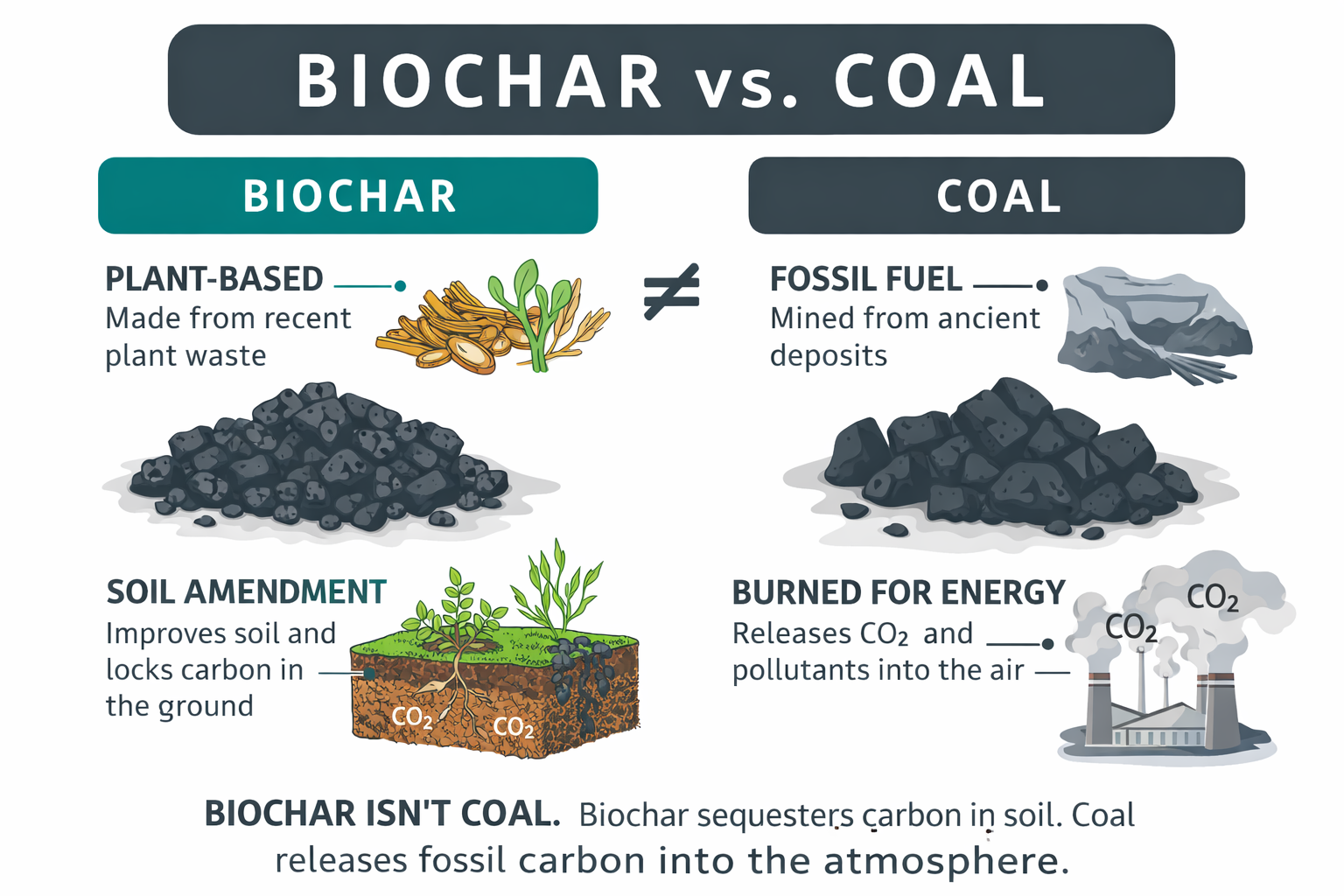
Although biochar and coal may look similar, they are fundamentally different materials with very different roles in the carbon cycle.
Coal is a fossil fuel formed from ancient plant matter that was buried and transformed under heat and pressure over millions of years. It is mined from the ground and burned for energy, releasing carbon that has been locked away since prehistoric times. Coal often contains sulfur, heavy metals, and other impurities, and its primary purpose is combustion.
Biochar, by contrast, is made from recent plant material and produced intentionally in modern systems over hours or days. It is not designed to be burned. Instead, biochar is meant to remain stable in soil, where it can improve soil structure, retain nutrients, immobilize pollutants, and store carbon.
From a climate perspective, the distinction matters. Burning coal releases ancient carbon into the atmosphere, increasing net emissions. Biochar locks up carbon from the current biological cycle, helping reduce atmospheric carbon when used as a soil amendment.
In short, coal is an energy source. Biochar is a soil tool. And it’s an investable commodity. A new fund manager in Texas has her eye on the growing demand for carbon credit projects that remove carbon from the atmosphere. Biochar, created through a process called pyrolysis that involves heating biomass and biowaste, is an emerging solution for trapping carbon. The biochar not only sequesters carbon, it can restore soil health and enable soil to store greater amounts of carbon. Founder Heather Stiles and her firm Kemet make debt and equity investments in companies supporting biochar production and use, waste-to-energy projects, and carbon trading. “The nascent biochar market lacks dominant players,” the company says. And now they have a new market: in agriculture.
Biochar companies in the US and Canada
NY Carbon – Large-scale biochar producer serving New York and New England markets
Finger Lakes Biochar – Regional biochar production for agriculture and remediation
Vermont Biochar – Farm- and soil-focused biochar production
The Biochar Company – Biochar for agriculture, remediation, and carbon storage
Integro Earth Fuels – Biomass pyrolysis and biochar production
Re:char – Mobile and modular biochar systems, soil and waste applications
Seattle Biochar – Biochar production from regional biomass waste
Whitfield Biochar – Biochar and carbon materials for soil and remediation
Carbonity (Airex Energy subsidiary) – Industrial-scale biochar and biocarbon production (Canada)
Canadian Biochar Investments (CBCI) – Modular biochar systems and carbon removal projects across Canada




Thanks for the great Article Karin! So important to share the new research and possibilities for biochar!
Is there something we should know about that we didn’t mention?