
Two-faced Turkey imposes tariffs on solar panels from Asia

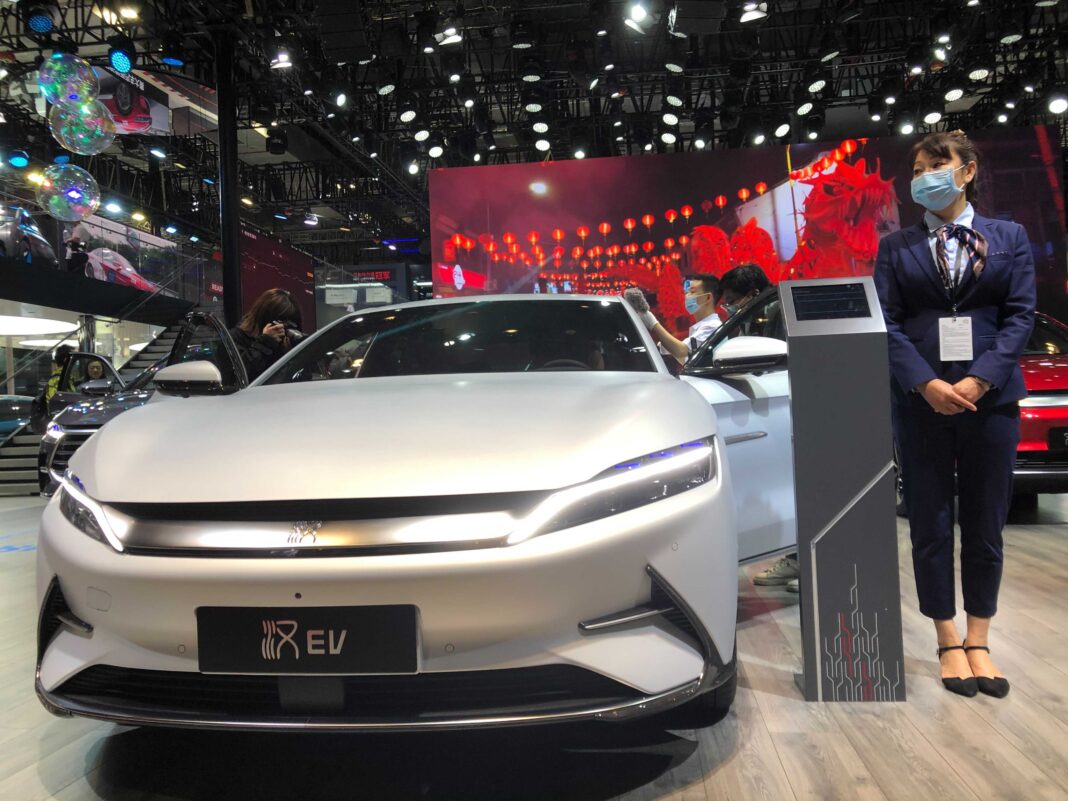
China opens a $1 billion agreement with Turkey to build EVs in Turkey
China makes a $1 billion deal with Turkey to build EVs in Turkey circumventing EU tariffs imposed on Chinese electric cars.

Turkey imposes tariffs on solar panels when it hurts its local economy but it speaks from the other side of its mouth when it stiffs Europe by helping China evade high tariffs on electric vehicles sold in Europe.

China evades tariffs through a $1B car factory it is building in Turkey. Meanwhile Volkswagen is seeing 3 factories shut down and 30,000 people laid off.

Keep Europe European

According to the Turkish General Directorate of Imports as of September 27, Energy Trend is reporting that Turkey has imposed a tariff of $25 per square meter on photovoltaic modules imported from Vietnam, Malaysia, Thailand, Croatia, and Jordan. But exemptions have been made for JinkoSolar’s Malaysian subsidiary, JA Solar’s Vietnamese subsidiary, Trina Solar’s Thai subsidiary, and Vina Solar, a Vietnamese module manufacturer acquired by Longi Green Energy a few years ago.

On November 25, 2023, Turkey’s Ministry of Trade announced that, at the request of Turkish companies, it had launched an anti-circumvention investigation into photovoltaic modules originating from China. The investigation seeks to determine whether Chinese products are being exported to Turkey via Vietnam, Malaysia, Thailand, Croatia, and Jordan to evade anti-dumping duties.

Turkey suspects that some companies from these five countries are using “transshipment” to circumvent the previously imposed $20 per square meter countervailing duty on Chinese photovoltaic products. After months of review, the Turkish government decided in March this year to impose a new tariff of $25 per square meter on photovoltaic products imported from these countries, a 25% increase over the previous tariff.

This is rich considering that Turkey is helping China circumvent EV trade tariffs as together China and Turkey build a $1B Chinese EV company, BYD, on its soil so that China and Turkey can both profit from EU electric vehicle tariff exemptions. Currently any China-made electric car would see a high tariff and tax if it gets sold in Europe – which does not make them a viable purchase in Europe. Meanwhile Volkswagen is laying off employees in Germany because of the lowered costs of cars coming from Asian countries like China.

Volkswagen is seeing 30,00 layoffs and the closure of three factories: “This is the plan of Germany’s largest industrial group to start the sell-off in its home country of Germany,” Cavallo added, not specifying which plants would be affected or how many of Volkswagen Group’s roughly 300,000 staff in Germany could be laid off.

Turkey is not part of the EU for a reason. It is playing dirty against Western values with Iran, Syria and China and its dealings with Chinese businesses to avoid EU tariffs should be investigated. Trump as the new US president will probably restructure this unholy alliance, but not before the quality of life in Europe crumbles further from globalism.

Karin Kloosterman
Karin Kloostermanhttp://www.greenprophet.com
Karin Kloosterman is an award-winning journalist, innovation strategist, and founder of Green Prophet, one of the Middle East’s pioneering sustainability platforms. She has ranked in the Top 10 of Verizon innovation competitions, participated in NASA-linked challenges, and spoken worldwide on climate, food security, and future resilience. With an IoT technology patent, features in Canada’s National Post, and leadership inside teams building next-generation agricultural and planetary systems — including Mars-farming concepts — Karin operates at the intersection of storytelling, science, and systems change. She doesn’t report on the future – she helps design it. Reach out directly to [email protected]

Read More

TRENDING

The Space Orchestra, and the search for extraterrestrial life, to eclipse celebration

The event will livestream eclipse views from Iceland and northern Spain, where the eclipse will be total, while the 35-member International Space Orchestra, made up of astronauts, scientists, engineers, and researchers—performs a new orchestral interpretation of Voyager by PJ Harvey.

Canada’s healthcare became the world’s digital health laboratory. Now Europe is taking notice

Canada's healthcare system may be under pressure, but its decades-long experience with digital transformation is becoming a model for Europe and beyond. In an interview with Nordic's Alison MacDonald, Green Prophet explores why successful AI in healthcare depends less on software than on empowering clinicians, improving workflows and building resilient systems.

Jewish Climate Network founded so innovators don’t leave their identity at the door

Rather than retreating from climate change work, the Jewish Climate Trust organization has backed a new initiative designed to strengthen both climate action and Jewish community.

The Hidden Components Powering the Renewable Energy Revolution

A rooftop solar system looks simple: panels, an inverter, a battery and a few cables. But beneath that simplicity lies a bill of materials thousands of lines long, where tiny current sensors, magnetic cores, gate drivers, capacitors and connectors quietly determine efficiency, safety and lifespan. These overlooked components—not the solar panels themselves—are why today's residential solar systems are smaller, smarter and far more reliable than those of a decade ago.

Teen Farmerettes were Canada’s answer to Victory Gardens during wartime food shortages

It is a wake-up call to teen girls on TikTok planning their next Coachella outfit or trip to Sephora: During the Second World War, thousands of young men left family farms to enlist, but the crops still needed planting and harvesting. Ontario's government answered by recruiting high school girls, from ages 16 to 18, to spend parts of spring, summer and fall to fill in for the labor shortage. 

The Essential Guide To Sustainability in Project Management

Sustainability is an approach where businesses and individuals balance the environmental, social, and economic aspects of a project such that current and future stakeholders are not overburdened with the impacts of the project in future.

Yerukim Forms a New Green Economy Where the Money is Really Green

The Yerukim members who pick up the recyclables get to keep the monetary reward, the public earns "green" bills that can be used in shops, and business owners get to be associated with environmentalism.

Choosing Riyadh over Dubai? What Investors Should Know

Saudi Arabia is deploying capital at unmatched scale to catalyze tourism and advanced industry while rewiring its power-and-water backbone. The investable frontier is widening—especially in renewables, grid storage, water efficiency/desal retrofits, and hospitality operating platforms. Prudent investors will insist on phased delivery, enforceable KPIs (energy, water, biodiversity), and RHQ/zone compliance—while pricing political-economy and reputational risks alongside growth upside.

Sell your cooking oil for biodiesel money

Want to make money on old french fry oil? Sell it.

Qatar Alternative Energy Summit Pairs Investors And Innovators

Alternative energy investors and innovators can meet n' greet in Doha, Qatar March 16 and 17.

Here’s How To Implement The Four Pillars Of Employee Engagement

If you throw a party for your work team and they are vegans, don't make it a barbecue. Know the sustainability values of your team to boost moral and retain good people.

Locals From Rishon Fight IKEA

Big Box stores are a pretty new concept in Israel, and thank God that not every Israeli city wants them in their backyard. A word from someone who has see the beautiful farmland around her hometown Newmarket, Ontario stripped and converted into vulgar strip malls of big box shops: they have no place in a healthy and sustainable town or city.

The Jewish National Fund Meets An Inconvenient Truth

According to the JNF, it has transformed thousands of acres of barren land into green forests in Israel. They state that each person emits about 23 tons of carbon per year, estimating that each tree planted can absorb one ton of carbon in its lifetime. That's a whole lot of trees you'd need to be planting. Could so many fit in Israel?

Popular Categories