

Saudi Arabia has inked a major financing deal to modernize desalination—again. The Saudi Water Authority (SWA) signed an agreement with the Asian Infrastructure Investment Bank (AIIB) and the Kingdom’s National Infrastructure Fund (Infra) to support upgrades at Jubail Phase I and Khobar Phase II, with total financing of USD 650 million. Signed on the sidelines of AIIB’s Annual Meeting in Beijing (June, 2025), the package will convert aging multi-stage flash (MSF) assets to reverse osmosis (RO)—the global standard for lower-energy, modular desalination.
According to the parties, AIIB will provide the lion’s share—over SAR 1.6 billion (~USD 450 million)—one of the bank’s largest non-sovereign corporate financings to date, while Infra contributes SAR 750 million (~USD 200 million) via a Murabaha facility. SWA executives say the modernization extends plant life by ~20 years, boosts output, and slashes energy intensity—key to Saudi’s climate and efficiency goals under Vision 2030.
Reverse osmosis uses membranes and pressure, not heat, to separate salts from seawater. It’s already the backbone of the world’s newest mega-plants, including Khobar Phase II, which has reached record daily production of ~671,000 m³. By replacing MSF trains with RO skids, operators can cut electricity demand and integrate solar and wind power more easily—vital in a grid pivoting toward renewables and green hydrogen.
But desalination isn’t a silver bullet. RO still concentrates salts and trace pollutants into brine, a disposal challenge for sensitive Red Sea reef ecosystems. Efficiency upgrades matter, yet so do smarter outfalls, brine-to-minerals recovery, and robust monitoring—especially along coastlines already under stress from microplastics and warming seas.
Don’t Forget Brackish Water
Saudi water isn’t only about the sea. The Kingdom also taps brackish inland aquifers—less salty than seawater—where RO can operate at a fraction of the energy and cost. With proper reuse and aquifer-recharge strategies, brackish desalination can relieve pressure on coastal plants and reduce the carbon footprint. The catch? Inland concentrate management. Without coastal dilution, brine needs evaporation ponds, deep-well injection, or recovery of valuable minerals to prevent soil and groundwater impacts.
Alongside hardware upgrades, Saudi utilities are embracing “smart water” analytics—pilots often grouped under initiatives like IRYIS—to track losses, predict failures, and squeeze more value from every cubic meter. Think AI-assisted pressure management, pipeline leak detection, and SCADA-integrated demand forecasting. In a country where urban resilience now hinges on real-time data, the software layer may deliver savings on par with plant retrofits.

NEOM’s Big “Eco” Claim—And the Caveats
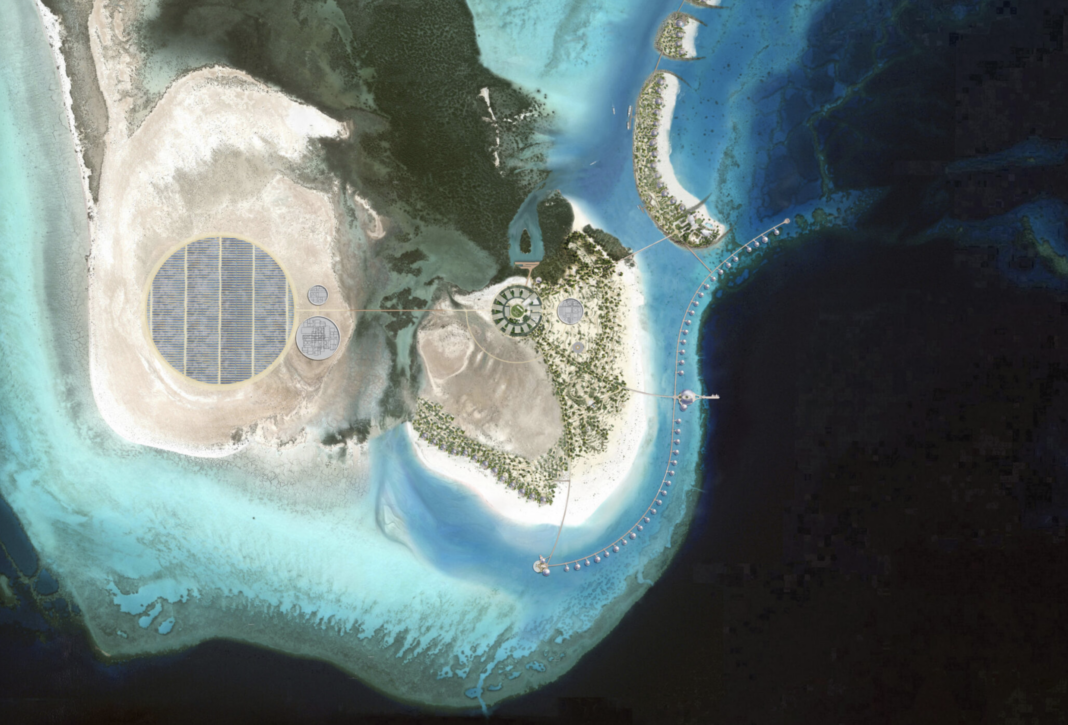
No Saudi water story is complete without NEOM, the high-profile giga-project selling a future of “100% renewable desalination,” circular brine chemistry, and hydrogen-powered industry. Ambition is welcome—Saudi needs moonshots to decouple water from oil. Yet branding vast coastal megaprojects as ecological projects raises tough questions about biodiversity impacts, embodied carbon, and social footprints along the Red Sea. But follow the money as plenty of Europeans are readying to greenwash NEOM for hard to ignore dividends.
If “green” is to be more than a marketing color, delivery must match the deck: renewables actually powering RO 24/7, brine managed as a resource not a waste, and transparent reporting on emissions and marine health.
The SWA–AIIB–Infra package signals a maturing water finance market. Blended capital, corporate structures, and performance-based upgrades can scale faster than sovereign megaprojects alone. As AIIB notes, “modernization” is climate adaptation—hardening critical supply while cutting energy per liter. If paired with demand-side efficiency, heritage water know-how, and water-smart urbanism, Saudi could pivot from crisis-driven builds to a resilient, circular water economy.
“This financing represents a significant step toward enhancing the water sector’s sustainability, increasing climate resilience, and improving the efficiency of national projects,” says Eng. Sharekh Al-Sharekh, SWA VP for Technical Affairs and Projects. AIIB calls it a commitment to “long-term water security” through modernization.
What to Watch Next in Saudi Arabia
- How quickly MSF units are retired and RO capacity ramps without service gaps.
- Proof that renewables—not oil and gas—are powering more of Saudi’s water.
- More Saudis in the workforce managing stakes in their own resources
- Transparent data on brine salinity, temperature, and outfall impacts in the Red Sea.
- Scaling of wastewater reuse and agri-water efficiency to reduce desal demand growth.
Further reading on Green Prophet
- Desalination’s brine problem and marine ecology
- Solar energy breakthroughs in the Middle East
- NEOM’s green hydrogen and the hype test
- Accelerating urban water resilience in Gulf cities
- Advancing wastewater reuse in MENA
- Permaculture tools for arid regions
- Ancient water systems that still work
- Microplastics and Middle East coasts
- Designing water-smart cities in MENA
- Regenerative farming and water savings