
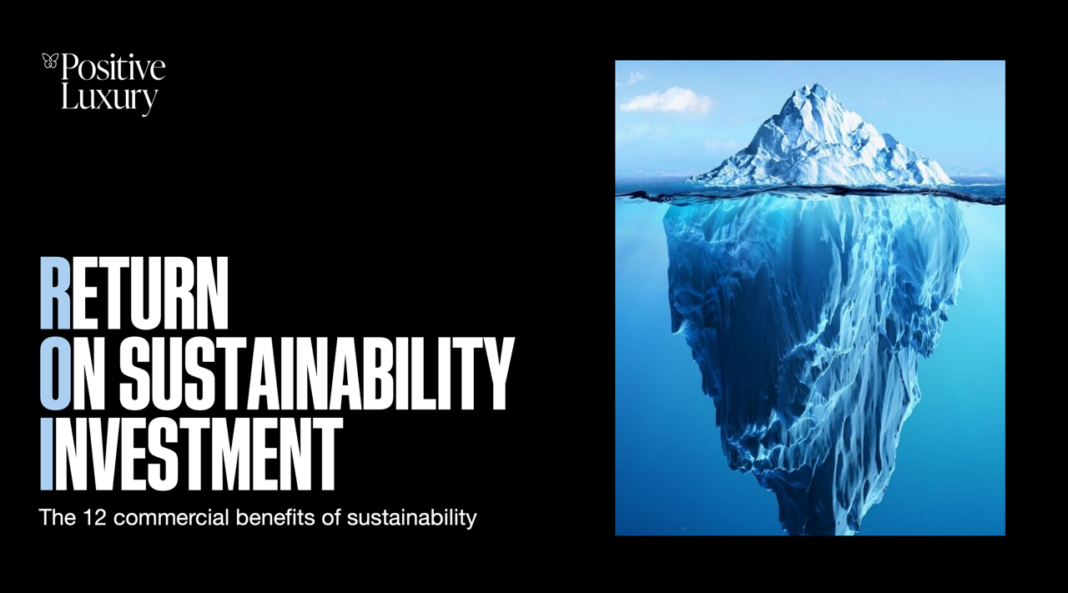

Is There a Business Case for Sustainability? New Report Highlights 12 Commercial Benefits of Sustainability Investment

Positive Luxury report

If you were presented with an opportunity to reduce waste, cost, and risk while simultaneously driving resilience, innovation, and competitive advantage—would you not seize it? In an era of backlash against ESG, regulatory shifts, and economic uncertainty, it has never been more critical for businesses to demonstrate clear returns on sustainability investment.

Positive Luxury, the leading sustainability expert in the luxury industry, has released a new briefing report that outlines a compelling business case for sustainability, revealing 12 key commercial benefits that brands cannot afford to ignore.

Related: Estee Lauder goes solar

We are entering a new era—the climate era. A period of rapid and accelerating climate transformation, with record-breaking temperatures, stronger storms, and ecosystem shifts that will increasingly disrupt our modus operandi. This is a certainty. It comes with risk and opportunity in equal measure. The question is: will you be sufficiently prepared?” asks Amy Nelson-Bennett, CEO of Positive Luxury.

Amy Nelson-Bennet

Key Takeaways from the Report:
Understand the business case for sustainability
Unlock 12 commercial benefits
Calculate your Return on Sustainability Investment (ROSI)
Sustainability as a Competitive Imperative

Businesses face a clear choice in 2025: integrate sustainability as a core strategy or risk falling behind in the race for talent, investment, and consumer trust. To remain competitive, brands must leverage sustainability to drive business growth. The report identifies four key areas where sustainability creates value:

1. Direct Benefits:
Premium pricing power – Sustainability-conscious consumers are willing to pay more for responsible luxury.
Consumer appeal, engagement & loyalty – Strengthening brand trust through sustainable practices.
New revenue streams – Opportunities in circular business models and sustainable innovations.

2. Cost Savings:
Operational efficiencies – Reducing energy, water, and material waste.
Resource & supply chain optimisation – Securing raw materials and ensuring long-term stability.
Regulatory cost reduction – Avoiding fines and penalties by staying ahead of compliance.

3. Indirect Benefits:
Supply chain resilience – Mitigating risk through responsible sourcing and ethical partnerships.
Talent retention – Employees increasingly prioritize working for purpose-driven companies.
Investor confidence – Attracting ESG-conscious investors and long-term capital.

4. Cost of Inaction:
Reputation risks – Greenwashing and unsustainable practices can lead to consumer backlash.
Climate-related resource risks – Scarcity of raw materials and rising operational costs.
Competitive risks – Falling behind more agile, sustainability-focused competitors.

Positive Luxury’s latest briefing provides luxury brands with the insights and tools needed to measure and maximize their sustainability impact. By making informed decisions today, businesses can ensure they thrive in the climate era.For more information, download the full report from 6th March here.


Read More

TRENDING

Paris Modest Fashion Week offers style without exposure for Muslims

France is home to around 5 to 7.5 million Muslims according to estimates, and Özlem Şahin, head of the organization behind Modest Fashion Week, has described Paris as "one of the leading modest fashion capitals in Europe".

Monitoring farmers’ tillage patterns from space

Tillage is one of the clearest signals of how a farm treats its soil. Intensive plowing can degrade structure, release carbon, and increase erosion. Conservation practices—no-till, cover cropping, minimal disturbance—do the opposite. They build soil, retain water, and support biodiversity. But until now, measuring these practices at scale has been slow, expensive, and often self-reported.

Tony Cho’s model for regenerative cities

Tony Cho is a regenerative developer and community builder focused on designing cities as living ecosystems that support human connection and ecological balance. A key figure in Miami’s urban transformation, he helped shape the Wynwood Arts District and founded the Magic City Innovation District. Influenced by an unconventional upbringing that included time in an ashram, Cho brings a spiritual lens to real estate, blending culture, community, and capital into what he calls regenerative placemaking.

Luxury meets the textile waste stream with Coach – Bank & Vogue

A new collaboration between luxury brand Coach and textile reuse pioneer Bank & Vogue attempts to stitch those two worlds together: high fashion and the global textile waste stream.

Levis is teaching Gen Z how to repair their clothes –– download all the teacher guides here

Somewhere between TikTok hauls and next-day delivery, we forgot how to fix things. We forgot how to cook without an app and a pre-made box, grow food without a kit, and sew a button back onto a shirt without throwing the whole garment away. Clothing, once stitched with intention (my mother made her ow dresses!), has become disposable. And with it, a quiet loss of skill, patience, and care.

How to quiet noise from construction in your office

Streets need to be resurfaced in New York but the humming and grinding noise is unsettling. Noise is environmental pollution. 

EarthX and a blueprint for sustainable investing

Trammell S. Crow, a Dallas-based businessman and father of four, is focusing his efforts on impact investing, and media that focuses on saving the planet through EarthX.

Mining Afghanistan’s Mineral Discoveries Similar to Avatar

Now that American forces in Afghanistan are commemorating the longest period of any war that America has been involved in, including the 1965-73 Vietnam War, the recent discoveries of large and extremely valuable mineral and metal deposits may finally bring to light a reason to continue the presence of US fighting forces in this war torn and backward country.

From Pilot Plant to Global Stage: How Aduro Clean Technologies’ 2026 Expansion Signals a Turning Point for Chemical Recycling Investors Like Yazan Al Homsi

The company's Next Generation Process (NGP) Pilot Plant in London, Ontario, has officially moved into initial operating campaigns, generating the kind of structured, repeatable data that separates laboratory promise from commercial viability.

Nobul’s Regan McGee on Shareholder Value: “Complacency Is the Silent Killer” 

Why the governance framework designed to protect shareholders so...

Should You Invest in the Private Market?

startustartup Unlike public stock exchanges, which offer daily trading, strict...

How to build a 100-year-company

Kongō Gumi is a Japanese construction company, purportedly founded in 578 A.D., making it the world's oldest documented company. What can we learn about building sustainable businesses from them?

How AI Helps SaaS Companies Reduce Repetitive Customer Support Work

SaaS products are designed for large numbers of users with different levels of experience, and also in renewable energy.

Popular Categories