Iran is sinking in sinkholes from overwatering

sinkhole in tehran

What’s that sinking feeling?

In Iran, the very ground under your feet may drop away.

The issue here isn’t war. The issue is land subsidence, a human-caused phenomenon that’s been ignored and mismanaged In Iran for decades. Over-pumping of groundwater is causing Iranian land to subside; that is, to sink.

Land subsidence causes damage like water pipes bursting, roads collapsing, and sewer and gas lines breaking. Houses and buildings crack as their foundations weaken. Iran is one of the most earthquake-prone countries in the world. With this land deformation, even a minor quake could cause catastrophic disaster.

The GFZ German Research Center for Geosciences in Potsdam used satellite data to reveal the extent of the subsidence. A tool known as Interferometric Synthetic Aperture Radar, which spots even the most minute difference in ground deformation, revealed that land around Imam Khomeini International Airport (IKIA) was sinking at around 5 centimeters per year. This is considered a “moderate” rate of land subsidence. According to Iran’s National Cartographic Center, other areas are sinking at the rate of 31 cm per year.

Land sinks slowly, almost invisibly. But now the effects of land subsidence are plain to see; especially when a hole in the earth opens up and swallows a whole car under your eyes. At risk are cities, historical sites, and crucial structures like Iran’s airport. In Tehran, Isfahan and Rafsajan, land has dropped by over 12 inches (30 cm) per year. It can’t be ignored anymore.

90% of Iranian groundwater is used for farming. Much is wasted through inefficient management, such as unmonitored drilling of deep wells to make up for reduced rainfall. 14.5 cubic meters of groundwater are pumped every second, an unsustainable rate of use. One way to reduce waste and water theft is to implement water metering.

One might think that innovative farming methods such as Saudi Arabia’s proposed hydroponic greenhouses might penetrate Iranian thought.

As for the largest urban center, 70% of Tehran’s water needs are supplied by five nearby dams. Now, according to current state media reports, the reservoirs are only 13 percent full.

Better management of water resources is needed, such as projects to reduce waste and recycle water; but corruption and plain official indifference impede it.
drought in Iran

Discussing water scarcity and air pollution in Tehran, the best that President Masoud Pezeshkian had to offer was a proposal to move Iran’s governmental hubs away.

“We have no choice but to move the country’s political and economic center closer to the sea,” he said.

In other words, no plan to manage water where the majority of people live: just moving government structures on to a better place.

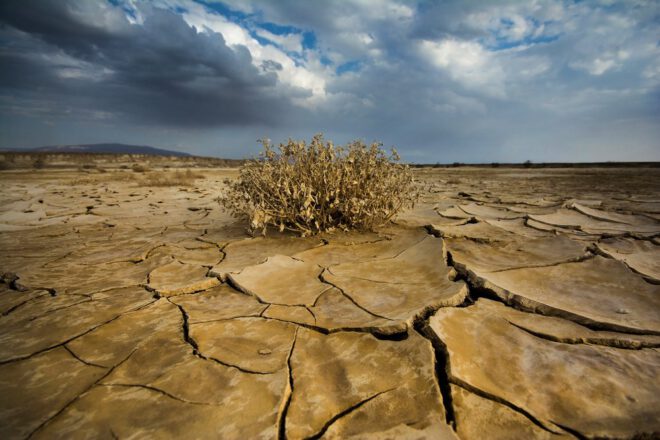
Climate change and air pollution have roles in this sorry story too. Droughts plague Iran. In 2024, precipitation was 60% below average. Ice formed on mountains, which as snowmelt helps fill wells and aquifers, could help, except that it’s contaminated with pollution that rises from urban air.

Human population growth also strains water resources and distribution: the population of Tehran, for example, has exploded from 2 million to over 15 million in the last five decades. With a population of 90+ million, ignoring land subsidence and the reasons it happens could eventually lead to widespread disaster.

Photos via Tehran Times

 

Miriam Kresh
Miriam Kreshhttps://www.greenprophet.com/
Miriam Kresh is an American ex-pat living in Israel. Her love of Middle Eastern food evolved from close friendships with enthusiastic Moroccan, Tunisian and Turkish home cooks. She owns too many cookbooks and is always planning the next meal. Miriam can be reached at miriam (at) greenprophet (dot) com.

Read More

TRENDING

How a tick bite can lead to a life-threatening meat allergy AFG

Imagine developing a severe allergy to steak after a single tick bite. That's the reality for people with alpha-gal syndrome, a rapidly emerging condition linked to lone star ticks and other tick species. As researchers uncover how tick saliva rewires the immune system, health officials warn that hundreds of thousands of Americans may already be living with this unusual red meat allergy.

Understanding Food Production: Karl Studer on the Urban-Rural Knowledge Gap

Karl Studer occupies an unusual position in American business. As President of Quanta Services, he oversees electrical infrastructure operations across the United States, Canada, and Australia, managing thousands of employees and multibillion-dollar projects.

Self-repairing contact lenses and desalination membranes that fix themselves?

Could the humble contact lens become a sustainability breakthrough? Researchers in Korea have developed a self-healing hydrogel lens that repairs scratches with just one hour of UV light exposure. Beyond reducing waste from disposable contacts, the technology could one day help extend the life of solar panels, water filtration systems, and other plastic-based products.

Wave wind energy for Nvidia’s next AI energy boom?

As AI factories consume unprecedented amounts of electricity, NVIDIA is looking beyond chips and data centers to the ocean. The company recently spotlighted Israel's Eco Wave Power and its wave energy projects in Jaffa and Los Angeles, highlighting how AI, digital twins and renewable energy can work together to meet future power demands. The collaboration reflects a growing realization that the future of artificial intelligence may depend as much on clean energy infrastructure as it does on computing power.

Weston Higginbotham found dead in a Kyoto forest: is climate anxiety part of the story?

In some ways, Weston has become a symbol of a generation wrestling with environmental and technological anxiety. Friends and family described him as deeply concerned about environmental issues. Reports also noted that he questioned the growing role of artificial intelligence in daily life, even reportedly disagreeing with his mother about her use of AI.

Yerukim Forms a New Green Economy Where the Money is Really Green

The Yerukim members who pick up the recyclables get to keep the monetary reward, the public earns "green" bills that can be used in shops, and business owners get to be associated with environmentalism.

Choosing Riyadh over Dubai? What Investors Should Know

Saudi Arabia is deploying capital at unmatched scale to catalyze tourism and advanced industry while rewiring its power-and-water backbone. The investable frontier is widening—especially in renewables, grid storage, water efficiency/desal retrofits, and hospitality operating platforms. Prudent investors will insist on phased delivery, enforceable KPIs (energy, water, biodiversity), and RHQ/zone compliance—while pricing political-economy and reputational risks alongside growth upside.

Sell your cooking oil for biodiesel money

Want to make money on old french fry oil? Sell it.

Qatar Alternative Energy Summit Pairs Investors And Innovators

Alternative energy investors and innovators can meet n' greet in Doha, Qatar March 16 and 17.

Here’s How To Implement The Four Pillars Of Employee Engagement

If you throw a party for your work team and they are vegans, don't make it a barbecue. Know the sustainability values of your team to boost moral and retain good people.

Locals From Rishon Fight IKEA

Big Box stores are a pretty new concept in Israel, and thank God that not every Israeli city wants them in their backyard. A word from someone who has see the beautiful farmland around her hometown Newmarket, Ontario stripped and converted into vulgar strip malls of big box shops: they have no place in a healthy and sustainable town or city.

The Jewish National Fund Meets An Inconvenient Truth

According to the JNF, it has transformed thousands of acres of barren land into green forests in Israel. They state that each person emits about 23 tons of carbon per year, estimating that each tree planted can absorb one ton of carbon in its lifetime. That's a whole lot of trees you'd need to be planting. Could so many fit in Israel?

How to quiet noise from construction in your office

Streets need to be resurfaced in New York but the humming and grinding noise is unsettling. Noise is environmental pollution. 

Popular Categories