What a martian ice age left behind tells us about our future

Mars
What we can learn from Mars about climate change

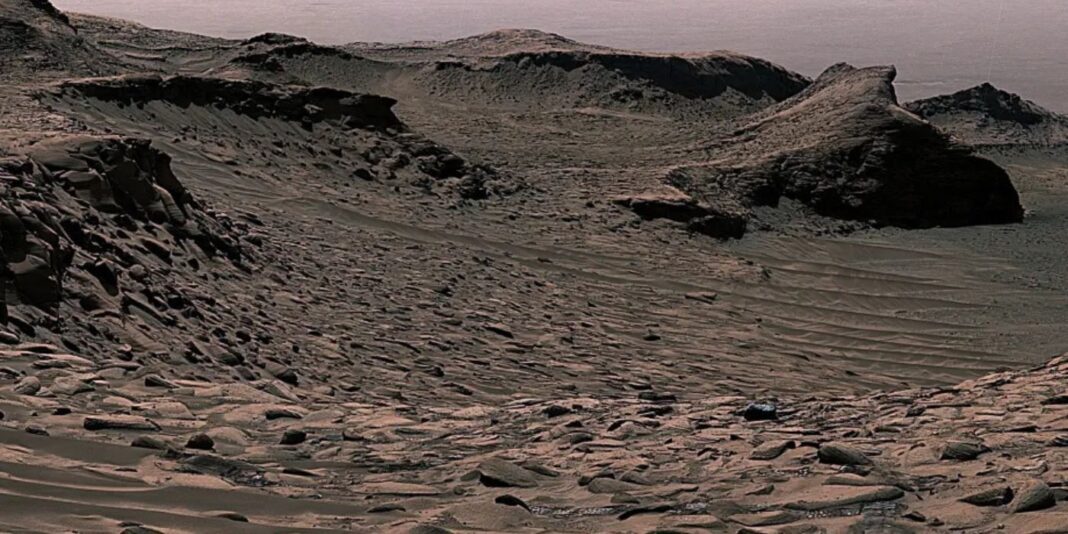
We have heard that peak climate change might be in sight. Does Mars have more clues about our future? Travelling from Mars’s equator toward its northern latitudes, planetary scientists reach a region called Coloe Fossae — a landscape carved by deep valleys, collapsed blocks of terrain, scattered craters, and remarkably, the fingerprints of a long-vanished ice age. New high-resolution images from ESA’s Mars Express mission offer the clearest evidence yet that the Red Planet once cycled through dramatic shifts in climate, much like Earth.

Earth has experienced several major ice ages over the past 2.5 billion years, the most recent peaking around 20,000 years ago when global temperatures fell to 7–10 °C. These events are driven by natural changes in Earth’s orbit and axial tilt — processes known as Milankovitch cycles. They bear no relation to modern, human-driven global warming, which scientists continue to warn about the climate crisis.

Mars, too, has undergone its own glacial rhythms. The new Mars Express imagery shows long, parallel lines cutting diagonally across Coloe Fossae — fractures created as alternating segments of ground collapsed over geological time. Scattered across the area are craters of every age and state: fresh and sharp-edged, or softened by erosion.

On the crater floors and valley bottoms lie the most intriguing features: swirling, textured patterns known as lineated valley fill and concentric crater fill. These formations arise when icy debris slowly flows, glacier-like, across the surface before becoming coated with rock and dust. On Earth, similar structures are found in glaciated mountain ranges and polar regions.

What makes Coloe Fossae especially fascinating is its latitude: 39°N — far from Mars’s polar caps. How did ice accumulate so far south?

The answer lies in Mars’s shifting axial tilt. Unlike Earth, whose tilt is stabilized by its large Moon, Mars wobbles chaotically over millions of years. During periods of extreme tilt, ice can migrate from the poles into mid-latitudes. Throughout multiple cold phases, glaciers spread outward and then retreated, leaving behind the flows and fills visible today. Scientists believe this region may have been covered in ice as recently as 500,000 years ago, when Mars’s most recent ice age ended.

The broader region, known as Protonilus Mensae, marks the dramatic boundary between Mars’s smooth northern lowlands and heavily cratered southern highlands. In some places, this global divide rises as a cliff two kilometers high; in others, like Coloe Fossae, it is a rugged transitional zone shaped by glaciers, impacts, and tectonic collapse. Similar features were observed in Acheron Fossae, highlighted in a previous Mars Express release.

These discoveries deepen our understanding of Mars as a dynamic planet with a shifting climate — and may even inform future studies of how planetary climates evolve, including our own,


Bhok Thompson
Bhok Thompsonhttp://www.greenprophet.com
Bhok Thompson is an “eco-tinkerer” who thrives at the intersection of sustainability, business, and cutting-edge technology. With a background in mechanical engineering and a deep fascination with renewable energy, Bhok has dedicated his career to developing innovative solutions that bridge environmental consciousness with profitability. A frequent contributor to Green Prophet, Bhok writes about futuristic green tech, urban sustainability, and the latest trends in eco-friendly startups. His passion for engineering meets his love for business as he mentors young entrepreneurs looking to create scalable, impact-driven companies. Beyond his work, Bhok is an avid collector of vintage mechanical watches, believing they represent an era of precision and craftsmanship that modern technology often overlooks. Reach out: [email protected]

Read More

LEAVE A REPLY

Please enter your comment!
Please enter your name here

TRENDING

5 projects to help kickstart your company’s sustainability journey 

True progress happens when environmental ambition meets action. Decarbonizing efficiently is possible for any business in any sector, but actually getting started can sometimes feel daunting.   The trick? It’s to start small and build momentum. Here are five potential projects to help you get started.  

Hormuz 2026 Conflict Poses an Energy and Food Security Dilemma in a Warming World

As tensions rise in one of the world’s most critical maritime chokepoints, the ripple effects go far beyond oil—touching food systems, climate pressures, and regional stability

Climate change traced in sea turtle shells

It's sea turtles which may in the end save islands in the Seychelles. They may also better help us understand climate change. Like rings on a tree, scientists have found a way to read sea turtle shells and how they are impacted by climate change tells a story. 

We’ve lived through the past 11 of the hottest years on record

Have we forgotten about global warming when the world...

Why we might be missing messages from aliens

Alien signals might be getting scrambled near their own stars before they reach Earth, so scientists searching for perfectly clear signals could be missing them.

How to quiet noise from construction in your office

Streets need to be resurfaced in New York but the humming and grinding noise is unsettling. Noise is environmental pollution. 

EarthX and a blueprint for sustainable investing

Trammell S. Crow, a Dallas-based businessman and father of four, is focusing his efforts on impact investing, and media that focuses on saving the planet through EarthX.

Mining Afghanistan’s Mineral Discoveries Similar to Avatar

Now that American forces in Afghanistan are commemorating the longest period of any war that America has been involved in, including the 1965-73 Vietnam War, the recent discoveries of large and extremely valuable mineral and metal deposits may finally bring to light a reason to continue the presence of US fighting forces in this war torn and backward country.

From Pilot Plant to Global Stage: How Aduro Clean Technologies’ 2026 Expansion Signals a Turning Point for Chemical Recycling Investors Like Yazan Al Homsi

The company's Next Generation Process (NGP) Pilot Plant in London, Ontario, has officially moved into initial operating campaigns, generating the kind of structured, repeatable data that separates laboratory promise from commercial viability.

Nobul’s Regan McGee on Shareholder Value: “Complacency Is the Silent Killer” 

Why the governance framework designed to protect shareholders so...

Should You Invest in the Private Market?

startustartup Unlike public stock exchanges, which offer daily trading, strict...

How to build a 100-year-company

Kongō Gumi is a Japanese construction company, purportedly founded in 578 A.D., making it the world's oldest documented company. What can we learn about building sustainable businesses from them?

How AI Helps SaaS Companies Reduce Repetitive Customer Support Work

SaaS products are designed for large numbers of users with different levels of experience, and also in renewable energy.

Popular Categories