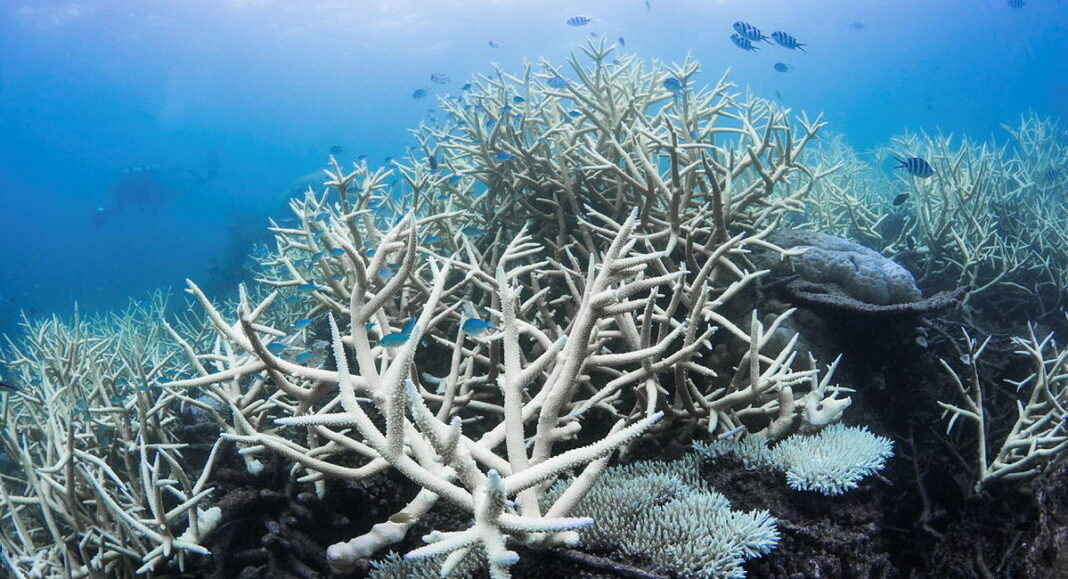
Is sea acidity a ticking time bomb?

Great Barrier Reef Foundation
Great Barrier Reef coral bleaching

Ocean Acidification Has Quietly Crossed a Planetary Boundary — And It’s Worse Than We Thought

Fresh analysis from a global team of researchers—including the UK’s Plymouth Marine Laboratory (PML), NOAA, and Oregon State University—reveals a troubling truth: ocean acidification has already breached a planetary boundary, and alarmingly, this occurred around five years ago.

The planetary boundary framework defines Earth’s “safe operating space,” with nine environmental limits. Until now, ocean acidification had remained within this zone—barely. New findings, however, show that by about 2020, global seawater conditions had exceeded the boundary, defined as a >20 % decline in calcium‑carbonate saturation relative to pre‑industrial times.

Disturbingly, at depths of 200 m—where much ocean life thrives—60 % of waters have passed that threshold.

This creeping acidity threatens organisms that build calcium‑carbonate shells—corals, molluscs, crustaceans, pteropods, oysters—and the ecosystems and economies that depend on them.

As PML’s marine ecologist and Global Ocean Acidification Observing Network co‑chair Prof Steve Widdicombe starkly warns: “Ocean acidification isn’t just an environmental crisis —it’s a ticking time‑bomb for marine ecosystems and coastal economies.”

Deep Waters, Deeper Problems
Lead author Helen Findlay from PML highlights that acidification isn’t confined to surface waters. She notes: “Most ocean life doesn’t just live at the surface … the waters below are home to many more different types of plants and animals. Since these deeper waters are changing so much, the impacts … could be far worse than we thought.”

Indeed, coral reef habitats are already shrinking: a 43 % habitat loss in tropical/subtropical corals, up to 61 % for polar pteropods, and 13 % for coastal bivalves.

too loud for baby oysters
Foods to boost testosterone include oysters · leafy green vegetables · fatty fish and fish oil. Bivalves are an aquatic mollusk that has a compressed body enclosed within a hinged shell, such as oystersclams, mussels, and scallops.

Lower ocean pH hampers shell formation, metabolic functions, reproductive success, and resilience. The Guardian underscores that acidification is accelerating, exacerbating threats to biodiversity and coastal industries like oyster farming—already suffering in the Pacific Northwest .

Marine ecologist Widdicombe tells Oceanographic Magazine: “If we could see ocean acidification, we’d be way more scared. … Couple ocean acidification with warming temperatures … you’ve got a way bigger problem than plastics.”

What’s Being Done—and What Still Needs to Happen
The study, published in Global Change Biology, combines ice‑core chemistry, historical ocean samples, and advanced modeling to track trends over 150 years .

Researchers advocate for:

  • Deep CO₂ emissions cuts to halt further acidification.
  • Targeted conservation of reefs and vulnerable habitats.
  • Upping acidification on policy agendas—it’s still largely sidelined.

Some are even exploring local fixes—like alkalinity enhancement—but scientists stress these remain unproven, and the real solution is still cutting fossil fuels out of our diet. Some companies like Make Sunsets in the US is going ahead and geo-engineering our planet, to the ire of ocean conservationists –- as we write here in this article.

Ocean acidification is dubbed the “evil twin” of climate change—and it has stealthily crossed a planetary limit, with cascading impacts on every layer of marine life, from shellmakers and corals to coastal economies. Professor Steve Widdicombe’s warning rings true: humanity is “gambling with both biodiversity and billions in economic value every day that action is delayed.”

We’re out of time. Reducing CO₂ emissions—and integrating acidification into global climate and biodiversity strategies—is no longer optional; it’s essential for the health of our oceans and ourselves. Greta Thunberg, can you come back to work?


Read More

TRENDING

How a tick bite can lead to a life-threatening meat allergy AFG

Imagine developing a severe allergy to steak after a single tick bite. That's the reality for people with alpha-gal syndrome, a rapidly emerging condition linked to lone star ticks and other tick species. As researchers uncover how tick saliva rewires the immune system, health officials warn that hundreds of thousands of Americans may already be living with this unusual red meat allergy.

Code Red from the Galapagos: human drugs and sunscreen are polluting the sea

Millions of visitors swim in the pristine waters of the Galápagos each year, but new research suggests sunscreen chemicals and other human-made pollutants are reaching even the islands' most protected marine habitats. Scientists are calling for urgent monitoring to safeguard one of Earth's most iconic ecosystems.

Understanding Food Production: Karl Studer on the Urban-Rural Knowledge Gap

Karl Studer occupies an unusual position in American business. As President of Quanta Services, he oversees electrical infrastructure operations across the United States, Canada, and Australia, managing thousands of employees and multibillion-dollar projects.

Wave wind energy for Nvidia’s next AI energy boom?

As AI factories consume unprecedented amounts of electricity, NVIDIA is looking beyond chips and data centers to the ocean. The company recently spotlighted Israel's Eco Wave Power and its wave energy projects in Jaffa and Los Angeles, highlighting how AI, digital twins and renewable energy can work together to meet future power demands. The collaboration reflects a growing realization that the future of artificial intelligence may depend as much on clean energy infrastructure as it does on computing power.

Weston Higginbotham found dead in a Kyoto forest: is climate anxiety part of the story?

In some ways, Weston has become a symbol of a generation wrestling with environmental and technological anxiety. Friends and family described him as deeply concerned about environmental issues. Reports also noted that he questioned the growing role of artificial intelligence in daily life, even reportedly disagreeing with his mother about her use of AI.

The Essential Guide To Sustainability in Project Management

Sustainability is an approach where businesses and individuals balance the environmental, social, and economic aspects of a project such that current and future stakeholders are not overburdened with the impacts of the project in future.

Yerukim Forms a New Green Economy Where the Money is Really Green

The Yerukim members who pick up the recyclables get to keep the monetary reward, the public earns "green" bills that can be used in shops, and business owners get to be associated with environmentalism.

Choosing Riyadh over Dubai? What Investors Should Know

Saudi Arabia is deploying capital at unmatched scale to catalyze tourism and advanced industry while rewiring its power-and-water backbone. The investable frontier is widening—especially in renewables, grid storage, water efficiency/desal retrofits, and hospitality operating platforms. Prudent investors will insist on phased delivery, enforceable KPIs (energy, water, biodiversity), and RHQ/zone compliance—while pricing political-economy and reputational risks alongside growth upside.

Sell your cooking oil for biodiesel money

Want to make money on old french fry oil? Sell it.

Qatar Alternative Energy Summit Pairs Investors And Innovators

Alternative energy investors and innovators can meet n' greet in Doha, Qatar March 16 and 17.

Here’s How To Implement The Four Pillars Of Employee Engagement

If you throw a party for your work team and they are vegans, don't make it a barbecue. Know the sustainability values of your team to boost moral and retain good people.

Locals From Rishon Fight IKEA

Big Box stores are a pretty new concept in Israel, and thank God that not every Israeli city wants them in their backyard. A word from someone who has see the beautiful farmland around her hometown Newmarket, Ontario stripped and converted into vulgar strip malls of big box shops: they have no place in a healthy and sustainable town or city.

The Jewish National Fund Meets An Inconvenient Truth

According to the JNF, it has transformed thousands of acres of barren land into green forests in Israel. They state that each person emits about 23 tons of carbon per year, estimating that each tree planted can absorb one ton of carbon in its lifetime. That's a whole lot of trees you'd need to be planting. Could so many fit in Israel?

Popular Categories