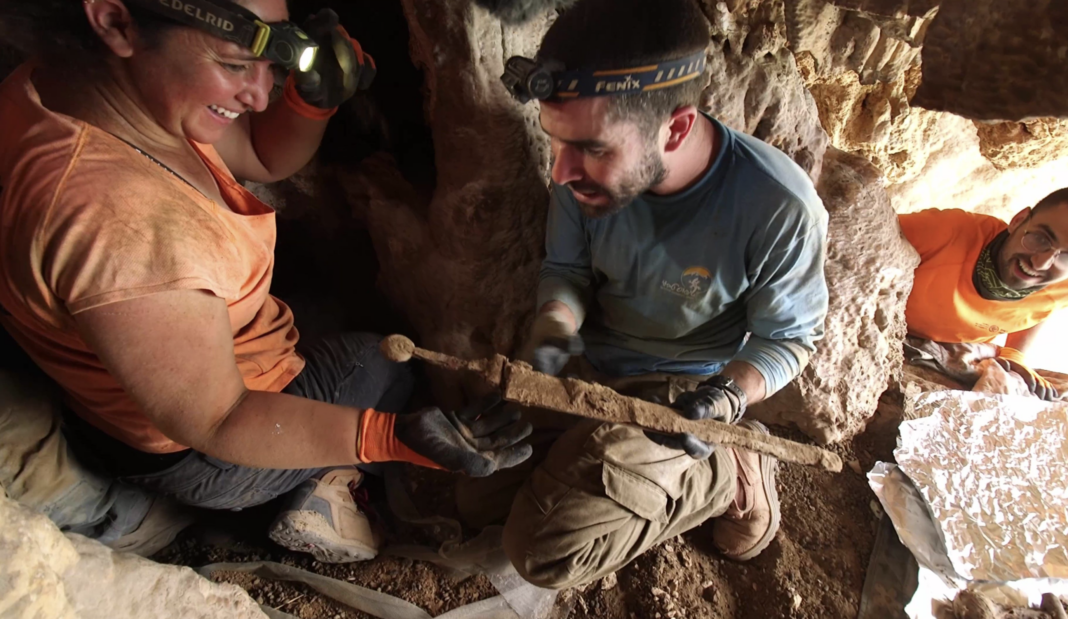


It’s as though they were forged by Romans just a few years ago. The blades perfectly preserved by the dry, hot conditions, four 1,900-year-old swords preserved in their wooden and leather scabbards were found in the cache located in the Ein Gedi Nature Reserve in the Dead Sea area of Israel. This is dramatic evidence of a specific moment in history, say the researchers from the Israel Antiquities Authority and Ariel University involved in the study.
An article published today in the book New Studies in the Archaeology of the Judean Desert: Collected Papers, suggests that the weapons were war booty, and were hidden in the cave by the Judean rebels. The book summarizes six years of archaeological surveys and excavations carried out in the Judean Desert caves.

A sensational find: the excellently preserved Roman swords and a shafted weapon were discovered in a crevice in a cave in the Ein Gedi Nature Reserve. It appears that the weapons were hidden by the Judean rebels, after they were seized from the Roman army as booty. “Finding a single sword is rare—so four? It’s a dream! We rubbed our eyes to believe it,” say the researchers.

The weapons were discovered in a small hidden cave located in an area of isolated and inaccessible cliffs north of ‘En Gedi, in the Judean Desert Nature Reserve, under the jurisdiction of the National Parks Authority. Fifty years ago, a stalactite with a fragmentary ink inscription written in ancient Hebrew script characteristic of the First Temple period, was found.

The Dead Sea Scrolls were found in the general area of the Dead Sea as well.
Recently, Dr. Asaf Gayer of the Department of the Land of Israel Studies and Archaeology at Ariel University, geologist Boaz Langford of the Institute of Earth Sciences and the Cave Research Center at the Hebrew University of Jerusalem, and Shai Halevi, Israel Antiquities Authority photographer, visited the cave. Their aim was to photograph the Paleo-Hebrew inscription written on the stalactite with multispectral photography that might be able to decipher additional parts of the inscription not visible to the naked eye.

While on the upper level of the cave, Asaf Gayer spotted an extremely well-preserved, Roman pilum— a shafted weapon in a deep narrow crevice. He also found pieces of worked wood in an adjacent niche that turned out to be parts of the swords’ scabbards.
The Judean Desert Cave Survey team, together with Asaf Gayer and Boaz Langford returned to the cave and carried out a meticulous survey of all the crevices in the rock, in the course of which they were astonished to find the four Roman swords in an almost inaccessible crevice on the upper level of the cave.
The swords were exceptionally well preserved, and three were found with the iron blade inside the wooden scabbards. Leather strips and wooden and metal finds belonging to the weapons were also found in the crevice. The swords had well-fashioned handles made of wood or metal.
The length of the blades of three swords was 60–65 cm, their dimensions identifying them as Roman spatha swords, and the fourth one was shorter with c. 45 cm long blade, identified as a ring-pommel sword. The swords were carefully removed from the crevice in the rock and transferred to the Israel Antiquities Authority climate-controlled laboratories for preservation and conservation. The initial examination of the assemblage confirmed that these were standard swords employed by the Roman soldiers stationed in Judea in the Roman period.

Did Jewish rebels hide their booty in the cave?
“The hiding of the swords and the pilum in deep cracks in the isolated cave north of ‘En Gedi, hints that the weapons were taken as booty from Roman soldiers or from the battlefield, and purposely hidden by the Judean rebels for reuse,” says Dr. Eitan Klein, one of the directors of the Judean Desert Survey Project. “Obviously, the rebels did not want to be caught by the Roman authorities carrying these weapons. We are just beginning the research on the cave and the weapon cache discovered in it, aiming to try to find out who owned the swords, and where, when, and by whom they were manufactured. We will try to pinpoint the historical event that led to the caching of these weapons in the cave and determine whether it was at the time of the Bar Kokhba Revolt in 132–135 CE.”
Following the discovery of the swords, an archaeological excavation was undertaken in the cave by the Israel Antiquities Authority, directed by Eitan Klein, Oriya Amichay, Hagay Hamer, and Amir Ganor. The cave was excavated in its entirety, and artifacts dating to the Chalcolithic period (c. 6,000 years ago) and the Roman period (c. 2,000 years ago) were uncovered. At the entrance to the cave, a Bar-Kokhba bronze coin from the time of the Revolt was found, possibly pointing to the time when the cave served for concealing the weapons.

According to Amir Ganor, Director of the Antiquities Looting Prevention Unit at the Israel Antiquities Authority, and one of the Directors of the Judean Desert Survey Project, “The Judean Desert doesn’t cease to surprise us. After six years of surveys and excavations, in the course of which over 800 caves were systematically recorded over an area of 170 km of cliff-line, we still discover new treasures in the caves. In the course of the project, we unfortunately encountered tens of caves that have been plundered since 1947.
“I shudder to think how much historical knowledge would have been lost had the looters reached the amazing artifacts in this cave before the archaeologists. This time, thanks to the national project initiated by the Israel Antiquities Authority, we managed to get there before the looters, and to save these fascinating finds for the benefit of the public and researchers around the world.”
RELATED: The Judean Desert goes green in the winter
Dr. Asaf Gayer of the Department of the Land of Israel Studies and Archaeology at Ariel University, says, “It is an honor and extremely exciting to take part in this discovery. The inscription and the weapons teach us a new chapter in the way in which the Jewish population exploited the Judean Desert caves in different periods. The wealth of finds exposes a new aspect of the ancient settlement in the ‘En Gedi oasis.”
According to Rabbi Amichai Eliyahu, the Minister of Heritage, “We are once again presented with thrilling findings from the Judean Desert that offer a glimpse into the daily lives of our ancestors who resided in this area about 2,000 years ago. The discovery of these swords within a cave, where a Hebrew inscription dating back to the time of the Temple was previously found, serves as further evidence of the enduring tradition of the people of Israel, emphasizing the significance of both the written word and the sword, symbolizing both our spiritual and physical heritage. The Ministry of Heritage, in collaboration with the Israel Antiquities Authority and its dedicated experts, will persist in their efforts to uncover, preserve, and transmit the rich history of the people of Israel within their homeland.”
According to Eli Escusido, Director of the Israel Antiquities Authority, “This is a dramatic and exciting discovery, touching on a specific moment in time. Not all are aware that the dry climatic conditions pertaining in the Judean Desert enable the preservation of artifacts that do not survive in other parts of the country. This is a unique time capsule, whereby fragments of scrolls, coins from the Jewish Revolt, leather sandals, and now even swords in their scabbards, sharp as if they had only just been hidden away today. The Judean Desert Survey, carried out by the Israel Antiquities Authority in cooperation with the Ministry of Heritage and the Archaeological Office for the Military Administration of Judea and Samaria, are writing new page in history books, and I am proud to present the first volume in the series.”
The preliminary article on the swords is published in the volume ‘New Studies in the Archaeology of the Judean Desert: Collected Papers’, that will be launched this evening in Jerusalem. The authors: Dr. Eitan Klein of the Israel Antiquities Authority, Dr. Asaf Gayer of the Department of the Land of Israel Studies and Archaeology at Ariel University, Amir Ganor, Hagay Hamer, Oriya Amichay, Shai Halevi, all of the Israel Antiquities Authority, Boaz Langford of the Institute of Earth Sciences in the Hebrew University of Jerusalem, and Dr. Guy D. Stiebel of the Department of Archaeology at Tel Aviv University.