SpaceX and SETI Partner to Protect Alien-Hunting Telescopes—But What About the Rest of the Sky?

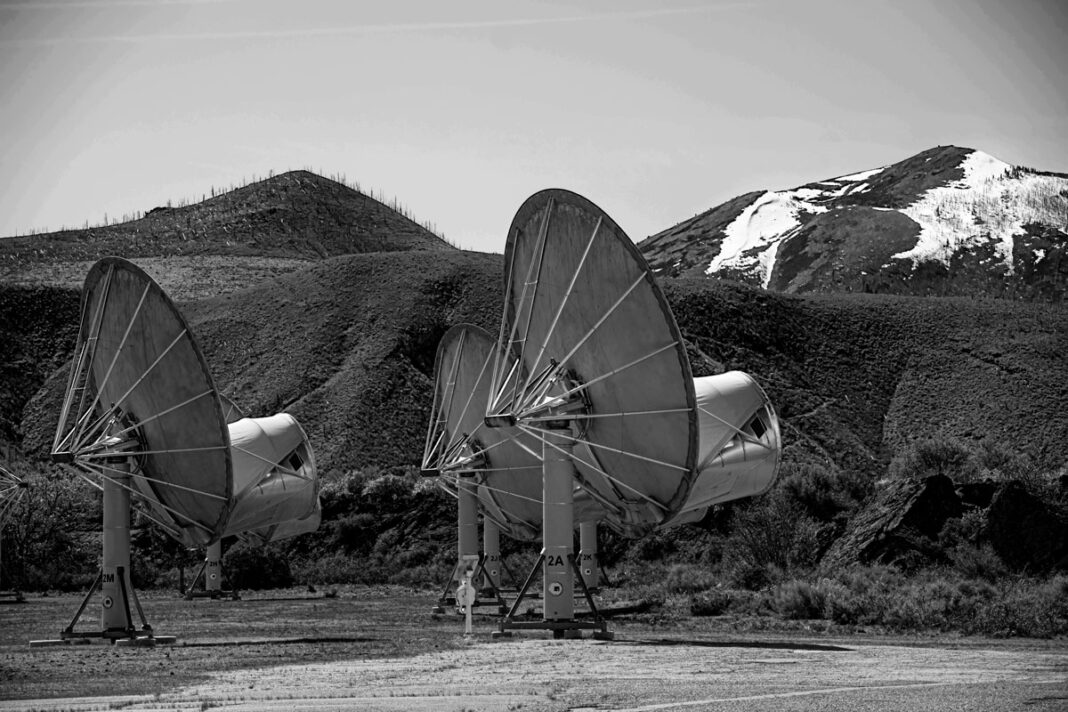
The Allen Telescope Array (ATA), operated by the SETI Institute

New agreement aims to shield radio astronomy from satellite interference, but the night sky faces growing threats.

As Starlink satellites crisscross our skies bringing internet to the most remote corners of Earth, they may also be interfering with humanity’s deepest question: Are we alone in the universe? In a quiet patch of Northern California, tucked away in Shasta County, a group of scientists has been listening.
The Allen Telescope Array (ATA), operated by the SETI Institute, is one of the few observatories in the world designed specifically to detect potential extraterrestrial signals—radio whispers from distant civilizations or unexplained cosmic bursts. But lately, it’s not aliens interrupting the feed. It’s us.
spacex starlink from space, satellite
SpaceX has deployed satellites to run Starlink
With over 6,000 Starlink satellites now in low Earth orbit—and more coming from Amazon, OneWeb, China, and others—radio astronomers are sounding the alarm. These satellites emit powerful radio signals, including new “direct-to-cell” transmissions, that can momentarily drown out the sensitive receivers on Earth-based telescopes. One passing satellite in the wrong place at the wrong time can effectively blind a telescope for several seconds—an eternity when hunting rare cosmic phenomena.
To address this, SpaceX and the SETI Institute announced this month a new partnership aimed at reducing interference at the ATA. Through real-time coordination and mitigation software, the system can now predict when a satellite will pass directly overhead and temporarily adjust operations to reduce “signal saturation”—a form of electronic overload that renders astronomical data useless.
“The SETI Institute is at the forefront of developing solutions that allow for the continued exploration of the cosmos while accommodating the rapid evolution of satellite communications,” said Dr. David DeBoer, a researcher at the ATA. “Our collaboration with SpaceX is an important step in demonstrating that scientific discovery and technological progress can go hand in hand with the right coordination.”

The Bigger Picture: Space Junk and a Dimming Night Sky

While this partnership is a positive step, it’s just one piece of a much larger puzzle. The skies above Earth are becoming a crowded, chaotic place. According to the European Space Agency, over 36,000 tracked objects now orbit the Earth, with tens of thousands more fragments too small to monitor. Space junk poses risks not only to telescopes but to functioning satellites, spacecraft, and astronauts aboard the ISS.
space junk debris
Space junk
And then there’s light pollution. The reflectivity of satellite surfaces causes sunlight to bounce back to Earth, creating bright streaks that interfere with optical astronomy—those majestic telescope images of galaxies, nebulae, and supernovae. Night sky advocates argue that the Milky Way, once visible to 99% of humanity, is now obscured for more than a third of the world’s population.
“It’s not just about data—it’s about cultural heritage,” says one astronomer in a 2024 report from the International Astronomical Union. “The night sky belongs to all of us.”
Some solutions are already in motion. Astronomers are exploring “radio dynamic zones,” where frequency use is coordinated in real time between scientific and commercial entities. SETI and others are pushing for international frameworks to designate quiet zones—like nature reserves, but for space.
SpaceX has taken steps to address concerns, including darker satellite coatings and directional signal shielding. But critics argue that without enforceable global standards, voluntary measures may not go far enough. Meanwhile, scientists at SETI and other institutions continue developing tools to protect the last wild frontier: the cosmic spectrum.
At Green Prophet, we celebrate innovation that connects us—especially in underserved regions—but we also believe that connectivity should not come at the cost of curiosity, culture, or the planet. The SETI–SpaceX collaboration is promising, but it raises a deeper question: As we race to digitize every corner of Earth, can we still leave room to listen to the stars?
Support organizations like the SETI Institute, the Dark Sky Association, and open-source astronomy efforts that fight for ethical, sustainable access to the cosmos.
Karin Kloosterman
Karin Kloostermanhttp://www.greenprophet.com
Karin Kloosterman is an award-winning journalist, innovation strategist, and founder of Green Prophet, one of the Middle East’s pioneering sustainability platforms. She has ranked in the Top 10 of Verizon innovation competitions, participated in NASA-linked challenges, and spoken worldwide on climate, food security, and future resilience. With an IoT technology patent, features in Canada’s National Post, and leadership inside teams building next-generation agricultural and planetary systems — including Mars-farming concepts — Karin operates at the intersection of storytelling, science, and systems change. She doesn’t report on the future – she helps design it. Reach out directly to [email protected]

Read More

TRENDING

Data centers in Space? Sophia Space and Apex plan on busing them in

Can data centers really be built in space? Pasadena-based Sophia Space is partnering with Apex to test the idea by launching modular AI computing systems into low Earth orbit in 2027. Using radiation-hardened compute TILEs cooled by passive radiative systems and mounted on scalable satellite buses, the companies aim to prove that edge computing can operate reliably in space. While challenges remain, the project represents an important step toward distributed orbital computing networks that could support everything from climate monitoring and pollution tracking to autonomous spacecraft navigation in an increasingly crowded orbital environment.

Can a one trillion-Dollar SpaceX IPO change life on earth?

A SpaceX IPO could become one of the most consequential financial events of the century, creating thousands of millionaires and fueling investment across the New Space economy. From orbital robotics and African space programs to launch infrastructure and satellite networks, the ripple effects may extend far beyond Earth—while forcing investors to reconsider whether generative AI remains the most compelling technology bet of the decade.

Do aliens exist? Maybe under new rules set for contact in the age of AI and deepfakes

While we have no evidence of intelligent aliens, astronomers have discovered more than 5,000 planets orbiting other stars. Many lie within regions where liquid water could potentially exist.

AI data centers are triggering panic, instead of cleantech opportunities

AI may unintentionally become the economic engine that finally modernizes America’s aging grid. California is experiencing a massive AI data center boom, ranking 3rd in the U.S. with 227 operating centers and 54 more in development as of April 2026, according to Stanford.

EU startup aiming to generate energy on moon villages

Stepping up to democratize the moon is an EU-funded company, Deep Space Energy, which has just raised more than $1 million USD as a seed fund to help it create energy generators on the moon.

Yerukim Forms a New Green Economy Where the Money is Really Green

The Yerukim members who pick up the recyclables get to keep the monetary reward, the public earns "green" bills that can be used in shops, and business owners get to be associated with environmentalism.

Choosing Riyadh over Dubai? What Investors Should Know

Saudi Arabia is deploying capital at unmatched scale to catalyze tourism and advanced industry while rewiring its power-and-water backbone. The investable frontier is widening—especially in renewables, grid storage, water efficiency/desal retrofits, and hospitality operating platforms. Prudent investors will insist on phased delivery, enforceable KPIs (energy, water, biodiversity), and RHQ/zone compliance—while pricing political-economy and reputational risks alongside growth upside.

Sell your cooking oil for biodiesel money

Want to make money on old french fry oil? Sell it.

Qatar Alternative Energy Summit Pairs Investors And Innovators

Alternative energy investors and innovators can meet n' greet in Doha, Qatar March 16 and 17.

Here’s How To Implement The Four Pillars Of Employee Engagement

If you throw a party for your work team and they are vegans, don't make it a barbecue. Know the sustainability values of your team to boost moral and retain good people.

Locals From Rishon Fight IKEA

Big Box stores are a pretty new concept in Israel, and thank God that not every Israeli city wants them in their backyard. A word from someone who has see the beautiful farmland around her hometown Newmarket, Ontario stripped and converted into vulgar strip malls of big box shops: they have no place in a healthy and sustainable town or city.

The Jewish National Fund Meets An Inconvenient Truth

According to the JNF, it has transformed thousands of acres of barren land into green forests in Israel. They state that each person emits about 23 tons of carbon per year, estimating that each tree planted can absorb one ton of carbon in its lifetime. That's a whole lot of trees you'd need to be planting. Could so many fit in Israel?

How to quiet noise from construction in your office

Streets need to be resurfaced in New York but the humming and grinding noise is unsettling. Noise is environmental pollution. 

Popular Categories