
Will there be a wildfire in Canada? Our phone data can help make the prediction

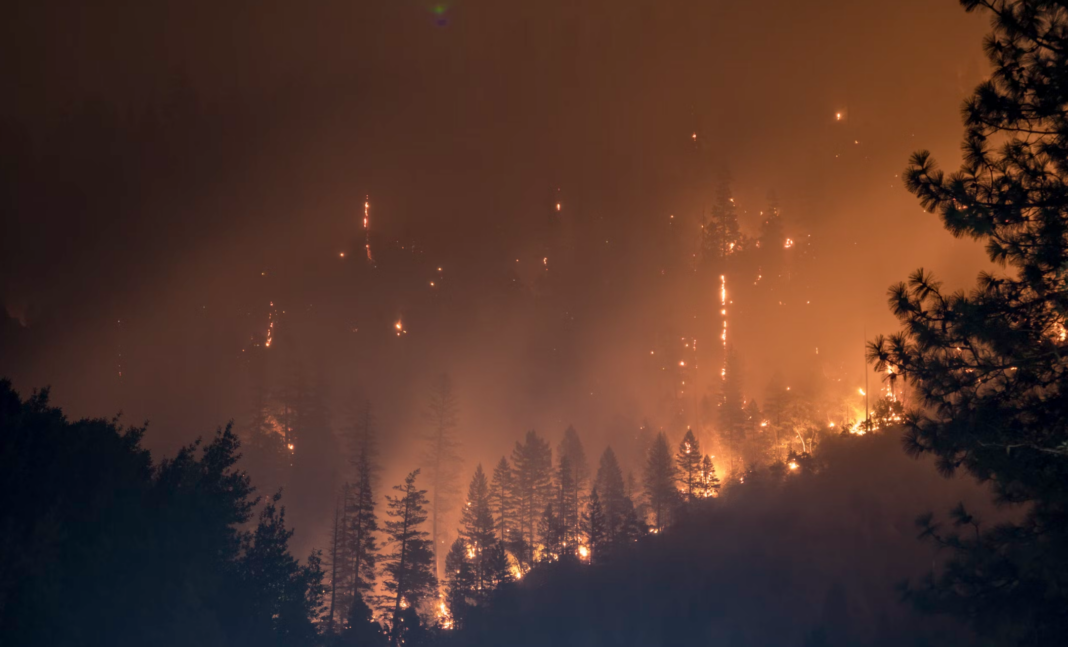
Klamath National Forest, Yreka, United States
Klamath National Forest, Yreka, United States, 2017

A new study has found that the smartphones we all carry in our pockets could help collect weather data from the public to provide early warnings for wildfires and other extreme weather conditions.

All smartphones are equipped with multiple micro-sensors capable of collecting important environmental data, such as temperature, barometric pressure, humidity, magnetic field, light, sound, location, acceleration, gravity, and more. These data help us find our way or define our location and they warn us when the battery overheats or the device absorbs moisture — all in real time, without saving the data.

Professor Colin Price and student Hofit Shachaf from the Porter School of the Environment and Earth Sciences used data collected from the global public via the WeatherSignal app (OpenSignal) to develop a methodology for assessing wildfire risk based solely on smartphone data collected by the public.

The results were published in the journal Natural Hazards and Earth System Sciences (NHESS).

The researchers demonstrated that smart use of such data could support early warnings for severe wildfire events, especially since millions or even billions of data points are collected worldwide every day by our smartphones. Today, early warning systems in remote forested areas typically lack data due to the absence of weather stations in remote locations. (Some researchers are using using goats, dogs and elephants to predict the weather!)

We take our phones everywhere but the data is normally lost and not saved.

Colin Price, climate change expert
Collin Price

However, many companies have started to collect smartphone data to use for various purposes, with user consent. The researchers believe that this huge data source could aid in forecasting extreme weather and natural disasters.

One key parameter determining the likelihood of a wildfire is the moisture content in vegetation (essentially the fuel available for the fire), which, in turn, is determined by the temperature and relative humidity of the surrounding air. Both the temperature and relative humidity can be easily obtained from the public’s smartphones. But smartphone data do contain errors. The temperature reading might reflect the air conditioning in your office, while the humidity sensor might identify moisture when the user is taking a shower.

The researchers say the huge amount of data collected from smartphones allows us to remove outliers in the data set. Furthermore, since the micro-sensors are not calibrated before they are put in our phones, it was necessary to first calibrate the local smartphone data against commercial meteorological stations. This procedure turned out to be relatively straightforward, with just a single calibration needed to correct a smartphone’s readings.

After calibrating or “training” the device, the researchers analyzed major wildfire events: one was the massive fire in Portugal in July 2013. The results were surprising, with smartphone data collected from the public showing significant anomalies before and during these major fires.

“It’s surprising, but even though each smartphone has its own errors and biases, with large amounts of data from many smartphones, we can average out the errors and still retain useful data,” Shachaf says. “The large volume of data helps overcome issues associated with individual smartphones.”

“Given the rapid increase in the number of smartphones worldwide, we propose utilizing this data source to provide better early warnings to the public and disaster managers about impending natural disasters,” Professor Price concludes. “Better early warnings could prevent natural hazards from becoming natural disasters.”

Karin Kloosterman
Karin Kloostermanhttp://www.greenprophet.com
Karin Kloosterman is an award-winning journalist, innovation strategist, and founder of Green Prophet, one of the Middle East’s pioneering sustainability platforms. She has ranked in the Top 10 of Verizon innovation competitions, participated in NASA-linked challenges, and spoken worldwide on climate, food security, and future resilience. With an IoT technology patent, features in Canada’s National Post, and leadership inside teams building next-generation agricultural and planetary systems — including Mars-farming concepts — Karin operates at the intersection of storytelling, science, and systems change. She doesn’t report on the future – she helps design it. Reach out directly to [email protected]

Read More

TRENDING

Are the Great Lakes polluted?

The Great Lakes may look pristine, but a new cleanup report reveals a growing tide of plastic pollution beneath the surface. From cigarette butts and food wrappers to tiny plastic fragments and discarded nicotine pouches, researchers are finding evidence that everyday consumer waste is making its way into North America's largest freshwater ecosystem. New technologies, including Canada's first BeBot beach-cleaning robot, are helping scientists understand how plastic travels through lakes, shorelines and stormwater systems before breaking down into microplastics.

Can a one trillion-Dollar SpaceX IPO change life on earth?

A SpaceX IPO could become one of the most consequential financial events of the century, creating thousands of millionaires and fueling investment across the New Space economy. From orbital robotics and African space programs to launch infrastructure and satellite networks, the ripple effects may extend far beyond Earth—while forcing investors to reconsider whether generative AI remains the most compelling technology bet of the decade.

Anthropic, Google and Stripe put nearly $1 Billion on carbon removal

A coalition led by Frontier, backed by Stripe, Google, Salesforce and newly joined AI company Anthropic, has committed an additional $915 million to remove carbon dioxide from the atmosphere. The pledge adds to a previous $1 billion commitment and brings Frontier's total buying power to nearly $2 billion.

Who Owns the Farm Robot? A State of Jefferson Startup Takes on Carbon Robotics

In California's self-proclaimed State of Jefferson, a small agricultural technology company is challenging the dominant laser-weeding business model. Laudando & Associates believes farmers should own and repair their AI-powered weeding tools rather than pay ongoing subscription fees. The approach has put the company on a collision course with industry leader Carbon Robotics, sparking a patent dispute that has pushed the Jefferson startup toward overseas markets while raising broader questions about ownership, right-to-repair, and the future of farm automation.

Weston Higginbotham found dead in a Kyoto forest: is climate anxiety part of the story?

In some ways, Weston has become a symbol of a generation wrestling with environmental and technological anxiety. Friends and family described him as deeply concerned about environmental issues. Reports also noted that he questioned the growing role of artificial intelligence in daily life, even reportedly disagreeing with his mother about her use of AI.

Yerukim Forms a New Green Economy Where the Money is Really Green

The Yerukim members who pick up the recyclables get to keep the monetary reward, the public earns "green" bills that can be used in shops, and business owners get to be associated with environmentalism.

Choosing Riyadh over Dubai? What Investors Should Know

Saudi Arabia is deploying capital at unmatched scale to catalyze tourism and advanced industry while rewiring its power-and-water backbone. The investable frontier is widening—especially in renewables, grid storage, water efficiency/desal retrofits, and hospitality operating platforms. Prudent investors will insist on phased delivery, enforceable KPIs (energy, water, biodiversity), and RHQ/zone compliance—while pricing political-economy and reputational risks alongside growth upside.

Sell your cooking oil for biodiesel money

Want to make money on old french fry oil? Sell it.

Qatar Alternative Energy Summit Pairs Investors And Innovators

Alternative energy investors and innovators can meet n' greet in Doha, Qatar March 16 and 17.

Here’s How To Implement The Four Pillars Of Employee Engagement

If you throw a party for your work team and they are vegans, don't make it a barbecue. Know the sustainability values of your team to boost moral and retain good people.

Locals From Rishon Fight IKEA

Big Box stores are a pretty new concept in Israel, and thank God that not every Israeli city wants them in their backyard. A word from someone who has see the beautiful farmland around her hometown Newmarket, Ontario stripped and converted into vulgar strip malls of big box shops: they have no place in a healthy and sustainable town or city.

The Jewish National Fund Meets An Inconvenient Truth

According to the JNF, it has transformed thousands of acres of barren land into green forests in Israel. They state that each person emits about 23 tons of carbon per year, estimating that each tree planted can absorb one ton of carbon in its lifetime. That's a whole lot of trees you'd need to be planting. Could so many fit in Israel?

How to quiet noise from construction in your office

Streets need to be resurfaced in New York but the humming and grinding noise is unsettling. Noise is environmental pollution. 

Popular Categories