The world needs to triple renewable energy capacity to 11.2 TW by 2030 to meet COP28 goal

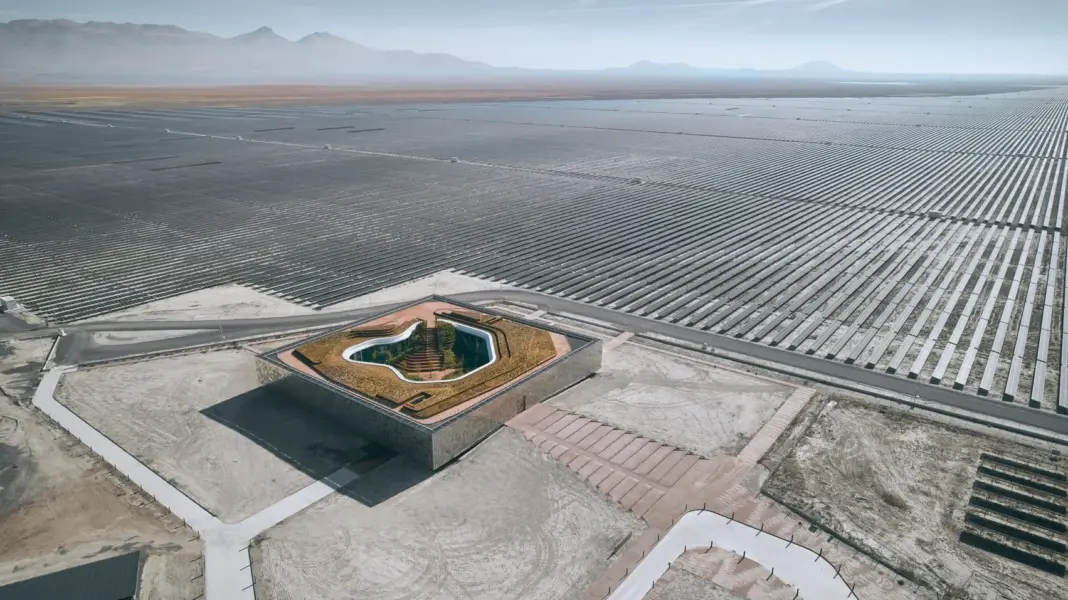
A facade of shimmering steel panels envelops this control centre that Istanbul studio Bilgin Architects has created in the plains of Karapinar, Turkey, for one of Europe's largest solar farms. Named Central Control Building, it is designed by Bilgin Architects to act as a centralised location from which to monitor and control the expansive field of 3.2 million solar panels.
A solar energy plant in Turkey: Record growth in renewables must be significantly topped up in the remaining 7 years to meet the UAE Consensus energy target set at COP28

The Renewable Energy Statistics 2024 report released by the International Renewable Energy Agency (IRENA) based in the UAE shows that despite renewables becoming the fastest growing source of power, the world risks missing the tripling renewables target pledged at the UN conference COP28

To stay the course, the world will now have to grow renewables capacity at a minimum 16.4% rate annually through 2030. 

The unprecedented 14% increase of renewables capacity during 2023 established a 10% compound annual growth rate (2017 to 2023). Combined with the constant decreasing additions of non-renewable capacity over the years, the trend sees renewable energy on its way to overtake fossil fuels in global installed power capacity.  

However, if last year’s 14% increase rate continues, the tripling target of 11.2 Terawatts (TW) in 2030 outlined by IRENA’s 1.5°C scenario will fall 1.5 TW short, missing the target by 13.5%.

Furthermore, if the world keeps the historic annual growth rate of 10%, it will only accumulate 7.5 TW of renewables capacity by 2030, missing the target by almost one-third. 

“Renewable energy has been increasingly outperforming fossil fuels, but it is not the time to be complacent,” says IRENA Director-General, Francesco La Camera.

“Renewables must grow at higher speed and scale. Our new report sheds light on the direction of travel; if we continue with the current growth rate, we will only face failure in reaching the tripling renewables target agreed in the UAE Consensus at COP28, consequently risking the goals of the Paris Agreement and 2030 Agenda for Sustainable Development.”

“As custodian agency tasked with monitoring the progress, IRENA is committed to support countries in their pathways to meet the target, but we need concrete policy actions and massive mobilisation of finance at full speed to reach our destination together. Consolidated global figures conceal ongoing patterns of concentration in geography. These patterns threaten to exacerbate the decarbonisation divide and pose a significant barrier to achieving the tripling target,” he added.  

COP28 President Dr Sultan Al Jaber said, “Today’s report is a wake-up call for the entire world: while we are making progress, we are off track to meet the global goal of tripling renewable energy capacity to 11.2 TW by 2030.

renewable energy crew IRENA, Abu Dhabi
A meeting of IRENA folks in Abu Dhabi, 2019

“We need to increase the pace and scale of development. That means increasing collaboration between governments, the private sector, multilateral organisations, and civil society. Governments need to set explicit renewable energy targets, look at actions like accelerating permitting and expanding grid connections, and implement smart policies that push industries to step up and incentivise the private sector to invest.

“Additionally, this moment provides a significant opportunity to add strong national energy targets in NDCs to support the global goal of keeping the 1.5°C target within reach. Above all, we must change the narrative that climate investment is a burden to it being an unprecedented opportunity for shared socio-economic development.” 

In terms of power generation, the latest data available for 2022 confirmed yet again the regional disparity in renewables deployment.

Who is leading renewable energy growth?

Asia holds its position as leader in the global renewable power generation with 3 749 Terawatt hours (TWh), followed for the first time by North America (1 493 TWh). The most impressive jump occurred in South America, where renewable power generation increased by nearly 12% to 940 TWh, due to a hydropower recovery and a greater role of solar energy.

With a modest growth of 3.5%, Africa increased its renewable power generation to 205 TWh in 2022, despite the continent’s tremendous potential and immense need for rapid, sustainable growth.

Acknowledging the urgent need for support and finance, IRENA is advancing the Accelerated Partnership for Renewables in Africa (APRA) initiative and is preparing an investment forum focused on APRA’s member countries later this year.

Read the full Renewable Energy Statistics 2024 including the highlights, here.

Karin Kloosterman
Karin Kloostermanhttp://www.greenprophet.com
Karin Kloosterman is an award-winning journalist, innovation strategist, and founder of Green Prophet, one of the Middle East’s pioneering sustainability platforms. She has ranked in the Top 10 of Verizon innovation competitions, participated in NASA-linked challenges, and spoken worldwide on climate, food security, and future resilience. With an IoT technology patent, features in Canada’s National Post, and leadership inside teams building next-generation agricultural and planetary systems — including Mars-farming concepts — Karin operates at the intersection of storytelling, science, and systems change. She doesn’t report on the future – she helps design it. Reach out directly to [email protected]

Read More

LEAVE A REPLY

Please enter your comment!
Please enter your name here

TRENDING

AI data centers are triggering panic, instead of cleantech opportunities

AI may unintentionally become the economic engine that finally modernizes America’s aging grid. California is experiencing a massive AI data center boom, ranking 3rd in the U.S. with 227 operating centers and 54 more in development as of April 2026, according to Stanford.

24 7 renewable energy: how solar, wind, batteries and AI SaaS replace fossil fuels

A new report from the International Renewable Energy Agency based in Abu Dhabi makes something clear that many in the industry already suspected. When solar and wind are paired with battery storage, they can deliver reliable, round the clock electricity at costs that compete with, and often beat, fossil fuels.

Japan wants to build a solar panel ring around the moon

Unlike solar power on Earth, which is limited by night cycles, weather, and seasons, the Moon offers something close to uninterrupted exposure to the Sun. By placing solar infrastructure in orbit or along the lunar surface, engineers could generate continuous clean energy at a scale that may exceed global electricity demand,  the Japanese scientists say.

Korean researchers create battery from greenhouse gases

Professor Ji-Soo Jang, in collaboration with Professor Taekwang Yoon of Ajou University and Professor Hansel Kim of Chungbuk National University, has developed a novel energy device that generates electricity during the process of capturing greenhouse gases.

Renewables hit 5,149 GW in 2025 as the world edges away from oil shocks and fossil-fueled conflict

“In the midst of uncertain time, renewable energy remains consistent and steadfast in its expansion,” said Francesco La Camera, IRENA’s Director-General. “A more decentralised energy system, with a growing share of renewables and more market players, is structurally more resilient.”

How to quiet noise from construction in your office

Streets need to be resurfaced in New York but the humming and grinding noise is unsettling. Noise is environmental pollution. 

EarthX and a blueprint for sustainable investing

Trammell S. Crow, a Dallas-based businessman and father of four, is focusing his efforts on impact investing, and media that focuses on saving the planet through EarthX.

Mining Afghanistan’s Mineral Discoveries Similar to Avatar

Now that American forces in Afghanistan are commemorating the longest period of any war that America has been involved in, including the 1965-73 Vietnam War, the recent discoveries of large and extremely valuable mineral and metal deposits may finally bring to light a reason to continue the presence of US fighting forces in this war torn and backward country.

From Pilot Plant to Global Stage: How Aduro Clean Technologies’ 2026 Expansion Signals a Turning Point for Chemical Recycling Investors Like Yazan Al Homsi

The company's Next Generation Process (NGP) Pilot Plant in London, Ontario, has officially moved into initial operating campaigns, generating the kind of structured, repeatable data that separates laboratory promise from commercial viability.

Nobul’s Regan McGee on Shareholder Value: “Complacency Is the Silent Killer” 

Why the governance framework designed to protect shareholders so...

Should You Invest in the Private Market?

startustartup Unlike public stock exchanges, which offer daily trading, strict...

How to build a 100-year-company

Kongō Gumi is a Japanese construction company, purportedly founded in 578 A.D., making it the world's oldest documented company. What can we learn about building sustainable businesses from them?

How AI Helps SaaS Companies Reduce Repetitive Customer Support Work

SaaS products are designed for large numbers of users with different levels of experience, and also in renewable energy.

Popular Categories