
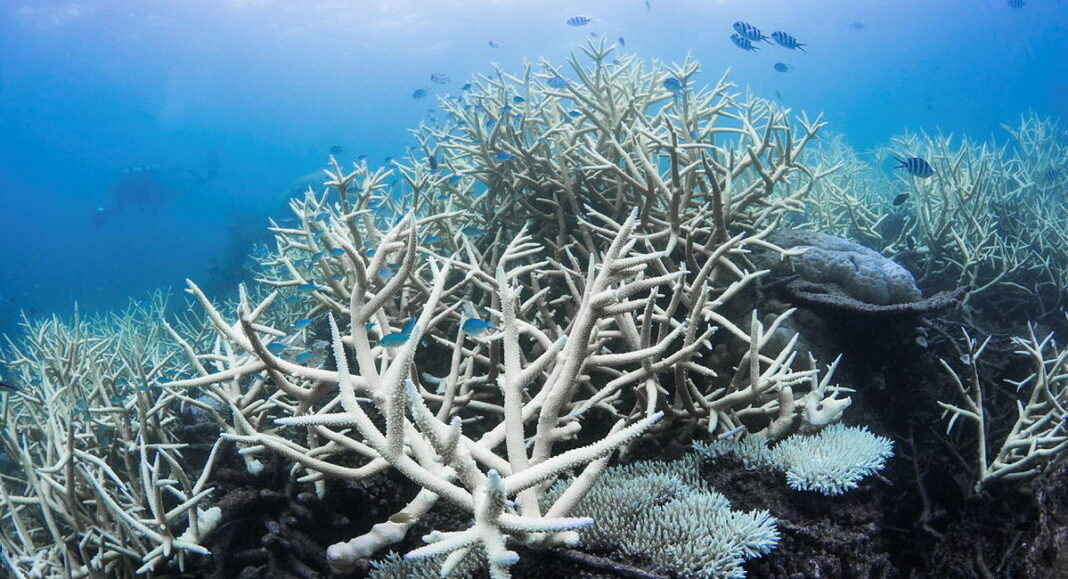
We’ve reached the coral tipping point

Great Barrier Reef Foundation
Great Barrier Reef coral bleaching

Widespread mortality of warm-water coral reefs under way, as world reaches first tipping point

The world faces a “new reality” as we have reached the first of many Earth system tipping points that will cause catastrophic harm unless humanity takes urgent action, according to a landmark report released by the University of Exeter and international partners.

With ministers gathering ahead of the COP30 summit, the second Global Tipping Points Report finds that warm-water coral reefs – on which nearly a billion people and a quarter of all marine life depend – are passing their tipping point. Widespread dieback is taking place and – unless global warming is reversed – extensive reefs as we know them will be lost, although small refuges may survive and must be protected.

We are on the brink of more tipping points, with devastating risks for people and nature: the irreversible melting of polar ice sheets, the collapse of key ocean currents and the dieback of the Amazon rainforest – where COP30 will be held.

With global warming set to breach 1.5°C, the report – by 160 scientists at 87 institutions in 23 countries – argues that countries must minimise temperature overshoot to avoid crossing more tipping points. Every fraction of a degree and every year spent above 1.5°C matters.

Green Prophet published an IRENA report today that shows while we’ve made progress in renewables, we aren’t going to make targets unless we double up.

Twende Solar in Ethiopia
Twende solar installation in Ethiopia

Action to trigger “positive tipping points” of self-propelling change – such as the rollout of green technologies – now offers the only credible route to a safe, just and sustainable future, the report says.

The researchers are working with Brazil’s COP30 Presidency to ensure that tipping points are on the agenda at the summit.

Professor Tim Lenton, from the Global Systems Institute at the University of Exeter, said: “We are rapidly approaching multiple Earth system tipping points that could transform our world, with devastating consequences for people and nature. This demands immediate, unprecedented action from leaders at COP30 and policymakers worldwide.

“In the two years since the first Global Tipping Points Report, there has been a radical global acceleration in some areas, including the uptake of solar power and electric vehicles. But we need to do more – and move faster – to seize positive tipping point opportunities. By doing so, we can drastically cut greenhouse gas emissions and tip the world away from catastrophic tipping points and towards a thriving, sustainable future.”

Dr Mike Barrett, chief scientific advisor at WWF-UK and co-author of the report, said: “The findings of this report are incredibly alarming. That warm-water coral reefs are passing their thermal tipping point is a tragedy for nature and the people that rely on them for food and income. This grim situation must be a wake-up call that unless we act decisively now, we will also lose the Amazon rainforest, the ice sheets and vital ocean currents. In that scenario we would be looking at a truly catastrophic outcome for all humanity.

A healthy coral reef in Eilat
A coral reef in the Red Sea.

“As we head into the COP30 climate negotiations it’s vital that all parties grasp the gravity of the situation and the extent of what we all stand to lose if the climate and nature crises are not addressed. The solutions are within our reach. Countries must show the political bravery and leadership to work together and achieve them.”

The report says that the nature of abrupt and irreversible Earth system tipping points mean that they pose a different type of threat to other environmental challenges, and that current policies and decision-making processes are not adequate to respond. Global action must include accelerating emissions reductions and scaling up carbon removal to minimise temperature overshoot. The expected impacts of tipping processes need to be considered in risk assessments, adaptation policies, loss and damage mechanisms and human rights litigation.

Dr Manjana Milkoreit, from the University of Oslo, said: “Current policy thinking doesn’t usually take tipping points into account. Tipping points present distinct governance challenges compared to other aspects of climate change or environmental decline, requiring both governance innovations and reforms of existing institutions.

“Preventing tipping points requires ‘frontloaded’ mitigation pathways that minimise peak global temperature, the duration of the overshoot period above 1.5°C, and the return time below 1.5°C. Sustainable carbon dioxide removal approaches need to be rapidly scaled up to achieve this.”


 

Read More

TRENDING

Weston Higginbotham found dead in a Kyoto forest: is climate anxiety part of the story?

In some ways, Weston has become a symbol of a generation wrestling with environmental and technological anxiety. Friends and family described him as deeply concerned about environmental issues. Reports also noted that he questioned the growing role of artificial intelligence in daily life, even reportedly disagreeing with his mother about her use of AI.

Billie Eilish’s Mom Takes the Stage at Hollywood Climate Summit — But Does Hollywood Still Care About Climate Change?

Hollywood once promised to help save the planet. Leonardo DiCaprio warned of climate catastrophe from awards stages. Celebrities flew to climate conferences. Studios pledged greener productions. Streaming platforms rushed to commission environmental documentaries. But in 2026, with the aftermath of wildfires, heatwaves and floods becoming routine, a question lingers: Does Hollywood still care about climate change?

Can Scientists Predict Coral Bleaching Before It Happens?

Now researchers at the Woods Hole Oceanographic Institution (WHOI) in the US say they have developed a way to predict coral bleaching five to six months before it occurs, potentially giving reef managers enough time to intervene and save vulnerable corals.

10 Amazing Facts About the Sidr Tree

Most people in the West have never heard of the Sidr tree. That's strange when you think about it. This tough, thorny desert tree has fed people, bees, birds, and camels for thousands of years. It appears in Islamic tradition. Its honey sells for astonishing prices.

Elkhorn corals planted to restore reef diversity

The project centers on “Flonduran” corals, which are offspring of Florida elkhorn corals bred with elkhorn corals from Honduras. These new corals are being evaluated alongside Florida elkhorn corals of the same age that are outplanted side by side in natural reef habitats to assess whether the new genetic diversity can enhance coral resilience and reduce coral bleaching during Florida’s warm summers.

Here’s How To Implement The Four Pillars Of Employee Engagement

If you throw a party for your work team and they are vegans, don't make it a barbecue. Know the sustainability values of your team to boost moral and retain good people.

Locals From Rishon Fight IKEA

Big Box stores are a pretty new concept in Israel, and thank God that not every Israeli city wants them in their backyard. A word from someone who has see the beautiful farmland around her hometown Newmarket, Ontario stripped and converted into vulgar strip malls of big box shops: they have no place in a healthy and sustainable town or city.

The Jewish National Fund Meets An Inconvenient Truth

According to the JNF, it has transformed thousands of acres of barren land into green forests in Israel. They state that each person emits about 23 tons of carbon per year, estimating that each tree planted can absorb one ton of carbon in its lifetime. That's a whole lot of trees you'd need to be planting. Could so many fit in Israel?

How to quiet noise from construction in your office

Streets need to be resurfaced in New York but the humming and grinding noise is unsettling. Noise is environmental pollution. 

EarthX and a blueprint for sustainable investing

Trammell S. Crow, a Dallas-based businessman and father of four, is focusing his efforts on impact investing, and media that focuses on saving the planet through EarthX.

Mining Afghanistan’s Mineral Discoveries Similar to Avatar

Now that American forces in Afghanistan are commemorating the longest period of any war that America has been involved in, including the 1965-73 Vietnam War, the recent discoveries of large and extremely valuable mineral and metal deposits may finally bring to light a reason to continue the presence of US fighting forces in this war torn and backward country.

From Pilot Plant to Global Stage: How Aduro Clean Technologies’ 2026 Expansion Signals a Turning Point for Chemical Recycling Investors Like Yazan Al Homsi

The company's Next Generation Process (NGP) Pilot Plant in London, Ontario, has officially moved into initial operating campaigns, generating the kind of structured, repeatable data that separates laboratory promise from commercial viability.

Nobul’s Regan McGee on Shareholder Value: “Complacency Is the Silent Killer” 

Why the governance framework designed to protect shareholders so...

Popular Categories