Sink holes from over-watering farmers’ fields

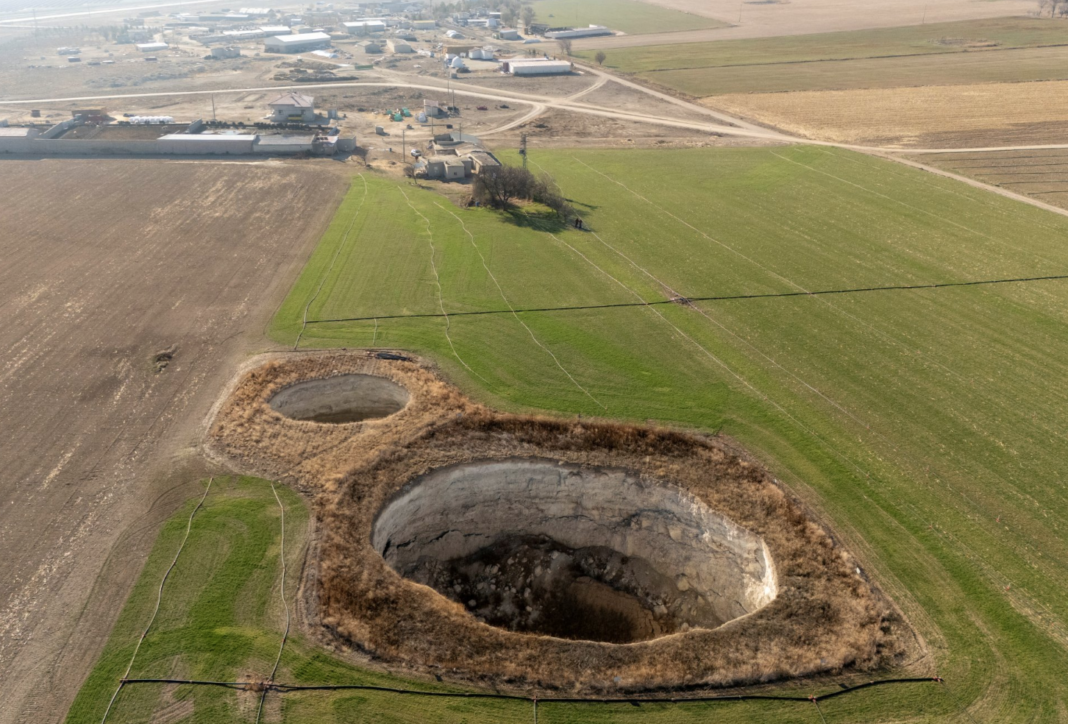
Sink holes appearing in Konya, Turkey due to overuse of irrigation water
Sink holes appearing in Konya, Turkey due to overuse of irrigation water. Via Reuters.

Sinkholes are rapidly appearing in Turkey’s central Anatolian farming region, particularly around Konya and Karapınar. These giant gaping holes in the ground in areas of farmland, known locally as obruk, are not random geological events. They are linked to prolonged drought, climate-driven heat stress, and heavy groundwater extraction for agriculture in one of the country’s most important breadbaskets. As rainfall declines and evaporation increases, natural aquifer recharge has slowed, while demand for irrigation water has surged. There are an estimated 700 new sink holes that have popped up this winter, according to Reuters.

Related: Explore Istanbul’s coolest neighborhood Balat

In Konya, large-scale farming relies heavily on groundwater wells. Farmers often respond to drought by pumping more water and overwatering crops, especially where irrigation remains inefficient or poorly regulated. When groundwater is withdrawn faster than it can be replenished, underground cavities lose pressure and stability. Over time, the land above can suddenly collapse, creating sinkholes that damage fields, roads, and infrastructure and threaten lives. Sinks holes have appeared in Iran, and also in Israel in the area of the Dead Sea. A giant sink hole collapsed an entire road in Bangkok, Thailand earlier this year.

Climate change has intensified drought through higher temperatures and shifting rainfall patterns, while decades of groundwater overuse for agriculture have compounded the damage. As in Turkey, farmers often drill deeper wells and irrigate more aggressively during dry years, accelerating aquifer depletion and land subsidence. Scientists warn that this cycle—drought followed by over-pumping—can permanently damage water systems and agricultural viability.

Related: learn more about Tunisia’s lagoons and hanging gardens for sustainable agriculture.

Across Turkey, the Dead Sea basin, and Iran, the lesson is consistent: groundwater is being treated as an endless emergency reserve. In reality, once aquifers are drained or destabilized, the land itself begins to fail. Sinkholes are not just geological curiosities; they are warning signs that climate change, drought, and overwatering are colliding with unsustainable farming practices.

Read more on resource overuse on Green Prophet:

Green Prophet: Turkey’s deadly sinkholes threaten agriculture and people

Green Prophet: Sinkholes and shrinking shores of the Dead Sea

Green Prophet: Land subsidence in Iran is a looming disaster

Read More

TRENDING

Weston Higginbotham found dead in a Kyoto forest: is climate anxiety part of the story?

In some ways, Weston has become a symbol of a generation wrestling with environmental and technological anxiety. Friends and family described him as deeply concerned about environmental issues. Reports also noted that he questioned the growing role of artificial intelligence in daily life, even reportedly disagreeing with his mother about her use of AI.

Billie Eilish’s Mom Takes the Stage at Hollywood Climate Summit — But Does Hollywood Still Care About Climate Change?

Hollywood once promised to help save the planet. Leonardo DiCaprio warned of climate catastrophe from awards stages. Celebrities flew to climate conferences. Studios pledged greener productions. Streaming platforms rushed to commission environmental documentaries. But in 2026, with the aftermath of wildfires, heatwaves and floods becoming routine, a question lingers: Does Hollywood still care about climate change?

Can Scientists Predict Coral Bleaching Before It Happens?

Now researchers at the Woods Hole Oceanographic Institution (WHOI) in the US say they have developed a way to predict coral bleaching five to six months before it occurs, potentially giving reef managers enough time to intervene and save vulnerable corals.

10 Amazing Facts About the Sidr Tree

Most people in the West have never heard of the Sidr tree. That's strange when you think about it. This tough, thorny desert tree has fed people, bees, birds, and camels for thousands of years. It appears in Islamic tradition. Its honey sells for astonishing prices.

AC Water Uses: How to Reuse Air Conditioner Condensate Water for Plants, Cleaning and Water Conservation

That means the water dripping from your air conditioner may already be usable for gardening, cleaning, flushing toilets, topping up humidifiers, or cooling systems — instead of disappearing into the sewer. A new study. Is it safe?

Locals From Rishon Fight IKEA

Big Box stores are a pretty new concept in Israel, and thank God that not every Israeli city wants them in their backyard. A word from someone who has see the beautiful farmland around her hometown Newmarket, Ontario stripped and converted into vulgar strip malls of big box shops: they have no place in a healthy and sustainable town or city.

The Jewish National Fund Meets An Inconvenient Truth

According to the JNF, it has transformed thousands of acres of barren land into green forests in Israel. They state that each person emits about 23 tons of carbon per year, estimating that each tree planted can absorb one ton of carbon in its lifetime. That's a whole lot of trees you'd need to be planting. Could so many fit in Israel?

How to quiet noise from construction in your office

Streets need to be resurfaced in New York but the humming and grinding noise is unsettling. Noise is environmental pollution. 

EarthX and a blueprint for sustainable investing

Trammell S. Crow, a Dallas-based businessman and father of four, is focusing his efforts on impact investing, and media that focuses on saving the planet through EarthX.

Mining Afghanistan’s Mineral Discoveries Similar to Avatar

Now that American forces in Afghanistan are commemorating the longest period of any war that America has been involved in, including the 1965-73 Vietnam War, the recent discoveries of large and extremely valuable mineral and metal deposits may finally bring to light a reason to continue the presence of US fighting forces in this war torn and backward country.

From Pilot Plant to Global Stage: How Aduro Clean Technologies’ 2026 Expansion Signals a Turning Point for Chemical Recycling Investors Like Yazan Al Homsi

The company's Next Generation Process (NGP) Pilot Plant in London, Ontario, has officially moved into initial operating campaigns, generating the kind of structured, repeatable data that separates laboratory promise from commercial viability.

Nobul’s Regan McGee on Shareholder Value: “Complacency Is the Silent Killer” 

Why the governance framework designed to protect shareholders so...

Should You Invest in the Private Market?

startustartup Unlike public stock exchanges, which offer daily trading, strict...

Popular Categories