How cities are treating noise pollution

Noise is too much in Beirut Lebanon
Holding her ears from the noise in Beirut, Lebanon

Noise is toxic and damaging to your peace of mind. An unsettled mind can lead to immune system malfunctions and chronic problems related to stress. A loud industrial saw is working on construction of the building next door to me in Tel Aviv, as I type. Music blasting in nature sites, bus speakers announcing stops, criminal level shouting and incessant honking and screaming – on the streets, and in classrooms, are the norm in an overly loud Israeli city. 

Israel, by law, has natural quiet hours –– between the hours of 2PM and 4PM when European Jews like to nap and it’s called schlafstunde –– Yiddish for afternoon sleep. The law is still intact, but it’s easy to get around it if you own a construction business and need to get the job done.

Chronic, including humming and droning noise by large machinery during waking and sleeping hours is not just annoying, it’s a health threat that goes largely unrecognized. The relentless din of cars, trucks, trains and planes increases the risk of hypertension, stroke and heart attacks according to research studies.

Even people who live in generally quiet areas are affected: those sudden jarring sounds coming from fire crackers are also particularly detrimental. Cities like New York enacted honking bans in some of the more populous areas of Manhattan already in the early 90s and now cities like Paris have installed noise cameras to monitor vehicles’ sound levels. Thanks to the lovely Swiss, they are introducing national quiet hours.

Noise pollution is a global concern

According to the European Environment Agency, more than one in every five EU citizens is exposed to chronic harmful levels of road traffic noise. This percentage is much higher in many urban areas. The number of people ‘highly annoyed’ and ‘highly sleep disturbed’ must be reduced by 5.4 million and 1.5 million, respectively, in order to meet the 2030 zero pollution targets for noise pollution. They say that “based on levels and measures currently in place, the prospect of meeting these targets is low.”

Noisy City sounds pollution
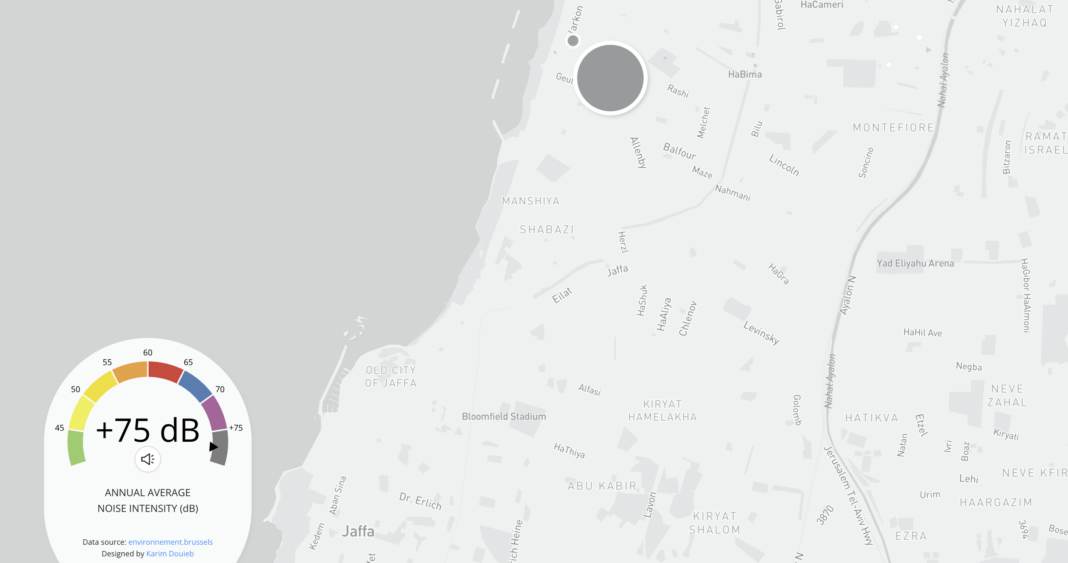
Check out Noisy City to see how cities of the world differ in sound pollution

Try this interactive map of noise pollution from Noisy City to see how your city and region fares. I rolled over Tel Aviv and experienced what more than 75 dB of sound can feel like all day, every day. 

Israel fortunately, does care about noise pollution but really doesn’t do much to enforce that the laws or guidelines are met. First step to complaining about noise is finding which ministry will deal with it. The Ministry of Environmental Protection, the weakest ministry in the Israeli Government, oversees noise pollution. But on a local level the police and city authorities may also handle complaints. If it’s construction noise ongoing, a hum of an air conditioner rattling your brain or the sounds of a garbage truck picking up a bin at 4am. All are different units. Consult this complainer’s noise guide if this is what you are looking for. 

If you want to change policy and law, contact Adam Teva V’Din, an Israeli organization that creates policies and the foundations for environmental law in Israel. 


Karin Kloosterman
Karin Kloostermanhttp://www.greenprophet.com
Karin Kloosterman is an award-winning journalist, innovation strategist, and founder of Green Prophet, one of the Middle East’s pioneering sustainability platforms. She has ranked in the Top 10 of Verizon innovation competitions, participated in NASA-linked challenges, and spoken worldwide on climate, food security, and future resilience. With an IoT technology patent, features in Canada’s National Post, and leadership inside teams building next-generation agricultural and planetary systems — including Mars-farming concepts — Karin operates at the intersection of storytelling, science, and systems change. She doesn’t report on the future – she helps design it. Reach out directly to [email protected]

Read More

TRENDING

90% of Americans worry about microplastics

Microplastics are showing up everywhere—from dollar store toys and synthetic clothing to bottled water, toothbrushes and even human sperm. A new Ocean Conservancy survey finds that nearly 9 in 10 Americans are concerned about the health impacts of microplastics, while support is growing for tougher regulations. As scientists uncover plastic particles in the heart, placenta and reproductive organs, the question is no longer whether microplastics are affecting our lives, but how much damage they are already doing.

Understanding Food Production: Karl Studer on the Urban-Rural Knowledge Gap

Karl Studer occupies an unusual position in American business. As President of Quanta Services, he oversees electrical infrastructure operations across the United States, Canada, and Australia, managing thousands of employees and multibillion-dollar projects.

Tigris River oil spill highlights Iraq’s environmental oversight and our addiction to oil

A fresh oil spill in the Tigris River, filmed by an Iraqi university student, has reignited concern over Iraq's polluted waterways. From ancient Mesopotamia to modern Basra, the country's dependence on oil has come at a steep environmental and human cost, with activists warning that unchecked contamination is putting ecosystems and public health at risk.

Doctor-Led Direct Hair Transplant: What Surgeon Involvement Means for Outcomes

Hair restoration technology continues to evolve, but the surgeon behind the procedure remains the most important factor. Doctor-led hair transplants emphasize careful diagnosis, conservative donor management, natural hairline design, and long-term planning rather than simply maximizing graft counts. By treating donor hair as a limited resource and tailoring each procedure to the patient's future hair loss, experienced surgeons can reduce the need for corrective surgery while delivering more natural, sustainable results.

Data centers in Space? Sophia Space and Apex plan on busing them in

Can data centers really be built in space? Pasadena-based Sophia Space is partnering with Apex to test the idea by launching modular AI computing systems into low Earth orbit in 2027. Using radiation-hardened compute TILEs cooled by passive radiative systems and mounted on scalable satellite buses, the companies aim to prove that edge computing can operate reliably in space. While challenges remain, the project represents an important step toward distributed orbital computing networks that could support everything from climate monitoring and pollution tracking to autonomous spacecraft navigation in an increasingly crowded orbital environment.

Yerukim Forms a New Green Economy Where the Money is Really Green

The Yerukim members who pick up the recyclables get to keep the monetary reward, the public earns "green" bills that can be used in shops, and business owners get to be associated with environmentalism.

Choosing Riyadh over Dubai? What Investors Should Know

Saudi Arabia is deploying capital at unmatched scale to catalyze tourism and advanced industry while rewiring its power-and-water backbone. The investable frontier is widening—especially in renewables, grid storage, water efficiency/desal retrofits, and hospitality operating platforms. Prudent investors will insist on phased delivery, enforceable KPIs (energy, water, biodiversity), and RHQ/zone compliance—while pricing political-economy and reputational risks alongside growth upside.

Sell your cooking oil for biodiesel money

Want to make money on old french fry oil? Sell it.

Qatar Alternative Energy Summit Pairs Investors And Innovators

Alternative energy investors and innovators can meet n' greet in Doha, Qatar March 16 and 17.

Here’s How To Implement The Four Pillars Of Employee Engagement

If you throw a party for your work team and they are vegans, don't make it a barbecue. Know the sustainability values of your team to boost moral and retain good people.

Locals From Rishon Fight IKEA

Big Box stores are a pretty new concept in Israel, and thank God that not every Israeli city wants them in their backyard. A word from someone who has see the beautiful farmland around her hometown Newmarket, Ontario stripped and converted into vulgar strip malls of big box shops: they have no place in a healthy and sustainable town or city.

The Jewish National Fund Meets An Inconvenient Truth

According to the JNF, it has transformed thousands of acres of barren land into green forests in Israel. They state that each person emits about 23 tons of carbon per year, estimating that each tree planted can absorb one ton of carbon in its lifetime. That's a whole lot of trees you'd need to be planting. Could so many fit in Israel?

How to quiet noise from construction in your office

Streets need to be resurfaced in New York but the humming and grinding noise is unsettling. Noise is environmental pollution. 

Popular Categories