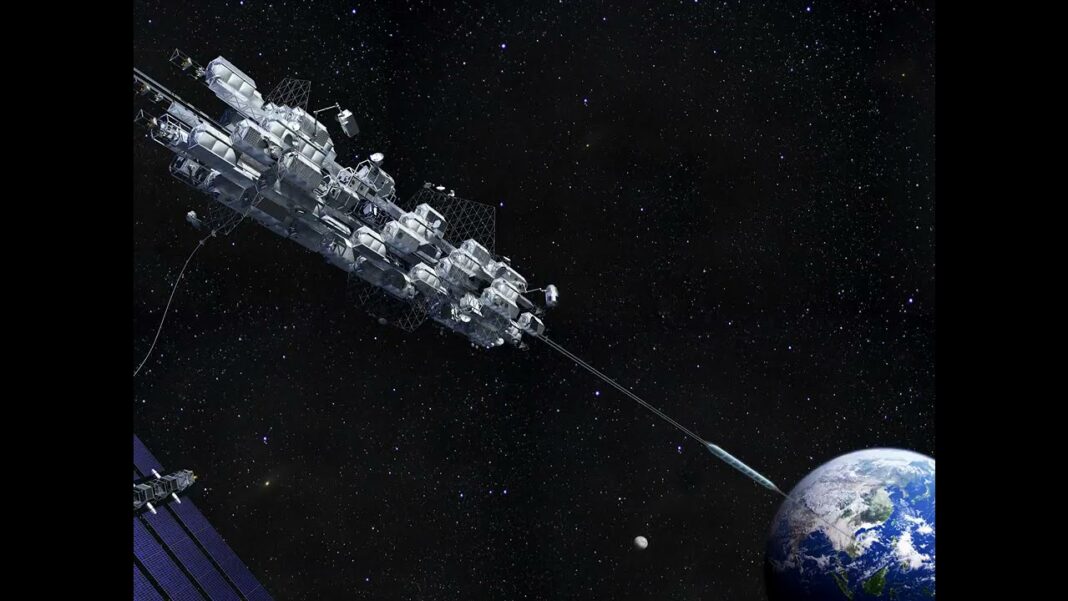
Ride on Japan’s space elevator

A space elevator, also called a space bridge, star ladder, or orbital lift, is a proposed type of planet-to-space transportation system, often depicted in science fiction. The main component of a space elevator would be a cable anchored to the surface and extending into space.

Futuristic Japan is planning one for the year 2050. Obayashi Corporation aims to connect Earth to space with an 80,000 mile cable made from carbon nanotubes (CNTs) allowing 30 passengers to be launched into space at about 150mph, getting them to a space station in about a week.


Japan's Obayashi Corporation space elevator
Japan’s Obayashi Corporation space elevator

The discovery of CNTs by a Japanese engineer in 1991 has pushed this vision forward, with potential launches of the construction project to begin as early as next year. Japan is not the first to come up with the idea of a space elevator.

In 1895, Konstantin Tsiolkovsky proposed to build a space elevator that could reach from Earth into space; it never got off the ground, but in 1957 another Russian – Yuri Artsutanov – came up with a more plausible idea. It wasn’t built either, but he had a chance to judge a team of Israeli students who were tackling the concept anew.

Japan's Obayashi Corporation space elevator

In Japan, the the space elevator construction would be multi-stage process with materials transported via rocket to low Earth orbit where a spaceship will use electric propulsion to ascend to geostationary Earth orbit.

One of the significant advantages of the space elevator, says the Obayashi Corporation is its cost-effectiveness and sustainability. Traditional rocket launches are expensive and polluting. Each launch could cost just a few thousand dollars, making space access more affordable and frequent. This project aligns with Japan’s goals for carbon neutrality by 2050, providing a greener alternative to current space travel technologies​.

Maybe they can figure out a way to get space junk out of orbit at the same time.

Obayashi Corporation is one of five major Japanese construction companies along with Shimizu Corporation, Takenaka Corporation, Kajima Corporation, and Taisei Corporation. It is listed on the Tokyo Stock Exchange and is one of the Nikkei 225 corporations. Its headquarters are in Minato, Tokyo.

Read More

TRENDING

Data centers in Space? Sophia Space and Apex plan on busing them in

Can data centers really be built in space? Pasadena-based Sophia Space is partnering with Apex to test the idea by launching modular AI computing systems into low Earth orbit in 2027. Using radiation-hardened compute TILEs cooled by passive radiative systems and mounted on scalable satellite buses, the companies aim to prove that edge computing can operate reliably in space. While challenges remain, the project represents an important step toward distributed orbital computing networks that could support everything from climate monitoring and pollution tracking to autonomous spacecraft navigation in an increasingly crowded orbital environment.

Why we might be missing messages from aliens

Alien signals might be getting scrambled near their own stars before they reach Earth, so scientists searching for perfectly clear signals could be missing them.

EU startup aiming to generate energy on moon villages

Stepping up to democratize the moon is an EU-funded company, Deep Space Energy, which has just raised more than $1 million USD as a seed fund to help it create energy generators on the moon.

Jeff Bezos’ climate change satellite goes dark, becomes space junk

MethaneSAT’s development marked a shift in how environmental data is collected and shared. Unlike many state-run satellites whose data is restricted or delayed, MethaneSAT was created to provide rapid, open-access emissions data to encourage faster policy responses and regulatory action.

SpaceX and SETI Partner to Protect Alien-Hunting Telescopes—But What About the Rest of the Sky?

SpaceX has taken steps to address concerns, including darker satellite coatings and directional signal shielding. But critics argue that without enforceable global standards, voluntary measures may not go far enough. Meanwhile, scientists at SETI and other institutions continue developing tools to protect the last wild frontier: the cosmic spectrum.

Yerukim Forms a New Green Economy Where the Money is Really Green

The Yerukim members who pick up the recyclables get to keep the monetary reward, the public earns "green" bills that can be used in shops, and business owners get to be associated with environmentalism.

Choosing Riyadh over Dubai? What Investors Should Know

Saudi Arabia is deploying capital at unmatched scale to catalyze tourism and advanced industry while rewiring its power-and-water backbone. The investable frontier is widening—especially in renewables, grid storage, water efficiency/desal retrofits, and hospitality operating platforms. Prudent investors will insist on phased delivery, enforceable KPIs (energy, water, biodiversity), and RHQ/zone compliance—while pricing political-economy and reputational risks alongside growth upside.

Sell your cooking oil for biodiesel money

Want to make money on old french fry oil? Sell it.

Qatar Alternative Energy Summit Pairs Investors And Innovators

Alternative energy investors and innovators can meet n' greet in Doha, Qatar March 16 and 17.

Here’s How To Implement The Four Pillars Of Employee Engagement

If you throw a party for your work team and they are vegans, don't make it a barbecue. Know the sustainability values of your team to boost moral and retain good people.

Locals From Rishon Fight IKEA

Big Box stores are a pretty new concept in Israel, and thank God that not every Israeli city wants them in their backyard. A word from someone who has see the beautiful farmland around her hometown Newmarket, Ontario stripped and converted into vulgar strip malls of big box shops: they have no place in a healthy and sustainable town or city.

The Jewish National Fund Meets An Inconvenient Truth

According to the JNF, it has transformed thousands of acres of barren land into green forests in Israel. They state that each person emits about 23 tons of carbon per year, estimating that each tree planted can absorb one ton of carbon in its lifetime. That's a whole lot of trees you'd need to be planting. Could so many fit in Israel?

How to quiet noise from construction in your office

Streets need to be resurfaced in New York but the humming and grinding noise is unsettling. Noise is environmental pollution. 

Popular Categories