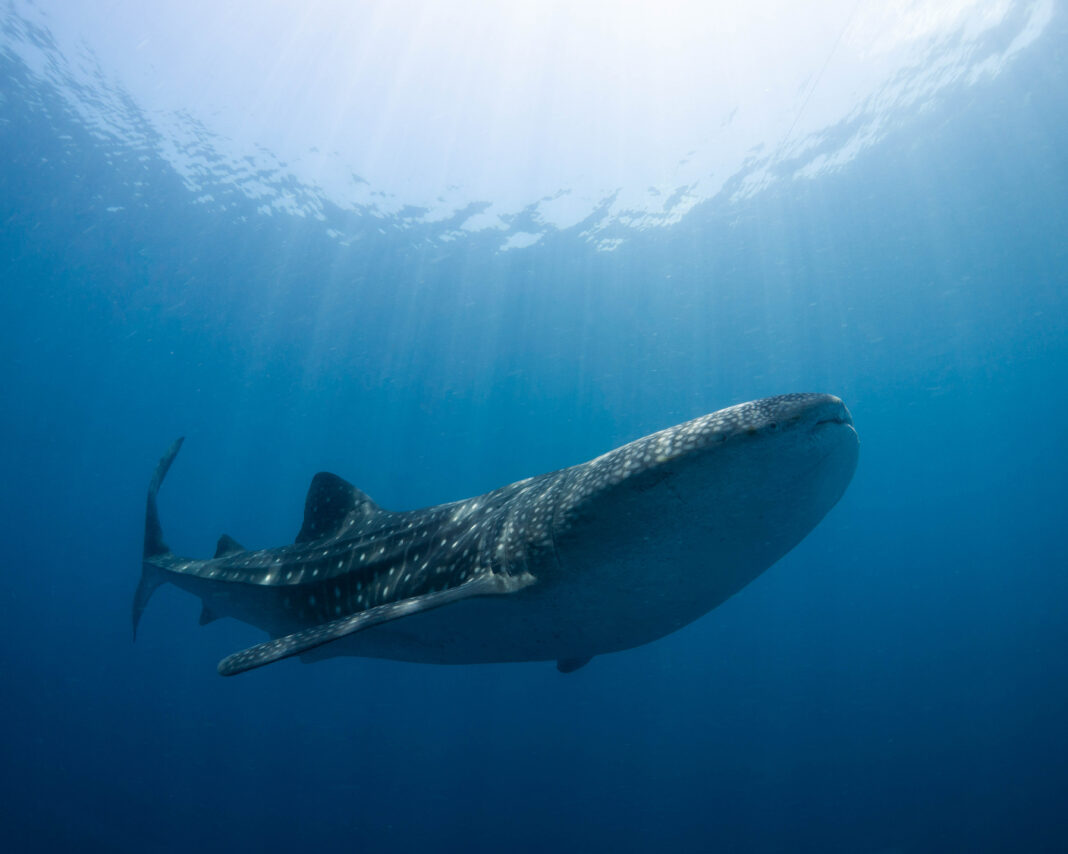
Shipping industry puts whale sharks at risk

whale shark meets people

Global warming could increase the threat posed to whale sharks from large ships, according to a new study published in Nature Climate Change.

Researchers from the Marine Biological Association (MBA) and University of Southampton predict that increased ocean temperatures will see this already endangered species driven into new habitats crossed by busy shipping lanes.

The study predicts that the co-occurrence of whale sharks and large ships could be 15,000 times higher by the end of the century compared to the present day.

Lead author Dr Freya Womersley, Postdoctoral Research Scientist at the MBA and University of Southampton said: “These shifts in the whale sharks’ habitat were most extreme under high emission scenarios. A global reshuffling could lead to core habitat losses in some areas as well as increased co-occurrence with shipping traffic as oceans warm and other variables change.”

Whale shark injuries up close

Whale sharks, the world’s largest fish, are highly mobile and responsive to changes in temperature. Recent evidence suggests they are also particularly vulnerable to ship strikes – where large marine animals are struck and injured, often fatally, by large vessels in the global fleet.

Researchers used whale shark satellite-tracking data coupled with global climate models to project the distribution of whale sharks under three different future climate scenarios.

The models project core habitat losses of over 50% in some national waters by 2100 under high emissions (where we continue to rely heavily on fossil fuels), with the greatest potential losses in Asia. Under a sustainable development scenario (in line with the target of no more than 2°C of global warming), some areas showed a gain in core habitat, notably in Europe.

Related: this mysterious whale shark eludes biologists

“The shifts we predict are likely to be less extreme if we are able to slow warming and mitigate climate change, suggesting that even complex, multi-factor impacts of climate change can be somewhat alleviated by our actions,” says Professor David Sims, co-author and Senior Research Fellow at the University of Southampton and MBA.

The team paired the distribution maps with information on shipping traffic density to determine if these habitat shifts would see whale sharks move into more heavily trafficked areas in the future, potentially increasing the likelihood of ship strikes.

They found that some newly suitable habitats overlapped with busy shipping routes. This was the case in the US part of the north Pacific Ocean, the Japanese part of the eastern China Seas, and the Sierra Leonian part of the north Atlantic Ocean, among many other sites globally.

Some areas, such as the Mexican part of the Gulf of Mexico, saw reductions in co-occurrence, where core habitats shifted into more coastal waters, away from the busy shipping routes in the centre of the Gulf.

Professor Sims says: “Overall ship co-occurrence increased under all future climate scenarios, even if shipping remained at current levels, rather than its anticipated expansion of up to 1,200 per cent by 2050.”

Womersley added: “We show that climate change has the potential to indirectly impact highly-mobile marine species through interacting pressures of humans and the environment. This highlights the importance of factoring climate change into discussions around endangered species management.”

Perhaps a software engineer can help solve this by timing migrating patterns with shipping routes.

 

Karin Kloosterman
Karin Kloostermanhttp://www.greenprophet.com
Karin Kloosterman is an award-winning journalist, innovation strategist, and founder of Green Prophet, one of the Middle East’s pioneering sustainability platforms. She has ranked in the Top 10 of Verizon innovation competitions, participated in NASA-linked challenges, and spoken worldwide on climate, food security, and future resilience. With an IoT technology patent, features in Canada’s National Post, and leadership inside teams building next-generation agricultural and planetary systems — including Mars-farming concepts — Karin operates at the intersection of storytelling, science, and systems change. She doesn’t report on the future – she helps design it. Reach out directly to [email protected]

Read More

TRENDING

Understanding Food Production: Karl Studer on the Urban-Rural Knowledge Gap

Karl Studer occupies an unusual position in American business. As President of Quanta Services, he oversees electrical infrastructure operations across the United States, Canada, and Australia, managing thousands of employees and multibillion-dollar projects.

Wave wind energy for Nvidia’s next AI energy boom?

As AI factories consume unprecedented amounts of electricity, NVIDIA is looking beyond chips and data centers to the ocean. The company recently spotlighted Israel's Eco Wave Power and its wave energy projects in Jaffa and Los Angeles, highlighting how AI, digital twins and renewable energy can work together to meet future power demands. The collaboration reflects a growing realization that the future of artificial intelligence may depend as much on clean energy infrastructure as it does on computing power.

Weston Higginbotham found dead in a Kyoto forest: is climate anxiety part of the story?

In some ways, Weston has become a symbol of a generation wrestling with environmental and technological anxiety. Friends and family described him as deeply concerned about environmental issues. Reports also noted that he questioned the growing role of artificial intelligence in daily life, even reportedly disagreeing with his mother about her use of AI.

Billie Eilish’s Mom Takes the Stage at Hollywood Climate Summit — But Does Hollywood Still Care About Climate Change?

Hollywood once promised to help save the planet. Leonardo DiCaprio warned of climate catastrophe from awards stages. Celebrities flew to climate conferences. Studios pledged greener productions. Streaming platforms rushed to commission environmental documentaries. But in 2026, with the aftermath of wildfires, heatwaves and floods becoming routine, a question lingers: Does Hollywood still care about climate change?

Can Scientists Predict Coral Bleaching Before It Happens?

Now researchers at the Woods Hole Oceanographic Institution (WHOI) in the US say they have developed a way to predict coral bleaching five to six months before it occurs, potentially giving reef managers enough time to intervene and save vulnerable corals.

Yerukim Forms a New Green Economy Where the Money is Really Green

The Yerukim members who pick up the recyclables get to keep the monetary reward, the public earns "green" bills that can be used in shops, and business owners get to be associated with environmentalism.

Choosing Riyadh over Dubai? What Investors Should Know

Saudi Arabia is deploying capital at unmatched scale to catalyze tourism and advanced industry while rewiring its power-and-water backbone. The investable frontier is widening—especially in renewables, grid storage, water efficiency/desal retrofits, and hospitality operating platforms. Prudent investors will insist on phased delivery, enforceable KPIs (energy, water, biodiversity), and RHQ/zone compliance—while pricing political-economy and reputational risks alongside growth upside.

Sell your cooking oil for biodiesel money

Want to make money on old french fry oil? Sell it.

Qatar Alternative Energy Summit Pairs Investors And Innovators

Alternative energy investors and innovators can meet n' greet in Doha, Qatar March 16 and 17.

Here’s How To Implement The Four Pillars Of Employee Engagement

If you throw a party for your work team and they are vegans, don't make it a barbecue. Know the sustainability values of your team to boost moral and retain good people.

Locals From Rishon Fight IKEA

Big Box stores are a pretty new concept in Israel, and thank God that not every Israeli city wants them in their backyard. A word from someone who has see the beautiful farmland around her hometown Newmarket, Ontario stripped and converted into vulgar strip malls of big box shops: they have no place in a healthy and sustainable town or city.

The Jewish National Fund Meets An Inconvenient Truth

According to the JNF, it has transformed thousands of acres of barren land into green forests in Israel. They state that each person emits about 23 tons of carbon per year, estimating that each tree planted can absorb one ton of carbon in its lifetime. That's a whole lot of trees you'd need to be planting. Could so many fit in Israel?

How to quiet noise from construction in your office

Streets need to be resurfaced in New York but the humming and grinding noise is unsettling. Noise is environmental pollution. 

Popular Categories