Shooting Northern lights? Here are the best camera settings

Want to shoot northern lights?

Your friends are posting their best Northern Lights pics on Facebook and Instagram, and you want to try it too. How can you get the best shot on a camera that isn’t a cell phone?

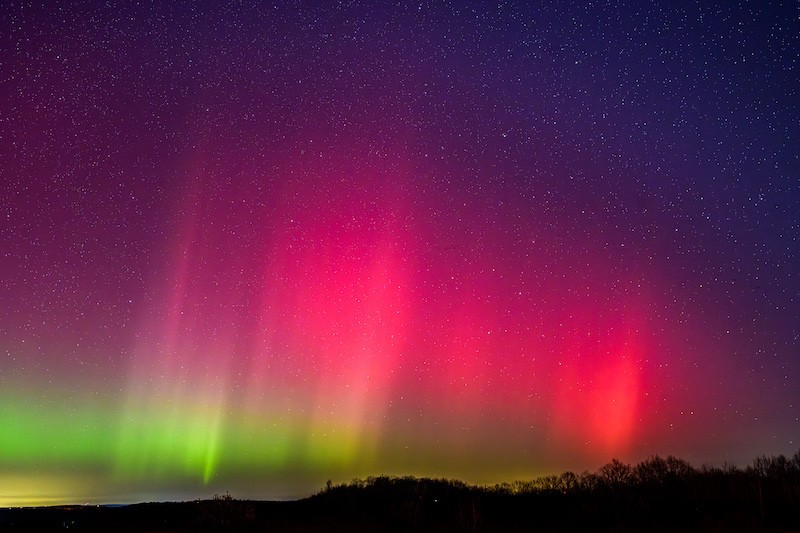
Capturing a strong photograph of the Northern Lights depends on using the right equipment, settings and technique, and on adapting to changing light and movement in the sky. A full-frame digital camera mounted on a tripod offers the best results because it can collect more light with lower noise during long exposures. Jessica Fridrich uses a Nikon Z7 for her aurora work.

“I must say that, until recently, I have always considered the Northern Lights to be a phenomenon that is only visible from polar regions. Last year, I realized that I had been missing out on a lot of fun.”

What settings does she use? She typically sets the white balance to 4000K and exposes for about six seconds at ISO 1600 to 4000 with an f/2.8 lens. These choices come from practical considerations: long exposures and relatively high ISO values allow the sensor to gather enough faint light from fast-changing auroral structures, while an aperture of f/2.8 lets in more light during each exposure.

Environmental conditions change the settings. When the Moon is out or when there is light pollution, the ISO should be reduced so the sky does not overexpose. If the aurora begins to move quickly, the exposure needs to be shortened to avoid motion blur in the structures. In that case, increasing the ISO compensates for the reduced exposure time; Fridrich shortens the exposure to four seconds or even two seconds when needed. Some auroral displays change shape rapidly, so adapting exposure length in real time is important.

Correct focus is essential. Autofocus is unreliable in darkness, so the camera must be switched to manual focus. The best way to achieve sharpness is to focus on a bright star. This ensures that both the sky and the auroral structures will appear crisp. Lenses with large apertures, meaning low f-stop values, work particularly well for night photography because they allow more light into the camera. Fridrich says she often uses a 24–70 mm f/2.8 lens, keeping it wide open. The zoom capability helps capture specific details within the display. For exceptionally large or bright auroras, especially those that stretch overhead, a wide-angle lens is preferred because it can capture the full extent of the scene.

Moisture is another practical concern. Dew often condenses on lenses during long sessions outdoors, so a simple lens cloth is important to keep the glass clear.

Phones can also record auroras. Using night mode is generally sufficient, as modern phones automatically lengthen exposure time and increase sensitivity in low light. For both cameras and phones, saving images in RAW or another uncompressed format provides more flexibility for later editing, though JPEGs are acceptable for those who do not plan to process their images.

Sites like Space Weather can help you find the right nights

TRENDING

Street Vegan in Sri Thanu is a must-stop family lunch spot on Koh Phangan, Thailand

If you’re anywhere near Sri Thanu on Koh Phangan, Thailand, around the yoga centers: Zen Beach, Haad Yao, or Salad Beach—make time for Street Vegan. It's vegan and so satisfying that one meal might convince you that eating plant-based is not a compromise. I suggest for any vegan restaurant owner or chef to come to this modestly-priced venue to learn from a master.

Plants can eat dust and grow – should we stop dusting them?

Dusty plants? Let them eat their hearts out.

Paris Modest Fashion Week offers style without exposure for Muslims

France is home to around 5 to 7.5 million Muslims according to estimates, and Özlem Şahin, head of the organization behind Modest Fashion Week, has described Paris as "one of the leading modest fashion capitals in Europe".

Kids are vaping. The media shock that made them stop

On one side: aggressive anti-vaping campaigns from the FDA, Truth Initiative, and state programs, backed by over $100 million in annual spending. On the other: a public health crisis. Screenshot

Baby teeth read like tree rings paint a picture of toxins in early life

A new study from the Icahn School of Medicine at Mount Sinai in New York offers a striking insight into how the environments we are born into can quietly shape our brains years later. By analyzing naturally shed baby teeth, the ones tucked under pillows for the tooth fairy, researchers have reconstructed a detailed timeline of exposure to environmental metals during pregnancy and early infancy.

Nobul’s Regan McGee on Shareholder Value: “Complacency Is the Silent Killer” 

Why the governance framework designed to protect shareholders so...

Should You Invest in the Private Market?

startustartup Unlike public stock exchanges, which offer daily trading, strict...

How to build a 100-year-company

Kongō Gumi is a Japanese construction company, purportedly founded in 578 A.D., making it the world's oldest documented company. What can we learn about building sustainable businesses from them?

From Pilot Plant to Global Stage: How Aduro Clean Technologies’ 2026 Expansion Signals a Turning Point for Chemical Recycling Investors Like Yazan Al Homsi

The company's Next Generation Process (NGP) Pilot Plant in London, Ontario, has officially moved into initial operating campaigns, generating the kind of structured, repeatable data that separates laboratory promise from commercial viability.

How AI Helps SaaS Companies Reduce Repetitive Customer Support Work

SaaS products are designed for large numbers of users with different levels of experience, and also in renewable energy.

Pulling Water from the Air

Faced with water shortage in Amman, Laurie digs up...

Turning Your Energy Consultancy into an LLC: 4 Legal Steps for Founders in Texas

If you are starting a renewable energy business in Texas, learn how to start an LLC by the books.

Tracking the Impacts of a Hydroelectric Dam Along the Tigris River

For the next two months, I'll be taking a break from my usual Green Prophet posts to report on a transnational environmental issue: the Ilısu Dam currently under construction in Turkey, and the ways it will transform life along the Tigris River.

Related Articles

Popular Categories