The Rising Threat of Woven Plastic Sacks to Eastern Mediterranean Sea Turtles

sea turtle rescue, Yaniv Levy, Israel Sea Turtle Rescue Center, sea turtles Mediterranean, loggerhead turtle entanglement, green sea turtle plastic, Caretta caretta, Chelonia mydas, polypropylene sacks pollution, marine animal rehabilitation, turtle growth rates, plastic pollution turtles, epipelagic phase turtles, turtle hospital Israel, marine conservation Israel, turtle amputation recovery, Mediterranean plastic debris, juvenile sea turtle threats, floating plastic hazards, turtle rescue Michmoret, Israeli marine biology, sea turtle entanglement, plastic feed bags marine, turtle strandings Israel
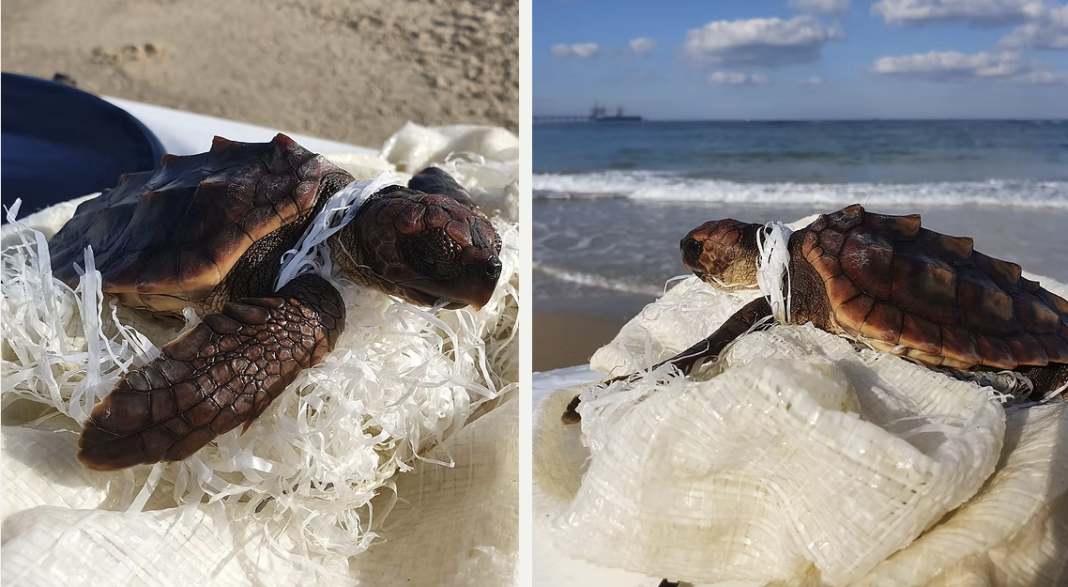
Sea turtle caught in a plastic feed sack, by Yaniv Levi

Commonly used for livestock feed—woven sacks act like floating death traps, snaring turtles by the neck or limbs

In a groundbreaking study published in Marine Science, researchers from Israel’s Sea Turtle Rescue Center (ISTRC), the University of Haifa, and Ruppin Academic Center present the first high-resolution monthly growth data for sea turtles in the eastern Mediterranean—and uncover a deadly new threat: entanglement in polypropylene (PP) sacks.

This study, authored by Shir Sassoon, Yair Suari, and Dr. Yaniv Levy, focuses on the “epipelagic phase”—the early life stage of sea turtles when hatchlings drift passively in open water. While most conservation efforts target nesting beaches, this study shifts attention offshore, where plastic pollution silently kills juvenile turtles long before they reach maturity.

Turtle ‘Lost Years’ Finally Found

Sea turtles spend up to a decade adrift in the open sea, a period known to scientists as the “lost years” due to limited data. Using over two decades of rescue records (1999–2020), the team compiled length data from 577 young turtles—both loggerhead (Caretta caretta) and green (Chelonia mydas)—to track monthly growth for the first time in this region.

Findings show that loggerhead turtles grow at an average of 0.76 cm per month during their first 19 months of life, while green turtles grow faster—0.92 cm per month over the first 11 months. These growth rates mirror those found in other parts of the Mediterranean but fill critical knowledge gaps, particularly for green turtles during this early life stage.

Seasonal fluctuations in growth were also observed, with reduced rates in winter months, highlighting the sensitivity of juvenile turtles to environmental conditions.

Polypropylene: A Lethal Trap

But the most shocking discovery wasn’t about how turtles grow—it was about how they’re dying.

Out of 324 injured epipelagic phase turtles treated at the ISTRC, nearly half (48%) were entangled in woven polypropylene sacks. These sacks—commonly used for livestock feed—act like floating death traps, snaring turtles by the neck or limbs. Many were so severely injured that they required amputations; 12% died from their injuries.

Loggerhead turtles were most affected, particularly during the summer months. Between 2008 and 2020, PP sack entanglements surged from just 20% to 75% of all epipelagic injury cases. The number of incidents jumped significantly after 2017, suggesting a new pattern in maritime waste disposal.

These sacks are strong, lightweight, and slow to degrade—perfect for transport, devastating for marine life. When researchers traced the logos on the sacks, they found origins from as far as Romania, Russia, and Greece, mostly linked to livestock shipping.

“The threads unravel and act like tourniquets,” says Dr. Yaniv Levy, director of ISTRC. “We see turtles arrive unable to swim, starved, and in pain. Many suffer limb loss or systemic infections.”

Floating sacks may mimic natural cover like Sargassum seaweed, attracting juvenile turtles who use them as shelter. Once entangled, turtles often cannot free themselves.

ISTRC is uniquely positioned to collect long-term health and injury data. Their clinical records have helped transform the hospital into a research center that informs both policy and turtle care. Turtles are triaged with CT scans, blood tests, and X-rays, and their rehabilitation includes custom slings, IVs, and even prosthetics.

Rehabilitated turtles are typically released after two months of care, but the team notes that many never reach land for rescue. The actual impact is likely far greater than reported.

Policy Implications

The study urges international regulation on maritime waste, especially from livestock carriers. The team tracked suspect ships using Automatic Identification Systems (AIS), identifying several that sail regularly through Israeli waters but do not dock—making legal accountability difficult. There is a natural current that causes plastic sacks tossed illegally off the ship into the sea, to end up on the Levantine shores where they entangle juvenile turtles. Some plastics are believed to be dumped close to show where they blow into the sea.

A proposed bill in the Israeli Knesset calls for an end to live animal shipments, which would reduce sack and marine waste dramatically. It would also reduce undue animal suffering while being shipped for slaughter while alive at sea. Meanwhile, the study suggests declaring protected marine zones and enhancing multinational enforcement to curb this specific pollutant.

The epipelagic phase is one of the most vulnerable life stages for sea turtles. And while global conservation has made strides in nesting beach protection, this study shows that the open sea remains a lawless frontier.

If you live near a marine environment and find a turtle entangled in plastics, it’s important not to remove it without a veterinarian, says Levy. The plastic can cause reduced blood flow and necrotic tissue and removing it puts poisoned blood into the turtle. The turtle above explains what a vet needs to do to treat the turtle. First a round of antibiotics.

The problem with turtles is feed sacks, not plastic straws, Levy emphasizes.

“Plastic pollution regulations must be extended to pelagic zones,” the authors write in the paper. “We need international collaboration and enforcement—not just for turtles, but for the oceans.”

As Dr. Levy notes, these early-stage turtles are not just victims—they’re indicators. “They’re telling us where our waste ends up, and how fast we need to act.”


 

Karin Kloosterman
Karin Kloostermanhttp://www.greenprophet.com
Karin Kloosterman is an award-winning journalist, innovation strategist, and founder of Green Prophet, one of the Middle East’s pioneering sustainability platforms. She has ranked in the Top 10 of Verizon innovation competitions, participated in NASA-linked challenges, and spoken worldwide on climate, food security, and future resilience. With an IoT technology patent, features in Canada’s National Post, and leadership inside teams building next-generation agricultural and planetary systems — including Mars-farming concepts — Karin operates at the intersection of storytelling, science, and systems change. She doesn’t report on the future – she helps design it. Reach out directly to [email protected]

Read More

TRENDING

Dan Zaslavsky’s energy tower dream is rising again in Iran and China

The Energy Tower idea never made the leap from drawings and engineering studies to full-scale construction. But nearly two decades after most people stopped talking about it, the concept is quietly evolving in two unexpected places: China and Iran. The concept let dreamers dream and doers do - figuring out more pleasing designs and engineering.

A visit to Amirim, Israel’s first all-vegetarian village in the Galilee

Just 15 kilometers from Tzfat there is a moshav that was founded in the late 50s that was ideologically influenced by organic, vegetarian and vegan principles. My hostess at Ohn-Bar, the tzimmer where I stayed, explained that the people of Amirim were among the pioneers of Israel’s strong vegetarian movement.

Israeli Hydrogen Startup H2Pro Are Trying to Solve Clean Energy’s Hardest Problem

The company has attracted backing from major investors including Breakthrough Energy Ventures, the climate fund founded by Bill Gates, along with industrial partners such as Sumitomo, ArcelorMittal, and Temasek, a multi-billion dollar company that owns Singapore airlines. H2Pro has raised more than $100 million USD and is moving from pilot projects toward commercial-scale deployments.

Desalination experts debunk Aqua Solaire, the floating desalination barge

AI makes it easy to dream, develop, and create images of what could be world-changing ideas, until the reality sets in. A new project making the rounds is Aqua Solaire, an allged French concept for a solar-powered desalination vessel designed to bring drinking water to coastal communities facing drought, storms, and infrastructure failures.

Mirai’s robots for the high seas can track polluters, pirates and saboteurs

Getting away with bad business at sea may soon be harder with Mirai Robotics on patrol.

Locals From Rishon Fight IKEA

Big Box stores are a pretty new concept in Israel, and thank God that not every Israeli city wants them in their backyard. A word from someone who has see the beautiful farmland around her hometown Newmarket, Ontario stripped and converted into vulgar strip malls of big box shops: they have no place in a healthy and sustainable town or city.

The Jewish National Fund Meets An Inconvenient Truth

According to the JNF, it has transformed thousands of acres of barren land into green forests in Israel. They state that each person emits about 23 tons of carbon per year, estimating that each tree planted can absorb one ton of carbon in its lifetime. That's a whole lot of trees you'd need to be planting. Could so many fit in Israel?

How to quiet noise from construction in your office

Streets need to be resurfaced in New York but the humming and grinding noise is unsettling. Noise is environmental pollution. 

EarthX and a blueprint for sustainable investing

Trammell S. Crow, a Dallas-based businessman and father of four, is focusing his efforts on impact investing, and media that focuses on saving the planet through EarthX.

Mining Afghanistan’s Mineral Discoveries Similar to Avatar

Now that American forces in Afghanistan are commemorating the longest period of any war that America has been involved in, including the 1965-73 Vietnam War, the recent discoveries of large and extremely valuable mineral and metal deposits may finally bring to light a reason to continue the presence of US fighting forces in this war torn and backward country.

From Pilot Plant to Global Stage: How Aduro Clean Technologies’ 2026 Expansion Signals a Turning Point for Chemical Recycling Investors Like Yazan Al Homsi

The company's Next Generation Process (NGP) Pilot Plant in London, Ontario, has officially moved into initial operating campaigns, generating the kind of structured, repeatable data that separates laboratory promise from commercial viability.

Nobul’s Regan McGee on Shareholder Value: “Complacency Is the Silent Killer” 

Why the governance framework designed to protect shareholders so...

Should You Invest in the Private Market?

startustartup Unlike public stock exchanges, which offer daily trading, strict...

Popular Categories