
New lab reactor uses water instead of toxic solvents

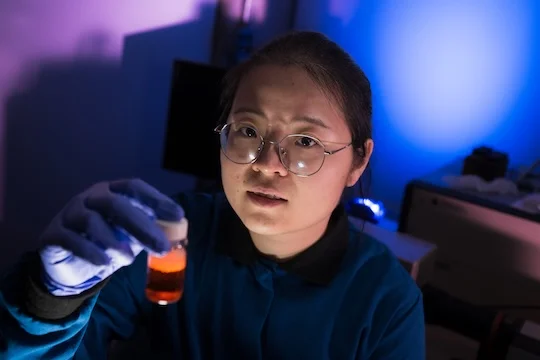
ying chen
Ying Chen is the first author of this study and a doctoral student in chemistry at Rice. Photo by Jeff Fitlow/Rice University.

Researchers at Rice University in Houston, Texas, have developed a new method for performing chemical reactions using water instead of toxic solvents.They call it green chemistry. We wrote about the potential of water over toxic solvents way back in 2008. The idea is now coming to fruition. Baby steps in science.

The scientists created microscopic reactors capable of driving light-powered chemical processes by designing metal complex surfactants (MeCSs) that self-assemble into nanoscale spheres called micelles. This innovation could drastically reduce pollution in industries including pharmaceuticals and materials science, where harmful organic solvents are often necessary.

The new micellar technology represents a step forward in sustainable chemistry. These self-assembled micelles form in water, where their hydrophobic cores provide a unique environment for reactions, even with materials that are typically insoluble in water.

The research team led by Angel Martí, professor and chair of chemistry at Rice, demonstrated that this system can efficiently perform photocatalytic reactions while eliminating the need for hazardous substances. The study was published in Chemical Science Feb. 10.

“Our findings show how powerful molecular design can be in tackling chemical sustainability challenges while maintaining high chemical performance,” Martí said. “We’ve created a tool that could transform how chemical reactions are performed, reducing environmental harm while increasing efficiency.”

How the discovery works

Surfactants are molecules with a dual nature: One part is attracted to water, while the other repels it. When added to water, they naturally form micelles or tiny spheres where the water-avoiding parts gather in the center, creating a small reaction space. The scientists modified these surfactants by adding a light-sensitive metal complex to their structure, making the MeCSs.

The researchers tested different versions of the MeCSs by altering the length of their hydrophobic, or water-repelling, tails. They found that these molecules could form micelles as small as 5-6 nanometers, much smaller than those in similar systems. The team used these micelles to perform a photocatalytic reaction, achieving high yields without needing harmful solvents.

marti
The new micellar technology represents a step forward in sustainable chemistry. Photo by Jeff Fitlow/Rice University.

“These micelles act like tiny reaction vessels,” said Ying Chen, first author of this study and a doctoral student in chemistry at Rice. “They enable chemical transformations that wouldn’t normally work in water while being more sustainable than traditional methods.”

Why this matters

Many chemical processes in manufacturing and research rely on organic solvents, which are harmful to the environment and expensive to handle safely. The development of photoactive water-based micelles capable of driving chemical reactions offers a safer, greener alternative. Additionally, the system can be reused, improving its cost-effectiveness and environmental footprint.

In 2008 we reported on the groundbreaking work, thanks to a groundbreaking discovery at Tel Aviv University. Prof. Arkadi Vigalok from the School of Chemistry has discovered a way to use water to make certain steps of a complicated chain of chemical reactions more environmentally-friendly.

Prof. Vigalok’s solution replaces chemical solvents, which can pollute the environment, with water. Though chemists have long thought it possible, Prof. Vigalok’s approach has only rarely been even attempted. His discovery was reported in the journal Angewandte Chemie, International Edition. Once ideas are published in the scientific community they become open-source questions and challenges for the science community around the world to solve.


Karin Kloosterman
Karin Kloostermanhttp://www.greenprophet.com
Karin Kloosterman is an award-winning journalist, innovation strategist, and founder of Green Prophet, one of the Middle East’s pioneering sustainability platforms. She has ranked in the Top 10 of Verizon innovation competitions, participated in NASA-linked challenges, and spoken worldwide on climate, food security, and future resilience. With an IoT technology patent, features in Canada’s National Post, and leadership inside teams building next-generation agricultural and planetary systems — including Mars-farming concepts — Karin operates at the intersection of storytelling, science, and systems change. She doesn’t report on the future – she helps design it. Reach out directly to [email protected]

Read More

TRENDING

Mini medical machines destroy pancreas cancer cells in new study

The idea of using MENPs to wirelessly control local electric fields was first proposed by Khizroev and Liang in 2011. Over the past decade, the concept evolved through global research partnerships and technological breakthroughs, culminating in this study.

Swedish silk turns clothes into charging stations with your body heat

Wear a dress from this silk and light up the room, literally

Pathogens are thriving in the plastisphere

This Nature article gives a complete overview on what we know about the plastisphere. And there is a new worry: nanoplastics.

Calling all real estate managers, factory operators, hospitals and data centers: This new heat transfer fluid can take 15% off your energy bill

Dublin based HT Materials Science (HTMS) has developed a breakthrough energy savings solution called Maxwell that can slash operating costs, increase system capacity in new and existing builds and offer carbon credits

Masdar nanotech promises to bring on the rain!

Umbrella sales in the UAE may soon see a...

Yerukim Forms a New Green Economy Where the Money is Really Green

The Yerukim members who pick up the recyclables get to keep the monetary reward, the public earns "green" bills that can be used in shops, and business owners get to be associated with environmentalism.

Choosing Riyadh over Dubai? What Investors Should Know

Saudi Arabia is deploying capital at unmatched scale to catalyze tourism and advanced industry while rewiring its power-and-water backbone. The investable frontier is widening—especially in renewables, grid storage, water efficiency/desal retrofits, and hospitality operating platforms. Prudent investors will insist on phased delivery, enforceable KPIs (energy, water, biodiversity), and RHQ/zone compliance—while pricing political-economy and reputational risks alongside growth upside.

Sell your cooking oil for biodiesel money

Want to make money on old french fry oil? Sell it.

Qatar Alternative Energy Summit Pairs Investors And Innovators

Alternative energy investors and innovators can meet n' greet in Doha, Qatar March 16 and 17.

Here’s How To Implement The Four Pillars Of Employee Engagement

If you throw a party for your work team and they are vegans, don't make it a barbecue. Know the sustainability values of your team to boost moral and retain good people.

Locals From Rishon Fight IKEA

Big Box stores are a pretty new concept in Israel, and thank God that not every Israeli city wants them in their backyard. A word from someone who has see the beautiful farmland around her hometown Newmarket, Ontario stripped and converted into vulgar strip malls of big box shops: they have no place in a healthy and sustainable town or city.

The Jewish National Fund Meets An Inconvenient Truth

According to the JNF, it has transformed thousands of acres of barren land into green forests in Israel. They state that each person emits about 23 tons of carbon per year, estimating that each tree planted can absorb one ton of carbon in its lifetime. That's a whole lot of trees you'd need to be planting. Could so many fit in Israel?

How to quiet noise from construction in your office

Streets need to be resurfaced in New York but the humming and grinding noise is unsettling. Noise is environmental pollution. 

Popular Categories