

Valley fever is an emerging fungal disease in the western United States that most often causes flu-like symptoms, but can also cause dangerous or even deadly complications.
By analyzing data on reported cases of Valley fever in California, which have increased dramatically over the last two decades, researchers from University of California San Diego and University of California, Berkeley, have identified seasonal patterns that could help individuals and public health officials better prepare for future surges in Valley fever cases.
Related: Microplastics you breath in the desert
The findings also have important implications for how the changing climate can exacerbate the threat of infectious diseases. The findings are published in The Lancet Regional Health – Americas.
The researchers collaborated closely with the California Department of Health (CDPH) to analyze all reported Valley fever cases in California from 2000 to 2021. By comparing these to seasonal climate data, they discovered how the disease cycles seasonally across different California counties and identified how these cycles are influenced by drought periods.
The researchers found that while most cases occur during the period from September to November, there were differences in seasonal patterns and timing between counties and years.
“Most seasonal infectious diseases show a peak in cases every year, so we were surprised to see that there were certain years during which few or no counties had a seasonal peak in Valley fever cases,” said author Alexandra Heaney. “This made us wonder what was driving these differences in seasonality between years, and based on the timing we observed, we hypothesized that drought might be playing a role.”
The researchers found that on average, counties in the San Joaquin Valley and Central Coast regions had the most pronounced seasonal peaks, though the peaks started earlier in San Joaquin Valley.
“This is valuable information to time public health messaging aimed at educating the public about the symptoms of Valley fever and how to protect themselves,” added Heaney.
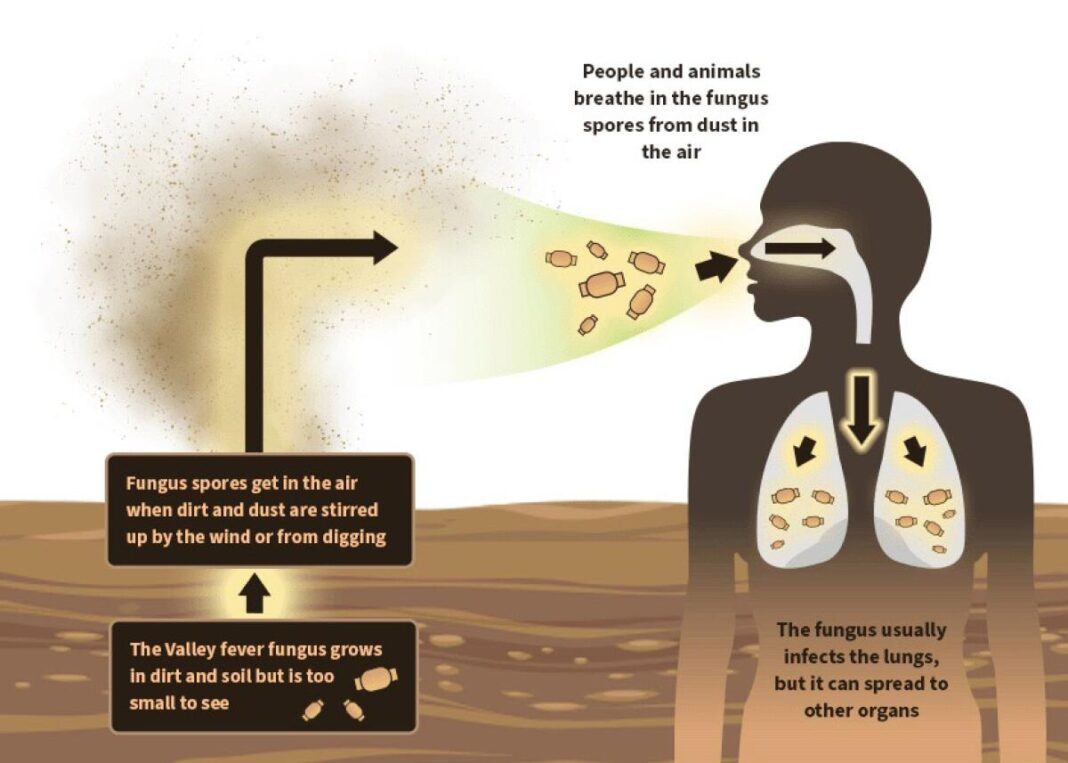
Valley fever is caused by spores from the soil-dwelling Coccidioides fungus. People contract Valley fever by inhaling infectious spores that become aerosolized when the soil is disturbed by wind or human activity. Valley fever is most likely to affect people who are exposed to airborne dust frequently, including those who work outdoors. However, the disease is not contagious.
Valley fever has long been a problem in the American Southwest, but the number of cases has skyrocketed in recent years, tripling from 2014–2018 and again from 2018–2022, according to the CDPH. However, because it is still relatively rare, and because it causes similar symptoms to other respiratory infections, including COVID-19, Valley fever is often misdiagnosed.
When left untreated, the fungus can cause severe damage to the respiratory system and spread to other parts of the body, such as the skin, bones and even the brain, the latter of which can be deadly.
“Knowing when the Valley fever season starts and how intense it will be can help health care practitioners know when they should be on high alert for new cases,” said corresponding author Justin Remais. “This is the first study to pin down exactly when disease risk is highest in all of California’s endemic counties, as well as places where the disease is newly emerging.”
The researchers observed that during drought periods, seasonal peaks in Valley fever cases are less severe. However, when the rains return, these peaks are particularly high. One hypothesis to explain this pattern is that droughts allow heat-resistant Coccidioides spores to outlast their less-hardy competitors. When rains return, the fungus is able to proliferate widely with less competition for moisture and nutrients.
Another hypothesis suggests that the links between Valley fever and drought may be due to drought’s impact on rodents that host the Coccidioides fungus. Because rodent populations decline during droughts, and because dead rodents are thought to be an important source of nutrients for the fungus, it may be able to survive and spread more easily in drought conditions.
“This work is an important example of how infectious diseases are influenced by climate conditions,” said Heaney. “Even though droughts appear to decrease Valley fever cases in the short term, the net effect is an increase in cases over time, particularly as we experience more frequent and severe droughts due to climate change.”
Individuals can help protect themselves against Valley fever during dry and dusty periods by minimizing time outdoors and wearing face coverings that can block dust. The researchers also emphasize the need for more thorough monitoring of the Valley fever fungus, which can be difficult to detect.
The team is now expanding the range of their analyses to include other Valley fever hotspots in the United States.
“Arizona is much dustier than California and has very different climate dynamics, and about two thirds of cases in the United States occur in Arizona, so that’s where we’re looking next,” said Heaney. “Understanding where, when, and in what conditions Valley fever is most prevalent is critical for public health officials, physicians, and the public to take precautions during periods of increased risk.”