
A new food safe blue called jagua can help save Colombian forests

A new blue from the jagua fruit
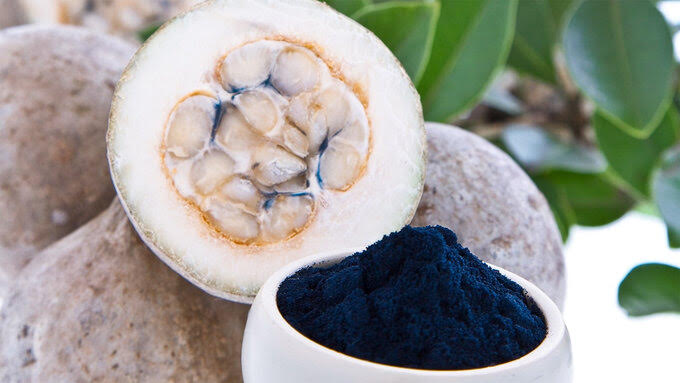
Synthetic food dyes should be avoided in everything we eat. But a true blue natural food dye was missing –– until now. It comes from a fruit about the size of a kiwi or a guava, growing on a semi-deciduous tree called the Genipa americana in the forests of Colombia. Opening a new chapter in the chronicle of food safety, it’s a “holy grail” in the food industry, the first ever blue food colouring to be natural in origin and resistant to acids. Let’s hope new interest in it will help protect forests, not cut them down.
When the pulp of the unripe jagua fruit is exposed to air, it turns dark blue in colour. The pigment has been widely used by various Indigenous Peoples in South America to paint their skin and dye their clothes, ceramics and some foods.
Now it’s been hailed by the food industry as the one remaining natural food colour needed to complete the entire spectrum. It was recently included in the Codex Alimentarius, or “Food Code”, a collection of standards, guidelines and codes of practices.
The jagua blue food colouring was developed in Colombia by a private company that set about creating and collecting the data needed for the scientific assessment of the safety of this food additive.
After a thorough scientific evaluation and confirmation that it was a product for which there was a need, jagua blue has been permitted for use under the Codex standard governing food additives, which covers everything from confectionery to breakfast cereals.
For Colombia, the jagua blue standard is a big deal. Officials there predict that the inclusion of jagua blue in the Codex Alimentarius can help improve the economic wellbeing of Indigenous Peoples who have used the colorant for generations. Particularly hoping to benefit are the Emberá Indigenous Peoples, many of whom have traditionally lived on the riverbanks of the densely forested northwestern Chocó region.
Whatever the production model, Colombia hopes the safety standard can open up new markets and opportunities as well as drive biodiversity conservation and the adoption of sustainable agricultural practices.
internationally has grown exponentially.

TRENDING

Street Vegan in Sri Thanu is a must-stop family lunch spot on Koh Phangan, Thailand

If you’re anywhere near Sri Thanu on Koh Phangan, Thailand, around the yoga centers: Zen Beach, Haad Yao, or Salad Beach—make time for Street Vegan. It's vegan and so satisfying that one meal might convince you that eating plant-based is not a compromise. I suggest for any vegan restaurant owner or chef to come to this modestly-priced venue to learn from a master.

April Is National Garlic Month

April is National Garlic Month! We’re close to the end of April, but fear not: the North American garlic harvest lasts through July, and you can pick up the bulbs until Fall. Even after the green stalks wither and the bulbs are drier, your garlic will remain pungent for any months if you store it well.

Tony Cho’s model for regenerative cities

Tony Cho is a regenerative developer and community builder focused on designing cities as living ecosystems that support human connection and ecological balance. A key figure in Miami’s urban transformation, he helped shape the Wynwood Arts District and founded the Magic City Innovation District. Influenced by an unconventional upbringing that included time in an ashram, Cho brings a spiritual lens to real estate, blending culture, community, and capital into what he calls regenerative placemaking.

Make nettle dumplings, also known as nettles malfatti

Springtime foraging yields a harvest of wild greens to cook at home, like nettles. Make delicious nettles malfatti dumplings with this recipe.

Farm To Table Israel Connects People To The Land

Farm To Table Israel is transforming the traditional dining experience into a hands-on journey.

Nobul’s Regan McGee on Shareholder Value: “Complacency Is the Silent Killer” 

Why the governance framework designed to protect shareholders so...

Should You Invest in the Private Market?

startustartup Unlike public stock exchanges, which offer daily trading, strict...

How to build a 100-year-company

Kongō Gumi is a Japanese construction company, purportedly founded in 578 A.D., making it the world's oldest documented company. What can we learn about building sustainable businesses from them?

From Pilot Plant to Global Stage: How Aduro Clean Technologies’ 2026 Expansion Signals a Turning Point for Chemical Recycling Investors Like Yazan Al Homsi

The company's Next Generation Process (NGP) Pilot Plant in London, Ontario, has officially moved into initial operating campaigns, generating the kind of structured, repeatable data that separates laboratory promise from commercial viability.

How AI Helps SaaS Companies Reduce Repetitive Customer Support Work

SaaS products are designed for large numbers of users with different levels of experience, and also in renewable energy.

Pulling Water from the Air

Faced with water shortage in Amman, Laurie digs up...

Turning Your Energy Consultancy into an LLC: 4 Legal Steps for Founders in Texas

If you are starting a renewable energy business in Texas, learn how to start an LLC by the books.

Tracking the Impacts of a Hydroelectric Dam Along the Tigris River

For the next two months, I'll be taking a break from my usual Green Prophet posts to report on a transnational environmental issue: the Ilısu Dam currently under construction in Turkey, and the ways it will transform life along the Tigris River.

Related Articles

Popular Categories