Houston eco mosque opens amid Texas faith and climate tensions

ismaili center houston architecture, ismaili center houston gardens, farshid moussavi building design, thomas woltz landscape, aga khan green building, houston buffalo bayou skyline, islamic modern architecture texas, sustainable civic center houston, reflecting pool ismaili center, aga khan development network, faith based architecture, pluralism in texas, eco architecture houston, islamic art design usa, houston cultural corridor, farshid moussavi architect, thomas woltz nelson byrd woltz, greenwashing architecture, aga khan award sustainability, houston civic landmark

On November 6, 2025, Houston welcomed its newest civic landmark: the Ismaili Center, Houston, a luminous Shia Muslim complex overlooking Buffalo Bayou Park that merges Islamic art, architecture, and landscape design.

It was inaugurated by Mayor John Whitmire alongside Rahim Aga Khan V.

Related: 5 eco mosques in the world

Aga Khan is the new Imam of the world’s Shia Ismaili Muslims — the Center marks the first Ismaili civic and cultural complex in the United States, and perhaps the most ambitious example of faith-based sustainable design built in the South. It is the first Ismaili Center in the United States, joining those in London, Vancouver, Lisbon, Dubai, Dushanbe, and Toronto. The project fulfills a vision set in motion by Shia leader Karim Aga Khan IV (1936–2025) and realized by his son and successor.

But in Texas, a state where political tensions are now rising over pluralism, and at a time when the Aga Khan’s own architecture awards have faced accusations of greenwashing, Houston’s newest monument is more than a work of beauty — it’s a test of credibility.

In September 2025, Governor Abbott signed a law banning what the state describes as “Sharia compounds” — developments “open only to Muslims” or controlled by religious law structures. This was in response to a Muslim-built EPIC city that discriminates on who can buy homes in the community based on religion.

A Civic Oasis in a Divided State?

ismaili center houston architecture, ismaili center houston gardens, farshid moussavi building design, thomas woltz landscape, aga khan green building, houston buffalo bayou skyline, islamic modern architecture texas, sustainable civic center houston, reflecting pool ismaili center, aga khan development network, faith based architecture, pluralism in texas, eco architecture houston, islamic art design usa, houston cultural corridor, farshid moussavi architect, thomas woltz nelson byrd woltz, greenwashing architecture, aga khan award sustainability, houston civic landmark

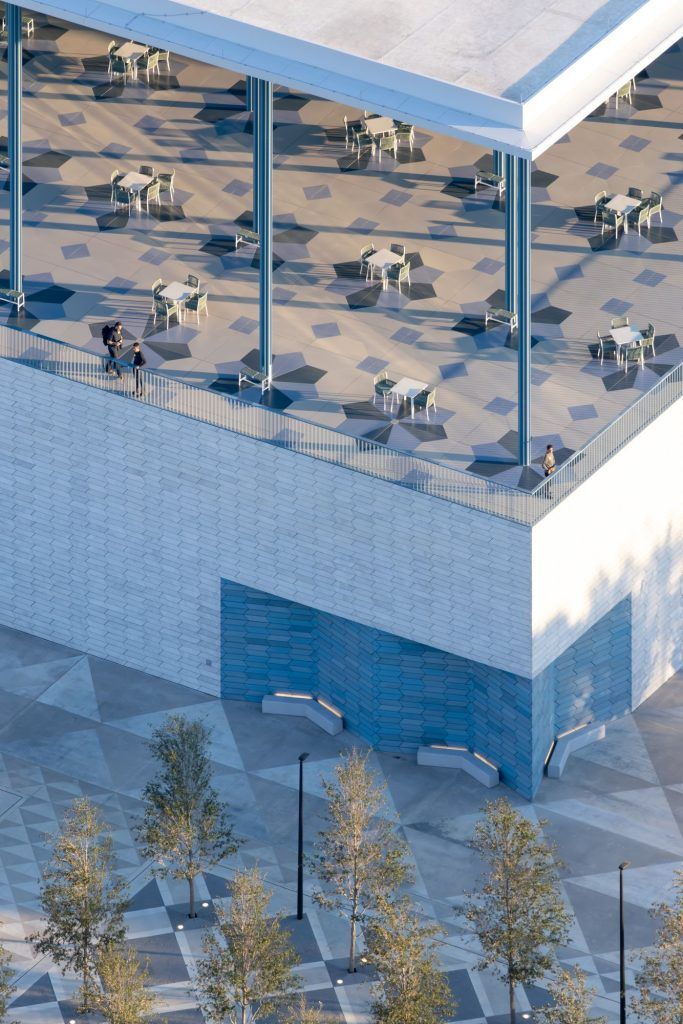
The estimated $170 million project sits at the intersection of Allen Parkway and Montrose Boulevard, within walking distance of the Rothko Chapel and the Menil Collection — Houston’s spiritual-artistic corridor.

That spirit will be tested. In recent months, Governor Greg Abbott has come under fire for launching a campaign to halt construction of a proposed Islamic-planned community near Dallas, drawing accusations of Islamophobia from faith leaders and civil-rights groups (Houston Chronicle). Elsewhere, redistricting maps have cut Black and Latino representation in Houston by half, prompting protests by local clergy and activists (Houston Chronicle).

Amid this climate, a Muslim-led institution dedicated to “shared human values” carries political resonance. The Ismaili Center, Houston, designed by London-based architect Farshid Moussavi and landscape architect Thomas Woltz, aims to model pluralism through design witnessed by open courtyards, shaded eivans (verandas), and gardens meant for dialogue, art, and quiet reflection.

ismaili center houston architecture, ismaili center houston gardens, farshid moussavi building design, thomas woltz landscape, aga khan green building, houston buffalo bayou skyline, islamic modern architecture texas, sustainable civic center houston, reflecting pool ismaili center, aga khan development network, faith based architecture, pluralism in texas, eco architecture houston, islamic art design usa, houston cultural corridor, farshid moussavi architect, thomas woltz nelson byrd woltz, greenwashing architecture, aga khan award sustainability, houston civic landmark

The building’s green credentials are strong — at least on paper. Rising above the 500-year floodplain, its underground garage doubles as a flood reservoir. The 11-acre landscape slopes gently toward the Bayou, channeling runoff through terraces, reflecting basins, and flood-adaptive gardens. It’s parking lot underground can hold runoff in the case of a flood.

Woltz calls it “a transect of Texas,” planted with desert agave, prairie grasses, and Gulf Coast reeds — a living metaphor for ecological and cultural adaptation.

Materials were chosen for longevity — stone, steel, and ultra-high-performance concrete with a 100-year life cycle. Natural light filters through perforated screens that recall Persian craft traditions. The design philosophy echoes the global movement for regenerative Islamic architecture explored in Green Prophet’s stories on Hassan Fathy’s legacy and green architecture across MENA.

Ismaili center concrete


The Shadow of Aga Khan Greenwashing

ismaili center houston architecture, ismaili center houston gardens, farshid moussavi building design, thomas woltz landscape, aga khan green building, houston buffalo bayou skyline, islamic modern architecture texas, sustainable civic center houston, reflecting pool ismaili center, aga khan development network, faith based architecture, pluralism in texas, eco architecture houston, islamic art design usa, houston cultural corridor, farshid moussavi architect, thomas woltz nelson byrd woltz, greenwashing architecture, aga khan award sustainability, houston civic landmark

The Aga Khan Development Network (AKDN), which oversees the Ismaili Centers and funds the prestigious Aga Khan Award for Architecture, has faced increasing scrutiny over how it markets “sustainability.”

Green Prophet’s recent investigation, “When Greenwashing Overwrites Ecology at the Superadobe Majara Residence”, questioned the ecological validity of one of the Aga Khan Award’s 2025 winners in Iran. That project — celebrated for its earthy “superadobe” domes — was found to rely heavily on unsustainable materials, tourist economics, and a romanticized desert aesthetic. They did not reply to our questions and ignored an Iranian architect Ronak Roshan who embodies ecological integrity above all in her practice.

Another Green Prophet piece on the 2025 Aga Khan Architecture Winners argued that the Award risks functioning as a form of cultural branding — celebrating Islamic modernity while skimming over deeper environmental costs and issues. These critiques raise a question for Houston: will this Center be an authentic green civic landmark, or a monumental case study in eco-optics and religious politics?

As we’ve explored in “Saudi Greenwashing at NEOM” and “UAE Green Finance and COP29”, even projects wrapped in the language of sustainability can mask carbon-heavy construction and elitist urbanism.

A Real Test of “Faith in Practice”
ismaili center houston architecture, ismaili center houston gardens, farshid moussavi building design, thomas woltz landscape, aga khan green building, houston buffalo bayou skyline, islamic modern architecture texas, sustainable civic center houston, reflecting pool ismaili center, aga khan development network, faith based architecture, pluralism in texas, eco architecture houston, islamic art design usa, houston cultural corridor, farshid moussavi architect, thomas woltz nelson byrd woltz, greenwashing architecture, aga khan award sustainability, houston civic landmark

Unlike many mosques or churches, the Ismaili Center Houston explicitly presents itself as civic infrastructure: a place for performances, classes, and lectures, with a café and art exhibitions open to all. The Aga Khan center does the same in Toronto. Yet when we see the way a dominant group politically includes projects with little merit for the sake of politics, we believe this is more politics and optics than true pluralism.

The Aga Khan’s global network has a record of genuine impact — funding hospitals, universities, and rural-resilience projects from East Africa to Pakistan. Yet critics note a lack of public reporting on carbon metrics or third-party audits.

If the Ismaili Center Houston truly evolves into a community green hub — hosting lectures on climate justice, native gardening workshops, or open dialogues on the energy transition — it could redefine how faith institutions serve cities in crisis. But given the rise of antisemitism across the United States and Canada, much of it fueled by extremist rhetoric, it’s fair to ask whether this is also a political project dressed in the language of pluralism. If its lush gardens and polished stone remain mostly symbolic, the Center risks becoming yet another addition to the Aga Khan’s portfolio of beautifully designed but tightly managed “sustainable” showcases.

Whether the Ismaili Center becomes a true model for green faith architecture or just another chapter in the Aga Khan’s controversial brand of eco-diplomacy will depend on what happens after the press photos fade.

Karin Kloosterman
Karin Kloostermanhttp://www.greenprophet.com
Karin Kloosterman is an award-winning journalist, innovation strategist, and founder of Green Prophet, one of the Middle East’s pioneering sustainability platforms. She has ranked in the Top 10 of Verizon innovation competitions, participated in NASA-linked challenges, and spoken worldwide on climate, food security, and future resilience. With an IoT technology patent, features in Canada’s National Post, and leadership inside teams building next-generation agricultural and planetary systems — including Mars-farming concepts — Karin operates at the intersection of storytelling, science, and systems change. She doesn’t report on the future – she helps design it. Reach out directly to [email protected]

Read More

TRENDING

10 Amazing Facts About the Sidr Tree

Most people in the West have never heard of the Sidr tree. That's strange when you think about it. This tough, thorny desert tree has fed people, bees, birds, and camels for thousands of years. It appears in Islamic tradition. Its honey sells for astonishing prices.

Farmer Focus Sold as Humane and Halal. PETA Says the Reality Is Far Less Ethical

According to documents obtained by PETA, and sent to Green Prophet, Farmer Focus accumulated 40 violations from the Harrisonburg-Rockingham Regional Sewer Authority between January and March 2026 for overly acidic wastewater and excessive pollutant levels.

Al-Khidr: Islam’s Original Green Prophet

Long before "sustainability" entered the modern lexicon, Islamic tradition had its own ecological saint. His name is Al-Khidr — The Green One. He appears briefly in the Quran, yet his presence has shaped Islamic thought, Sufi mysticism, and folk tradition across fourteen centuries. Today, he's emerging as an unexpected symbol for Muslims thinking seriously about the environment.

Muslim vegetarians? More young Muslims are saying yes

The halal food market is now worth trillions globally, and companies are beginning to notice growing demand for halal-certified vegetarian and vegan products.

AI data centers are triggering panic, instead of cleantech opportunities

AI may unintentionally become the economic engine that finally modernizes America’s aging grid. California is experiencing a massive AI data center boom, ranking 3rd in the U.S. with 227 operating centers and 54 more in development as of April 2026, according to Stanford.

Locals From Rishon Fight IKEA

Big Box stores are a pretty new concept in Israel, and thank God that not every Israeli city wants them in their backyard. A word from someone who has see the beautiful farmland around her hometown Newmarket, Ontario stripped and converted into vulgar strip malls of big box shops: they have no place in a healthy and sustainable town or city.

The Jewish National Fund Meets An Inconvenient Truth

According to the JNF, it has transformed thousands of acres of barren land into green forests in Israel. They state that each person emits about 23 tons of carbon per year, estimating that each tree planted can absorb one ton of carbon in its lifetime. That's a whole lot of trees you'd need to be planting. Could so many fit in Israel?

How to quiet noise from construction in your office

Streets need to be resurfaced in New York but the humming and grinding noise is unsettling. Noise is environmental pollution. 

EarthX and a blueprint for sustainable investing

Trammell S. Crow, a Dallas-based businessman and father of four, is focusing his efforts on impact investing, and media that focuses on saving the planet through EarthX.

Mining Afghanistan’s Mineral Discoveries Similar to Avatar

Now that American forces in Afghanistan are commemorating the longest period of any war that America has been involved in, including the 1965-73 Vietnam War, the recent discoveries of large and extremely valuable mineral and metal deposits may finally bring to light a reason to continue the presence of US fighting forces in this war torn and backward country.

From Pilot Plant to Global Stage: How Aduro Clean Technologies’ 2026 Expansion Signals a Turning Point for Chemical Recycling Investors Like Yazan Al Homsi

The company's Next Generation Process (NGP) Pilot Plant in London, Ontario, has officially moved into initial operating campaigns, generating the kind of structured, repeatable data that separates laboratory promise from commercial viability.

Nobul’s Regan McGee on Shareholder Value: “Complacency Is the Silent Killer” 

Why the governance framework designed to protect shareholders so...

Should You Invest in the Private Market?

startustartup Unlike public stock exchanges, which offer daily trading, strict...

Popular Categories