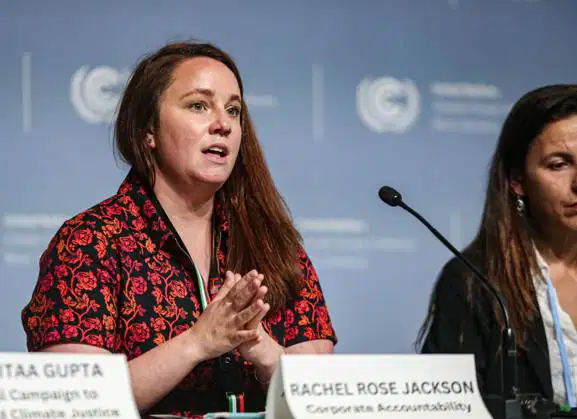
Is COP30 intentionally confusing and opaque so the public can’t see how Global North countries and big polluters block real climate action. This is the argument of Rachel Rose Jackson, Director of Climate Research and Policy at Corporate Accountability. Behind closed doors, she asserts, wealthy nations avoid paying climate debt while expanding fossil fuels, and fossil fuel lobbyists flood the negotiations. The result is an artificial COP bubble disconnected from real-world climate crises, designed to protect polluters rather than people.
Here is her piece.
“If you’re finding it almost impossible to track and understand the finer details of what is happening across the negotiating rooms of COP30, you are not alone. It’s tediously technical, and at best very confusing. This is by design. It’s all part of a carefully orchestrated plan to distance every day humans from what happens here, to construct veils of secrecy, and to create a fake, alternate universe that spurs a complete disconnect from the reality of the world that we’re all living and the climate crisis that we’re all experiencing outside of these halls.
This is an intentional plan to distract and distance from the typhoons that are currently happening in the Philippines while we are here, where hundreds of people are dying, and many activists here are not even sure if their families are safe or if they’ll come home to a community that was the same as when they left. This is a plan to create intentional disconnect from the trillions of dollars that are being spent annually on war and fossil fuel violence in places like Palestine. From the wildfires, from the floods, from the grabbed lands, from the harm caused all around the world by the very same actors that are here creating this disconnect.
It is not a coincidence that it is so difficult to track the inner workings of COP30. This carefully orchestrated illusion is crafted by the very same countries that are most responsible for climate change and most responsible for the past three decades of blocking progress to address it. I’m talking about Global North– the countries whose economies have gotten rich off fossil fuels, extracting and burning and profiting at the expense of people across the world, particularly Global South communities, frontline communities, and Indigenous Peoples.
In clearer terms, here’s what’s happening behind the doors of COP30. The systematic denial of the trillions of dollars that is overdue in climate debt by the Global North to communities in the Global South who are hit hardest and worst. This debt is not charity, it’s not kindness, it’s owed, and it’s long overdue. There’s then the thorough withdrawal of all other forms of meaningful finance that have the chance to become public and people-centered, on one hand, and the rolling out and ramping up of carbon markets and other ‘carbon finance’ schemes that allow the Global North and Big Polluters to continue profit off of polluting the planet. And then, the pretense of the TFFF, which is riddled with loopholes and is another attempt to profit off of nature. All of this while at home, these same Global North countries are proclaiming climate championship while doing very little to decrease emissions or to do their fair share of climate action. Instead, they are actually scaling up fossil fuel production.
Last week, research by Oil Change International showed that just four Global North countries have derailed an oil and gas phase out since the Paris Agreement. This quartet increased their oil and gas production by 40% between when the Paris Agreement was agreed and last year. In this same period, the rest of the world had a combined oil and gas decrease of 2%. These planet wrecking climate blockers are Canada, Australia, Norway, and the United States.
Which brings me to the United States. They’re not at COP30, right? Incorrect. Let’s be clear, the United States has always been the largest blocker of climate action at home and abroad, the largest polluter, and the biggest bully. They may not be officially at COP30, but they are very much undermining action. And the fact that they don’t have an official delegation doesn’t change that.
The United States is here as the biggest donor to the World Bank, which is now the interim trustee and host of both the TFFF as well as the Loss and Damage Fund. So they hold the purse strings to some of the biggest parts of climate action. And at home, they’re also using tariffs and economic sanctions to weaponize climate action and to prevent other countries from being able to take the action they need domestically to respond to the climate crisis. So the US is very much here. They’ve taken off the gloves and they’re ready to throw down, as are their other fight club buddies Canada, Australia, Norway, and the EU.
In addition, it’s also really important we understand that it is not only countries who are being invited to COP30 to do dirty. Kick Big Polluters Out just released exposing that there are more than 1,600 fossil fuel lobbyists at COP30. Thats means 1 out of 25 participants is advancing a fossil-fueled agenda, outnumbering delegates from the Philippines from 50 to one and delegates from Jamaica 40 to one. Big Polluters are overrunning this place. They are everywhere. They’re whispering in the ears of delegates. They are in rooms that even civil society doesn’t have access to. And just 90 of these oil and gas corporations that have attended COP26-COP29 are responsible for nearly 60% of oil and gas production in 2024.
So as we head into the final days of these critical talks, and while the climate crisis impacts people all around the world, we want to know what are Big Polluters doing here? And if Global North countries aren’t getting serious about doing their fair share of climate action, why are they wasting our time? As the window COP 30 starts to wind down, so-called world leaders mustIt’s time to step up. It’s time to Kick Big Polluters Out. It’s time for Global North countries to do their long-overdue fair share of climate action, to justly end fossil fuels, and to crack open that disconnect between the real world that’s outside these halls and the carefully orchestrated artificial universe inside these halls.”