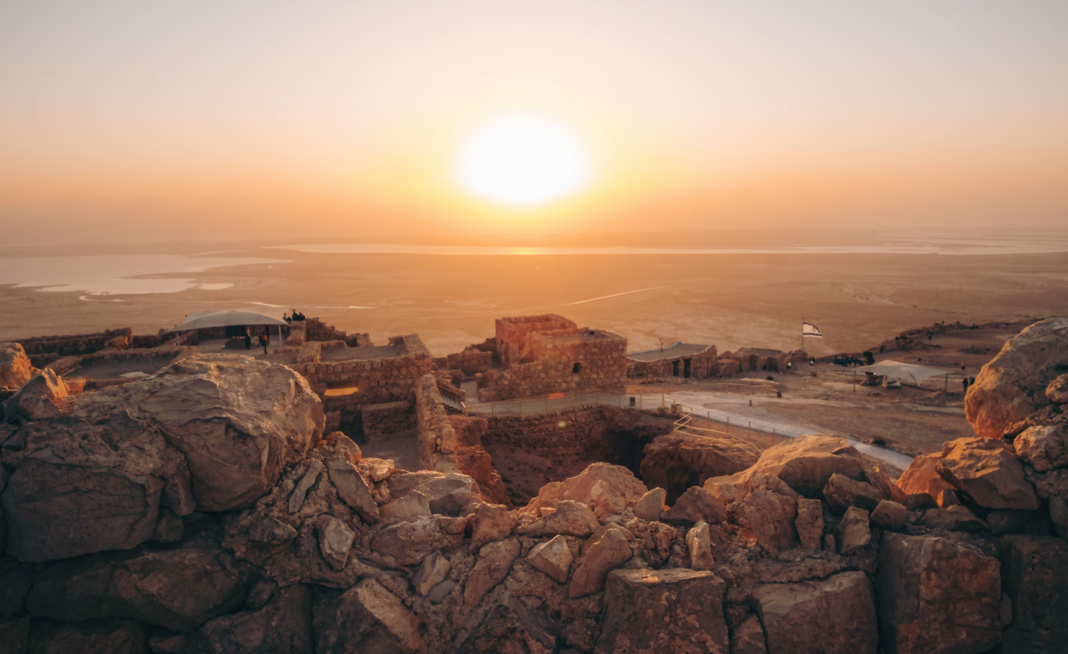


It’s down in the history books of legends. How could the Jews hold onto the fortress of Masada for years without food and water? According to the common myth, the Romans laid siege to the Dead Sea fortress of Masada for three long years. A new survey using advanced technologies indicates that the siege was probably a much quicker affair: more like weeks.
Researchers in Archaeology at Tel Aviv University used a range of modern technologies, including drones, remote sensing, and 3D digital modeling, to generate the first objective, quantified analysis of the Roman siege system at Masada.
Findings indicate that contrary to the widespread myth, the Roman army’s siege of Masada in 73 CE lasted no more than a few weeks.
The study was conducted by Guy Stiebel, together with Hai Ashkenazi to attempt a new understanding of what really happened at Masada. The paper was published in the Journal of Roman Archaeology.
Why the siege against the Jews started?
The First Jewish Revolt against the Romans started in 66 CE after years of political instability. One of the first acts in this war was the seizure of Masada from its Roman garrison by a group of Jewish rebels. At the beginning of the rebellion, the Jewish forces managed to defeat an army led by Cestius Gallus, the governor of Syria.

Later, after suffering heavy losses in the field, and following the arrival in 67 CE of a second expedition led by Vespasian and his son Titus, the local militias usually avoided meeting the Roman forces in the field and took shelter in fortified towns and forts, most of which had been built during previous periods.
This led to a war characterized mainly by Roman siege warfare. Several years of careful Roman advance culminated in the siege of Jerusalem in 70 CE, and though the Romans faced bitter resistance from the city’s defenders, the city was conquered and destroyed within that same year.
Read related: ancient date from Masada sprouts after 2000 years
About three years later, the Romans followed the remaining rebels to their last stronghold – Masada. The amount of effort invested by the Romans in chasing these last few hundred rebels to their final refuge in the middle of the desert may seem surprising.
Some researchers argue that it was done in order to completely assert Roman rule over the country, to send a message to other potential rebels, and to “restore the impression of Roman might”; others have recently claimed that the Romans’ aim was to protect the valuable Balsam (opobalsamum) perfume production center at the nearby oasis of Ein Gedi.

The researchers used drones carrying remote sensors that provided precise, high-resolution measurements of the height, width, and length of all features of the siege system. This data was used to build an accurate 3D digital model, enabling exact calculation of the structures’ volume and how long it took to build them.
Researcher Stiebel says: “We use drones, remote sensing, and aerial photography to collect accurate high-resolution data from Masada and its environs, with special emphasis on three aspects: the water systems, the trails leading to and from the palatial fortress, and the Roman siege system.
“The collected information is used to build 3D digital models that provide us with a clear and precise image of the relevant terrains. In the current study we focused on the siege system, which, thanks to the remote location and desert climate, is the best-preserved Roman siege system in the world.”
Dr. Stiebel adds: “For many years, the prevailing theory that became a modern myth asserted that the Roman siege of Masada was a grueling three-year affair. In recent decades researchers have begun to challenge this notion, for various reasons. In this first-of-its kind study we examined the issue with modern technologies enabling precise objective measurements.”

Reliable estimates are available of the quantity of earth and stones a Roman soldier was able to move in one day, the researchers explain. Ashkenazi says: “We also know that approximately 6,000-8,000 soldiers participated in the siege of Masada. Thus, we were able to objectively calculate how long it took them to build the entire siege system – eight camps and a stone wall surrounding most of the site.
“We found that construction took merely about two weeks. Based on the ancient historical testimony it is clear that once the assault ramp was completed, the Romans launched a brutal attack, ultimately capturing the fortress within a few weeks at the most.
“This leads us to the conclusion that the entire siege of Masada lasted no more than several weeks.”
Says Stiebel: “The narrative of Masada, the Great Jewish Revolt, the siege, and the tragic end as related by Flavius Josephus, have all become part of Israeli DNA and the Zionist ethos, and are well known around the world. The duration of the siege is a major element in this narrative, suggesting that the glorious Roman army found it very difficult to take the fortress and crush its defenders.
“For many years it was assumed that the siege took three long years, but in recent decades researchers have begun to challenge this unfounded belief. In our first-of-its-kind study we used objective measurements and advanced technologies to clarify this issue with the first data-driven scientific answer.
“Based on our findings we argue that the Roman siege of Masada took a few weeks at the most. As empires throughout history have done, the Romans came, saw, and conquered, quickly and brutally quelling the uprising in this remote location.
“Our conclusion, however, detracts nothing from the importance of this historical event, and many baffling questions remain to be investigated.
“For example: Why did the Romans put so much effort into seizing this remote and seemingly unimportant fortress? To answer this and many other intriguing questions we have initiated a vast, innovative project in and around Masada … to ultimately shed new light on the old enigma: What really happened at Masada?”