
AI could be the key to protecting our solar-powered future — making grids smarter, safer, and resilient against blackouts and cyberattacks.
Elon Musk has been saying it for years and it’s something that solar power pioneers already know: the sun has enough energy to power all of our energy needs. The problem is limited not only by making sure that people get the technology to harvest the sun on solar panels, but in cities and urban centers one of the biggest issues is storage and what to do with a surplus of energy when the sun shines? Consumers and businesses, when they can, typically shoot back the energy to the grid where they earn money or credits for what they’ve contributed.
But electricity grids can’t always handle excessive or varying amounts of energy. It’s a complicated switchboard that can be overloaded during extreme heat waves when everyone turns on their air conditioners. Energy managers want to make the grids most efficient and mixed with the least carbon intensive energy sources, but how? And what about cyber attacks that can bring down an entire nation’s power like what happened in Spain and Portugal this year. A team of scientists say they can predict attacks and blackouts, making the grid more resilient –– and they are using AI.
Related: Maria Telkes, solar over and solar home energy pioneer
Researchers at Sandia National Laboratories have developed brain-inspired AI algorithms that detect physical problems, cyberattacks and both at the same time within the grid. And this neural-network AI can run on inexpensive single-board computers or existing smart grid devices.
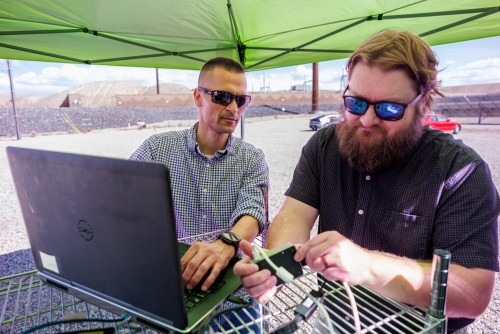
“As more disturbances occur, whether from extreme weather or from cyberattacks, the most important thing is that operators maintain the function and reliability of the grid,” said Shamina Hossain-McKenzie, a cybersecurity expert and leader of the project. “Our technology will allow the operators to detect any issues faster so that they can mitigate them faster with AI.”
The importance of cyber-physical protection

As the United States adds more smart controls and devices to the grid, it becomes more flexible and autonomous but also more vulnerable to cyberattacks and cyber-physical attacks. Cyber-physical attacks use communications networks or other cyber systems to disrupt or control a physical system such as the electric grid. Potentially vulnerable equipment includes smart inverters that turn the direct current produced by solar panels and wind turbines into the alternating current used by the grid, and network switches that provide secure communication for grid operators, said Adrian Chavez, a cybersecurity expert involved in the project.
Because the neural network can run on single-board computers, or existing smart grid devices, it can protect older equipment as well as the latest equipment that lack only cyber-physical coordination, Hossain-McKenzie said.
Related: Could AI save Ivanpah from shutting down?
“To make the technology more accessible and feasible to deploy, we wanted to make sure our solution was scalable, portable and cost-efficient,” Chavez said.
The package of code works at the local, enclave and global levels. At the local level, the code monitors for abnormalities at the specific device where it is installed. At the enclave level, devices in the same network share data and alerts to provide the operator with better information on whether the issue is localized or happening in multiple places, Hossain-McKenzie said.
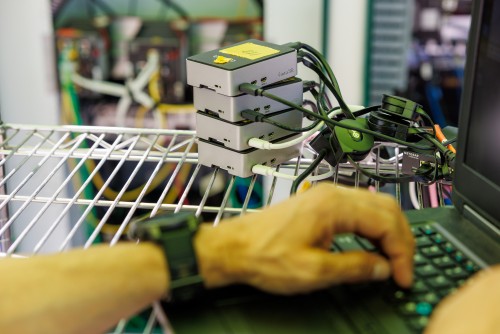
At the global level, only results and alerts are shared between systems owned by different operators. That way operators can get early alerts of cyberattacks or physical issues their neighbors are seeing but protect proprietary information.
The Sandia team collaborated with experts at Texas A&M University to create secure communication methods, particularly between grids owned by different companies, Hossain-McKenzie said.
The biggest challenge in detecting cyber-physical attacks, or if we go further to predicting major power outages from over-use, is combining the constant stream of physical data with intermittent packets of cyber data, said Logan Blakely, a computer science expert who led development of the AI components.
Physical data such as the frequency, voltage and current of the grid is reported 60 times a second, while cyber data such as other traffic on the network is more sporadic, Blakely said. The team used data fusion to extract the important signals in the two different kinds of data.
Then the team used an autoencoder neural network, which classifies the combined data to determine whether it fits with the pattern of normal behavior or if there are abnormalities with the cyber data, physical data or both, Hossain-McKenzie said. For example, an increase in network traffic could indicate a denial-of-service attack while a false-data-injection attack could include atypical physical and cyber data, Chavez said.
Unlike many other kinds of AI, autoencoder neural networks do not need to be trained on data labeled with every type of issue that may show up, Blakely said. Instead, the network only needs copious amounts of data from normal operations for training.
The use of an autoencoder neural network makes the package pretty much plug and play, Hossain-McKenzie added.
Once the team constructed the autoencoder neural network, they put it to the test in three different ways.
First, they tested the autoencoder in an emulation environment, which includes computer models of the communication-and-control system used to monitor the grid and a physics-based model of the grid itself, Hossain-McKenzie said. The team used this environment to model a variety of cyberattacks or physical disruptions, and to provide normal operational data for the AI to train on.
Then the team incorporated the autoencoder onto single-board computer prototypes that were tested in a hardware-in-the-loop environment, Hossain-McKenzie said. In hardware-in-the-loop testing, researchers connect a real piece of hardware to software that simulates various attack scenarios or disruptions. When the autoencoder is on a single-board computer, it can read the data and implement the algorithms faster than a virtual implementation of the autoencoder can in an emulation environment, Chavez said. Generally, hardware implementations are a hundred or thousand times faster than software implementations, he added.
The team is working with Sierra Nevada Corporation to test how Sandia’s autoencoder AI works on the company’s existing cybersecurity device called Binary Armor, Hossain-McKenzie said.
“This will give a really great proof-of-concept on how the technology can be flexibly implemented on an existing grid security ecosystem,” she said.
The team is testing both formats — single-board prototypes interfaced with the grid and the AI package on existing devices — in the real world at the Public Service Company of New Mexico’s Prosperity solar farm as part of a Cooperative Research and Development Agreement, Hossain-McKenzie said. These tests began last summer, Chavez said.
“There’s nothing like going to an actual field site,” Chavez said. “Having the ability to see realistic traffic is a really great way to get a ground-truth of how this technology performs in the real world.”
The team also worked with PNM early in the project, to learn what AI design might be most useful for grid operators. It was during conversations with PNM staff that the Sandia team identified the need to connect cyber-defenders with system operators rapidly and automatically.