Who was Mária Telkes, the solar energy Sun Queen?

Mária Telkes, solar energy pioneer

Mária Telkes, a solar energy pioneer. The Hungarian-American biophysicist and inventor Mária Telkes pioneered solar energy by inventing a solar oven, a solar desalination kit and, in the late 1940s, she helped design one of the first solar-heated houses.

Mária Telkes, born on December 12, 1900, in Budapest, Hungary, emerged as a solar energy pioneer long before the world would turn to renewable energy. She invented a solar oven, a solar desalination kit and, in the late 1940s, she helped design one of the first solar-heated houses. She is known as the Sun Queen.


Telkes, who came from a Jewish family that converted to Christianity, studied at the University of Budapest and then later in Switzerland at the University of Geneva where she mastered chemistry and physics, and earned a Ph.D. in 1924.

In 1925, while visiting her uncle in Cleveland, USA, she worked along the renowned surgeon George Washington Crile who performed the first successful blood transfusion.

Telkes dedicated the next 12 years of her life to researching the energy changes cells undergo during death or cancer, resulting in the publication of their findings in a collaborative book.

Upon becoming an American in 1937, Telkes joined Westinghouse Electric, where her focus shifted towards solar energy in 1939 upon becoming a member of the Massachusetts Institute of Technology’s (MIT) Solar Energy Conversion project.

As the world grappled with the Second World War, Telkes was enlisted by the Office of Scientific Research and Development (OSRD), which worked on the Manhattan Project. Her task was to leverage solar energy to transform salty water into drinkable water, addressing the critical issue of dehydration faced by soldiers at sea.
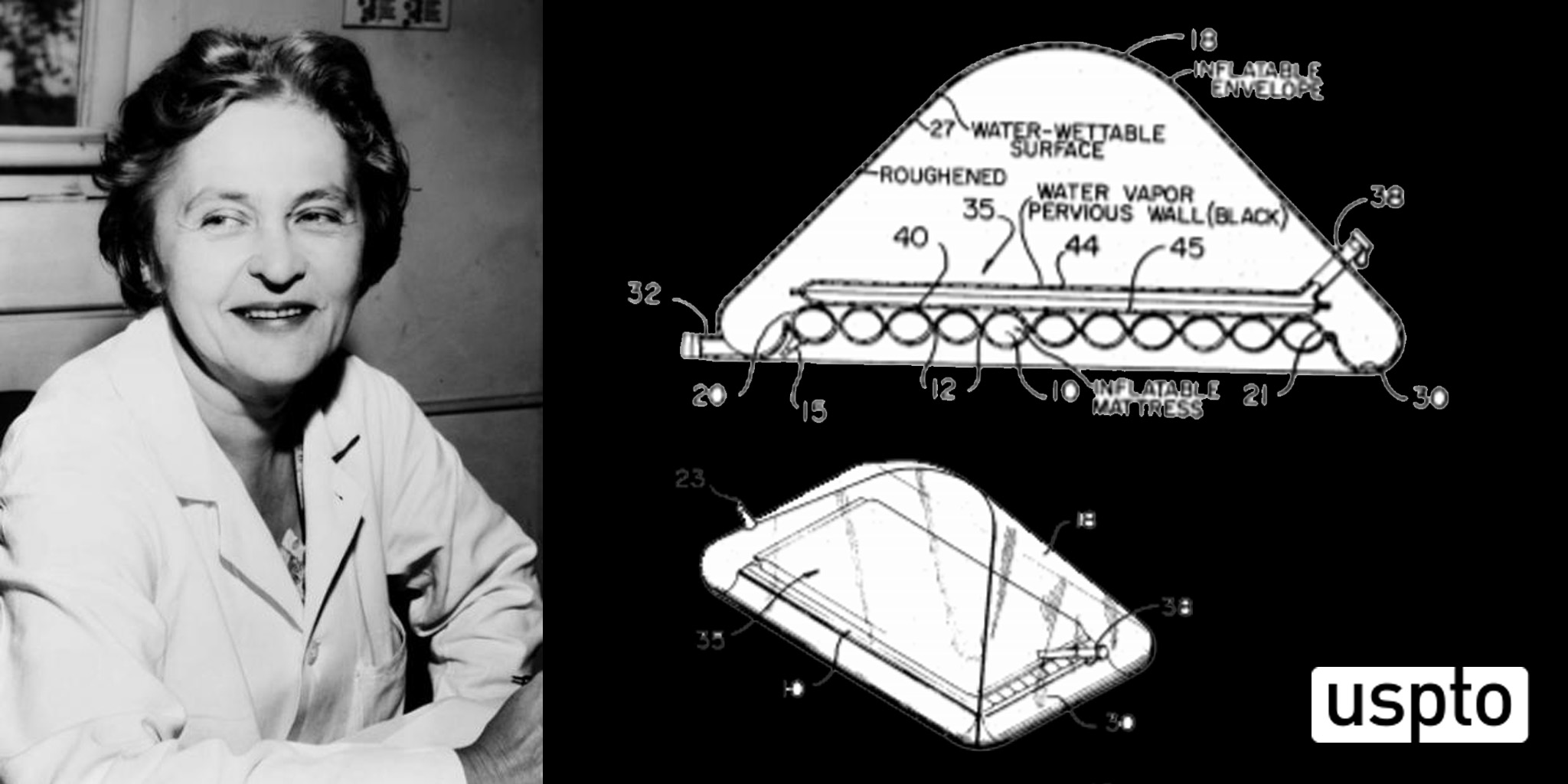
Maria Telkes invention so soldiers could drink water at sea
Maria Telkes solar energy invention so soldiers could drink water at sea

In response, Telkes invented the first solar water distillation device, capable of producing one liter of drinkable water per day using seawater. This innovation quickly became a standard component in every soldier’s pack, earning her a merit from OSRD for her invaluable contribution.
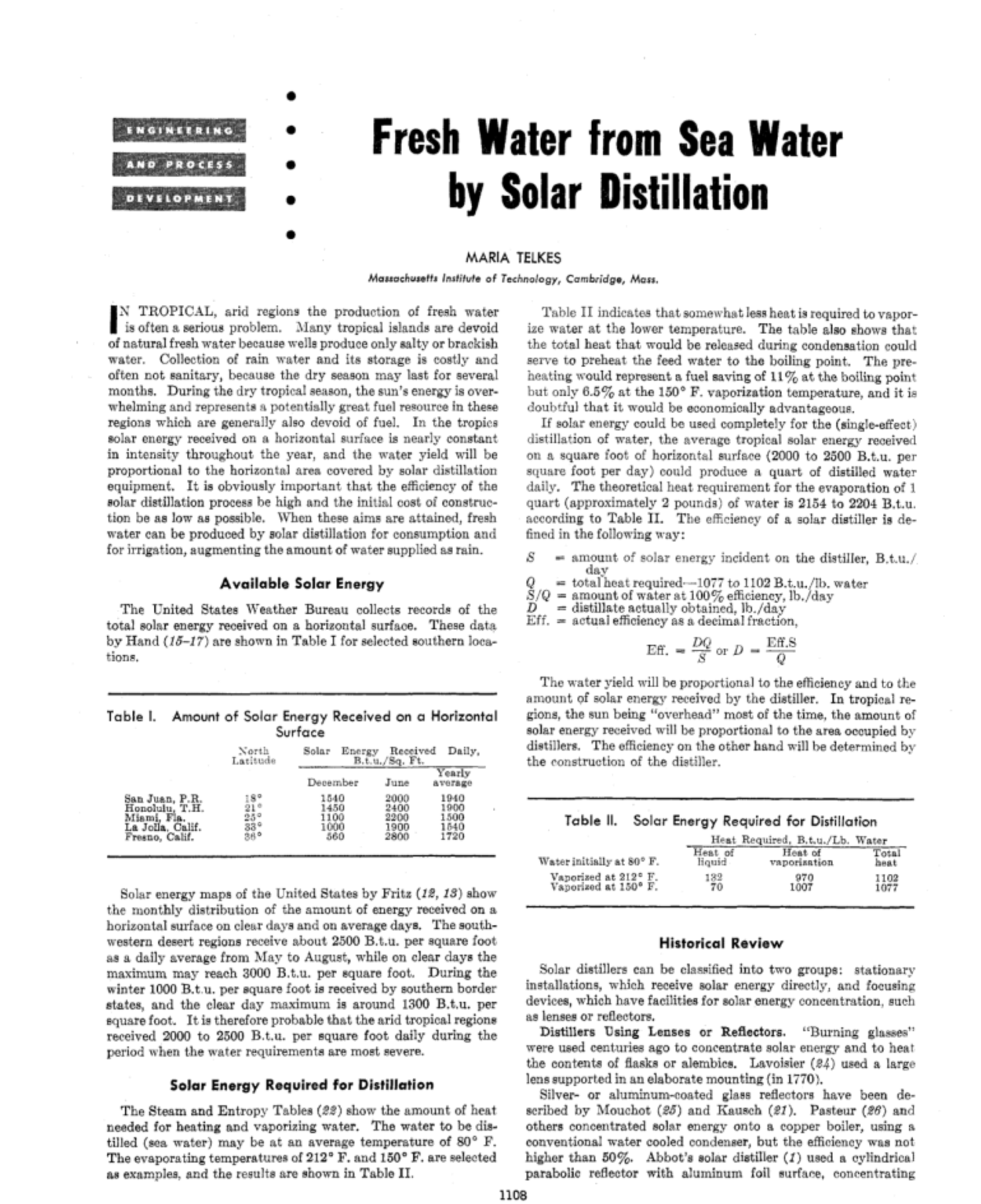
Maria Telkes saltwater sea solar energy paper
Maria Telkes dscribed the science of solar desalination in this paper from 1953

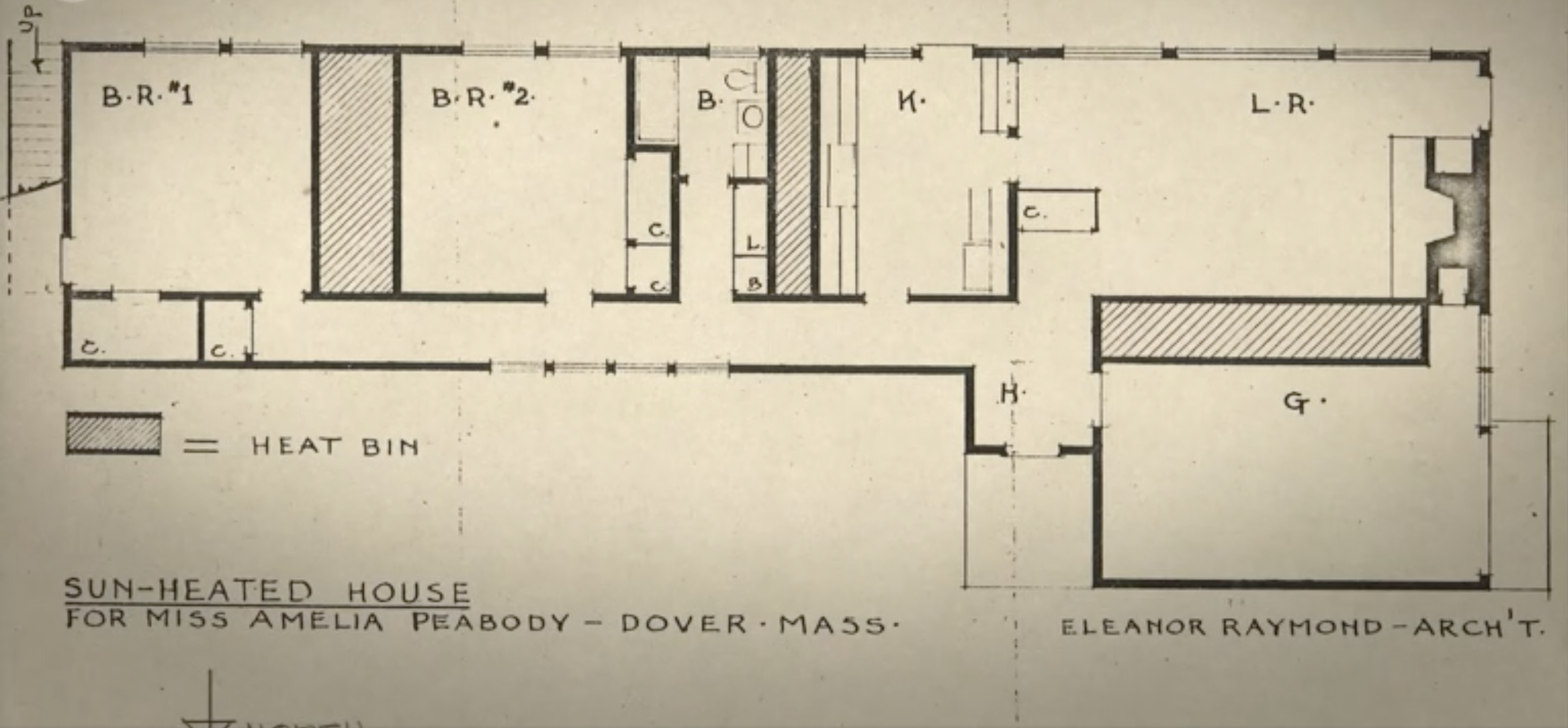
However, Telkes’ most renowned invention was the creation of the first solar house in 1948, the Dover Sun House, near Boston, designed by Eleanor Raymond and tested by the Némethy family, Telkes’ relatives.

Maria Telkes and the Dover Sun House image
Maria Telkes and the Dover Sun House. The large windows faced the sun and collected heat and stored the energy in salts. Dover Sun House was one of the world’s first solar-heated houses. It was designed by architect Eleanor Raymond and had a heating system developed by physicist Mária Telkes. Client Amelia Peabody made it noteworthy for being “exclusively a feminine project.”

To tackle the challenge of storing solar energy for use on cloudy days, Telkes ingeniously employed a glauber salt solution (natrium sulfuricium) with a low melting point (32 °C) and high enthalpy of fusion, capable of storing solar energy for up to ten days.
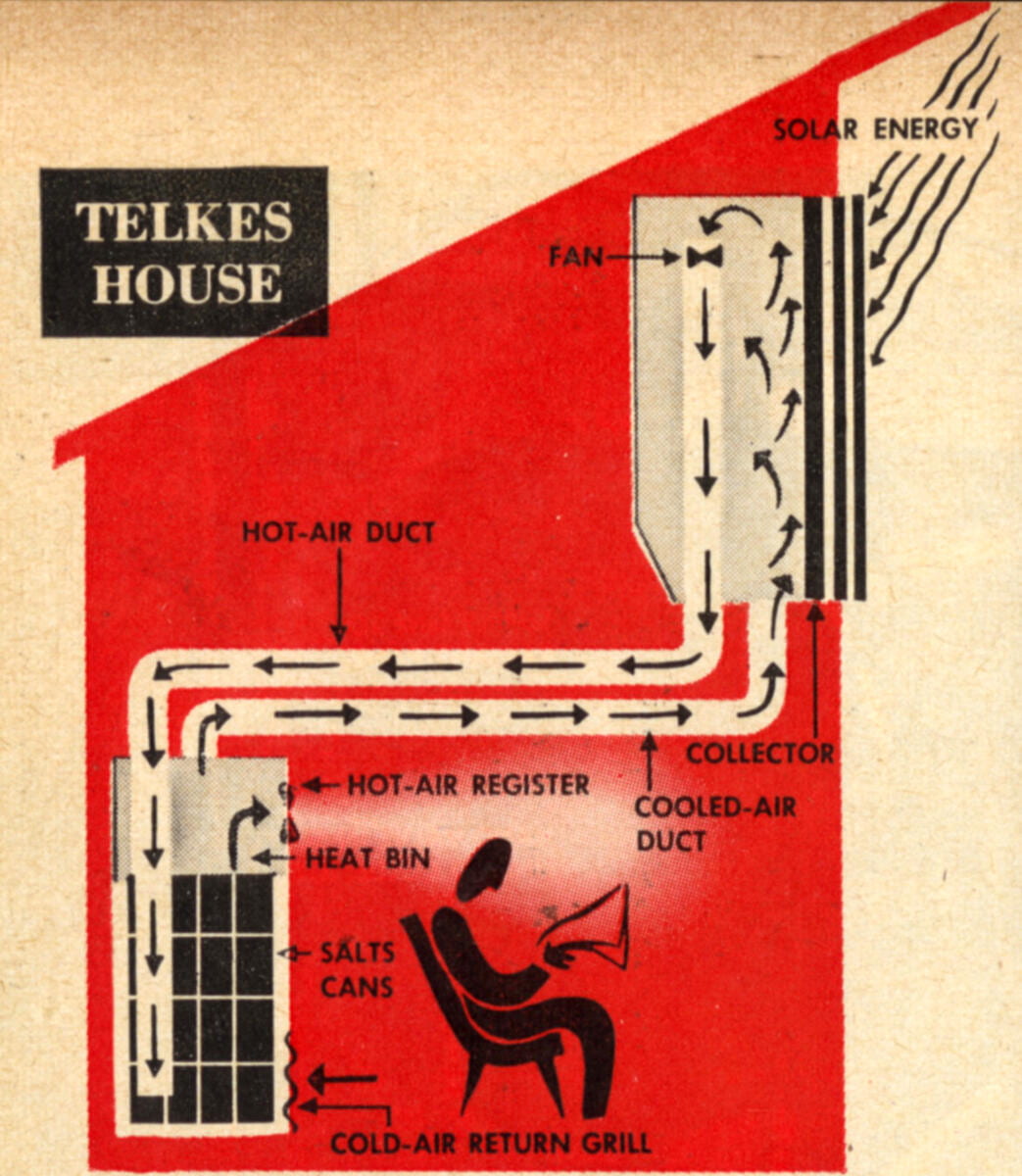

Maria Telkes and the Dover Sun House Maria Telkes and the Dover Sun House image

Despite initial challenges – the unusually cold winter of 1948 and subsequent leakage in the solution tanks in 1953 – the solar house laid the groundwork for the acceptance of solar energy as a viable heating source.
Maria Telkes outside the Dover Sun House

“It was a proof of premise, a radical idea for her to be thinking that broadly and to think that far ahead and actually create a liveable house as an experiment,” says Andrew Nemethy, who was a boy who lived in the Dover Sun House growing up. “She needed astronauts, and I guess we were the lucky ones,” he said in a PBS documentary.

This marked a significant shift, considering that sustainable development was not yet a recognized term. People began incorporating solar panels into house designs, often complemented by traditional heating systems in areas with insufficient sunny days.

The Dover Sun House was demolished in 2010. A PBS documentary explores the contribution of Telkers and the Dover Sun House that would be heated only by the sun in a New England winter.

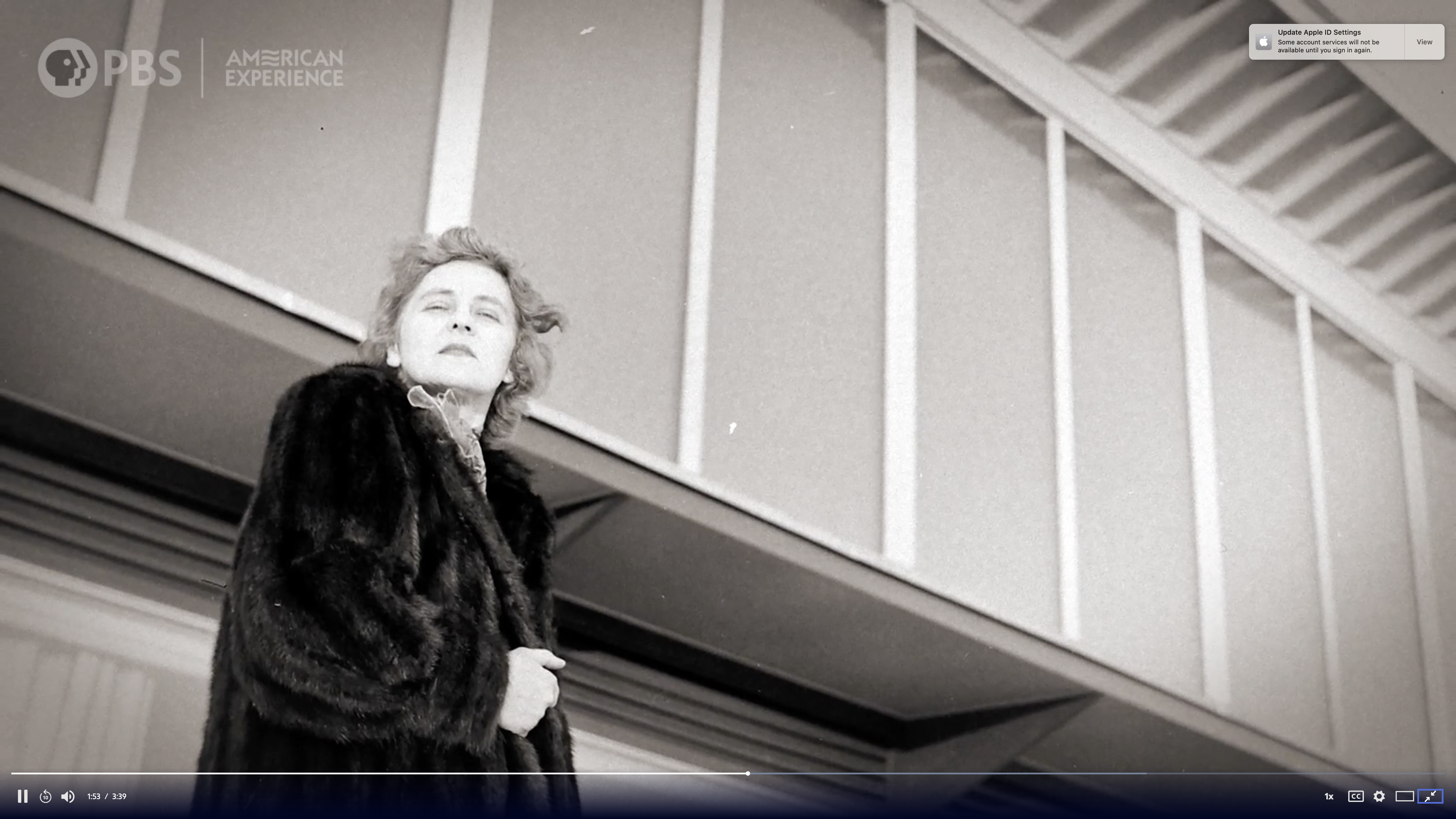
Inside the Dover Sun House. Gauber salts stored and released heat from the windows.

Maria Telkes outside the Dover Sun House
Maria Telkes outside the Dover Sun House in the PBS documentary about the Dover Sun House.

Telkes received the Society of Women Engineers Award in 1952, earning the moniker “The Sun Queen” in the United States.

In 1953, when Telkes was at New York University, she received a Ford Foundation grant to develop a solar stove that could be used in developing countries. Like the designs previous, she took a simple approach.

The stove was constructed as an insulated metal box equipped with doors on both ends, topped with glass over the food placement area. Harnessing the sun’s rays, the glass amplified their intensity, aided by four metal plates strategically angled at 60 degrees.

Maria Telkes solar cooker
Diagram of Maria Telkes solar cooker

Triangular mirrors positioned between the plates further enhanced the amplification of solar wavelengths. Remarkably, the stove could reach temperatures of 400 degrees, requiring no specialized materials for its construction and boasting an affordable price tag of merely four dollars.
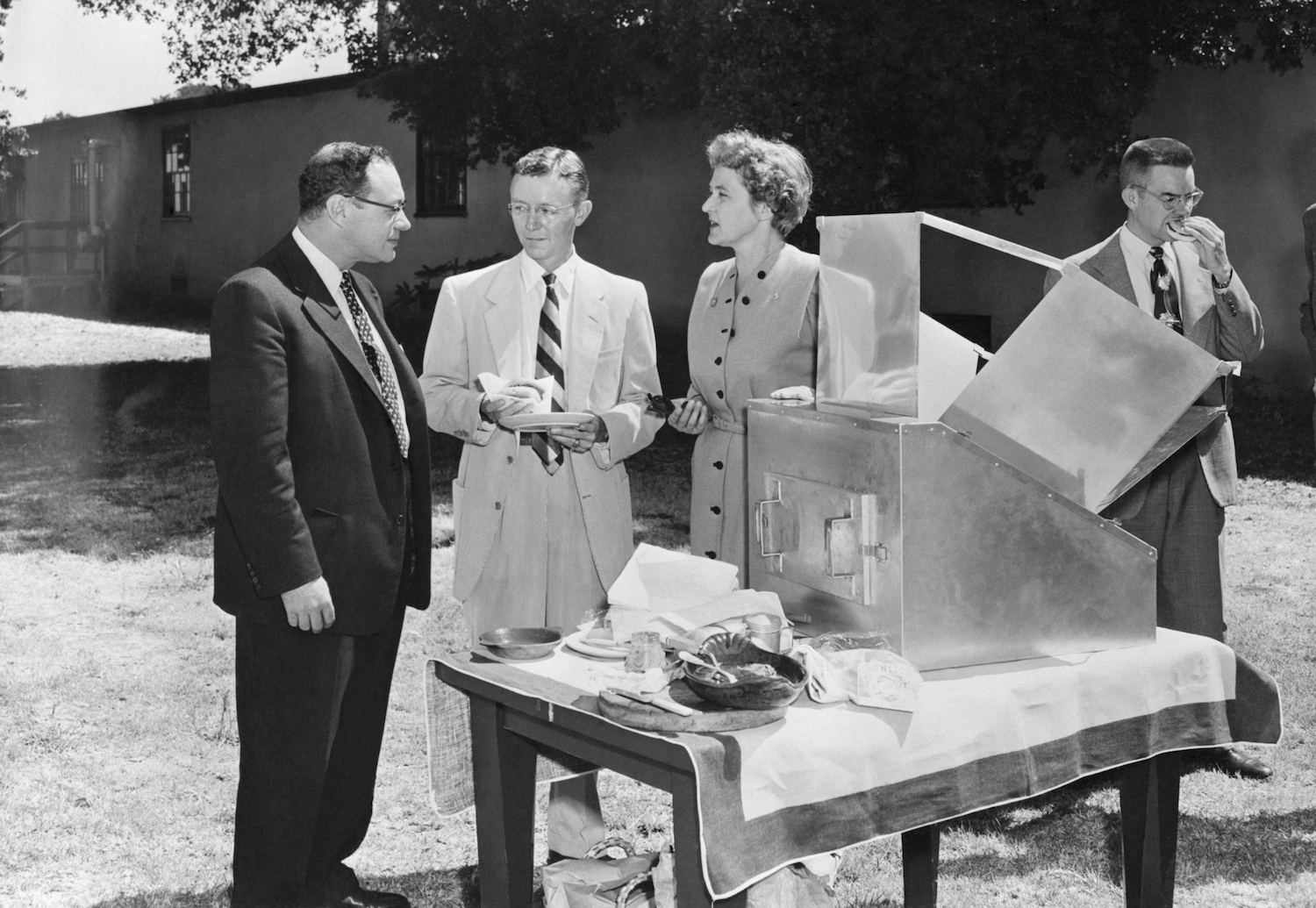
Maria Telkes and her solar cooker invention
Dr. Maria Telkes, “world’s most famous woman inventor in solar energy,” speaks with Dr. J.E. Hobson (left) and Thomas K. Hitch.

Its user-friendly design (you can download the instructions here) found a welcoming market in midcentury India, precisely the tropical climate its inventor had envisioned. Telkes enthusiastically praised its merits to a reporter during a cooking demonstration, expressing, “Everything seems to taste so much better when it is cooked by the sun.”

In 1977, the American Solar Energy Society honored her with the Charles Greeley Abbot Award. At the age of 90 in 1990, Telkes submitted her last invention, leaving an indelible mark on the field.

Returning to her hometown, Budapest, after 70 years, Telkes passed away on December 2, 1995, at the age of 94. In recognition of her unparalleled contributions, she was posthumously inducted into the National Inventors Hall of Fame in 2012, alongside physicist Dénes Gábor.

Mária Telkes’ legacy endures as an inspiration for future innovators and a testament to the transformative power of solar energy in shaping a sustainable future.

Karin Kloosterman
Karin Kloostermanhttp://www.greenprophet.com
Karin Kloosterman is an award-winning journalist, innovation strategist, and founder of Green Prophet, one of the Middle East’s pioneering sustainability platforms. She has ranked in the Top 10 of Verizon innovation competitions, participated in NASA-linked challenges, and spoken worldwide on climate, food security, and future resilience. With an IoT technology patent, features in Canada’s National Post, and leadership inside teams building next-generation agricultural and planetary systems — including Mars-farming concepts — Karin operates at the intersection of storytelling, science, and systems change. She doesn’t report on the future – she helps design it. Reach out directly to [email protected]

Read More

TRENDING

Collecting kinetic energy from roads; REPS turns traffic into a power plant

REPS announced a $23.6M equity financing round to scale...

Desalination experts debunk Aqua Solaire, the floating desalination barge

AI makes it easy to dream, develop, and create images of what could be world-changing ideas, until the reality sets in. A new project making the rounds is Aqua Solaire, an allged French concept for a solar-powered desalination vessel designed to bring drinking water to coastal communities facing drought, storms, and infrastructure failures.

Jordan’s $6 Billion Aqaba–Amman Desalination Project from the Red Sea Moves Forward

In 2025, the Jordanian government signed agreements with a consortium led by Meridiam and SUEZ, alongside VINCI Construction and Orascom Construction. Under a 30-year concession agreement, the consortium will design, build, finance, operate, and maintain the system before transferring it back to the Jordanian government. The total investment is estimated at approximately $6 billion USD.

The Saudi Startup Turning Desalination’s Toxic Waste Into Its Own Disinfectant

For millennia, the Middle East's water crisis seemed an immutable fact of geography — a region defined as much by what it lacked as by what lay beneath its sands. Today, a convergence of plummeting solar costs, advancing membrane technology, and hard-won engineering expertise is rewriting that story.

10 Proven Israeli Technologies to Help Somaliland Build Food, Water, and Energy Security

Israel’s water and agricultural technologies didn’t emerge from ideal conditions. They were developed under pressure: low rainfall, saline water, political isolation, lack of energy resources, and the constant need to feed a growing population with limited land. Over the years, I’ve written about many of these companies not as miracle-makers, but as problem-solvers. That’s what makes them relevant to places like Somaliland. Israel was the first country in the world to recognize Somaliland as an independent state although Ethiopia has been treating the nation as such for decades.

Yerukim Forms a New Green Economy Where the Money is Really Green

The Yerukim members who pick up the recyclables get to keep the monetary reward, the public earns "green" bills that can be used in shops, and business owners get to be associated with environmentalism.

Choosing Riyadh over Dubai? What Investors Should Know

Saudi Arabia is deploying capital at unmatched scale to catalyze tourism and advanced industry while rewiring its power-and-water backbone. The investable frontier is widening—especially in renewables, grid storage, water efficiency/desal retrofits, and hospitality operating platforms. Prudent investors will insist on phased delivery, enforceable KPIs (energy, water, biodiversity), and RHQ/zone compliance—while pricing political-economy and reputational risks alongside growth upside.

Sell your cooking oil for biodiesel money

Want to make money on old french fry oil? Sell it.

Qatar Alternative Energy Summit Pairs Investors And Innovators

Alternative energy investors and innovators can meet n' greet in Doha, Qatar March 16 and 17.

Here’s How To Implement The Four Pillars Of Employee Engagement

If you throw a party for your work team and they are vegans, don't make it a barbecue. Know the sustainability values of your team to boost moral and retain good people.

Locals From Rishon Fight IKEA

Big Box stores are a pretty new concept in Israel, and thank God that not every Israeli city wants them in their backyard. A word from someone who has see the beautiful farmland around her hometown Newmarket, Ontario stripped and converted into vulgar strip malls of big box shops: they have no place in a healthy and sustainable town or city.

The Jewish National Fund Meets An Inconvenient Truth

According to the JNF, it has transformed thousands of acres of barren land into green forests in Israel. They state that each person emits about 23 tons of carbon per year, estimating that each tree planted can absorb one ton of carbon in its lifetime. That's a whole lot of trees you'd need to be planting. Could so many fit in Israel?

How to quiet noise from construction in your office

Streets need to be resurfaced in New York but the humming and grinding noise is unsettling. Noise is environmental pollution. 

Popular Categories