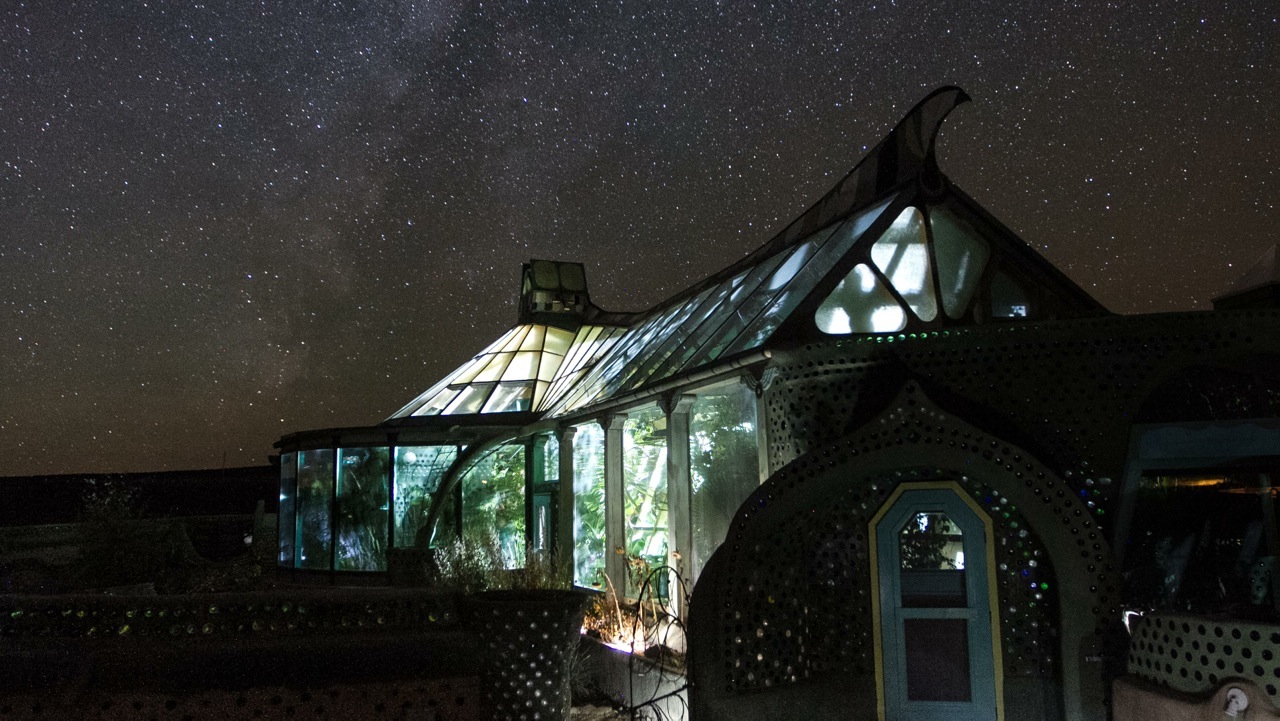
In the high desert outside Taos, New Mexico, a cluster of otherworldly homes rises from the sagebrush. Curved walls sparkle with embedded glass; thick earthen berms blunt the wind. These are Earthships—self-sufficient buildings conceived more than 50 years ago by architect Michael E. Reynolds, founder of Earthship Biotecture.

An Earthship is designed to provide six human essentials from one structure: shelter, power, water, waste management, food, and thermal comfort. To do it, Earthships combine thermal mass (often earth-packed tires) and passive solar design for heating and cooling; rainwater collection with filtration and staged reuse (potable → greywater for plants → blackwater); and on-site renewable energy via rooftop solar (sometimes wind). Many include lush indoor greenhouses that turn wastewater into tomatoes, herbs—even bananas in alpine climates.
“After decades of trial and error, I finally feel like I know what I’m doing,” says Reynolds. “Now I’m spending the rest of my life sharing that knowledge.”
Who’s behind the movement
Reynolds began experimenting in the early 1970s—famously with can-and-bottle “bricks”—and formalized the approach as Earthship Biotecture. Today, his team’s projects span climates and countries, from luxury models like the Phoenix Earthship to pared-back disaster-relief builds.
For a Green Prophet primer from the archives, see “How to build an Earthship”.
A new virtual space: Earthship Backstage
To open up five decades of R&D, Earthship Biotecture recently launched Earthship Backstage, a members-only archive packed with original drawing sets, concept art, construction animations, engineering notes, rare books (including The Coming of Wizards), and Q&A videos with Reynolds. It’s both a living museum and a practical toolkit for builders, students, and policy-minded skeptics.
Learn it, then localize it
Earthships aren’t meant to be copied blindly from Taos; they’re a set of principles that adapt to place. If you’re Earthship-curious, start small and start local:
- Learn the principles—passive solar, thermal mass, staged water reuse, on-site renewables, and indoor food systems. A concise intro lives at Earthship.com.
- Check codes early—zoning and building rules vary widely. (Green Prophet has covered low-carbon building pathways across the region; e.g. adobe & straw in Israel.)
- Get hands-on—Earthship Biotecture runs Weekend Seminars in Taos (next up: Sept 27–28, 2025) and an in-person Academy, with a condensed one-week format launching in 2026.
- Use local materials—the “earth-first” ethic means sourcing what’s abundant and climate-appropriate.
- Prototype—build a greenhouse, studio, or battery room to master techniques before committing to a full home.
Materials & strategies by climate
One strength of Earthship design is material flexibility. The table below suggests starting points; always tune to local codes, hazards, and supply chains.
| Climate / Biome | Locally abundant materials | Design focus | Green Prophet context |
|---|---|---|---|
| Forests / Temperate | Timber, straw bales, local stone, earth-packed tires | Moisture control, air-tightness, high insulation R-values | Strawbale how-to |
| Desert / Hot-dry | Rammed earth, adobe, tires, bottle/can infill | Thick thermal mass, shaded glazing, earth tubes for cooling | Adobe & straw in arid zones |
| Cold / Mountain | Stone, insulated rammed earth, straw bale hybrids | South glazing, vestibules, storm-resilient detailing | Earthship basics |
| Tropical / Humid | Bamboo, reclaimed hardwoods, lime plasters | Cross-ventilation, wide eaves, mold-resistant assemblies | Bamboo architecture |
| Urban / Resource-constrained | Salvaged brick, reclaimed concrete, upcycled composites | Small footprints, shared systems, creative reuse | Waste-to-house case study |
Regional starting points
- Middle East & North Africa (desert/arid): prioritize adobe/rammed earth, deep overhangs, night-flush ventilation; study vernacular masters like Hassan Fathy and New Gourna (read more).
- Levant & Mediterranean (hot-dry summers, cool winters): hybridize stone or compressed earth with high-performance glazing and shading; consider cistern-centric water layouts.
- Europe & North America—temperate/forest: straw-bale skins over earth-tire cores boost R-value; manage vapor carefully in wet seasons.
- Cold continental/mountain: increase insulation, add airlocks/vestibules, optimize solar gain windows with insulated shutters; greenhouses double as heat buffers.
- Tropical coastal: trade some mass for ventilation and shade; specify borate-treated bamboo and lime plasters to resist pests and mold.
Why it matters now
Grids strain under heat waves and storms; water scarcity grows; construction waste piles up. Earthships aren’t a universal answer—permits can be hard, sweat equity is real, and costs concentrate up front—but they’re proof that buildings can deliver resilience rather than passively consume it. They’re also a cultural bridge: a modern system that honors vernacular wisdom, from Nubian vaults to Mediterranean stonework.
Get involved

- Explore the archive: Earthship Backstage
- Go hands-on: Weekend Seminar (Sept 27–28, 2025) or the
Earthship Academy (condensed 1-week format from 2026) - Primer and context on Green Prophet:
Earthship 101 •
Adobe & straw in Israel •
Strawbale how-to
Further reading on natural building (Green Prophet archive)

- Hassan Fathy: the Middle East’s father of sustainable architecture
- New Gourna & Hassan Fathy’s earth architecture for the people
- How to build an Earthship
- Building with adobe and straw in Israel
- Build your own strawbale home (Canelo Project)
- The strawbale house in Israel
- Micro-financed straw houses for Pakistan (quake-resistant)
- Five innovative firms building with bamboo
- Tiny house built with diaper–concrete upcycling