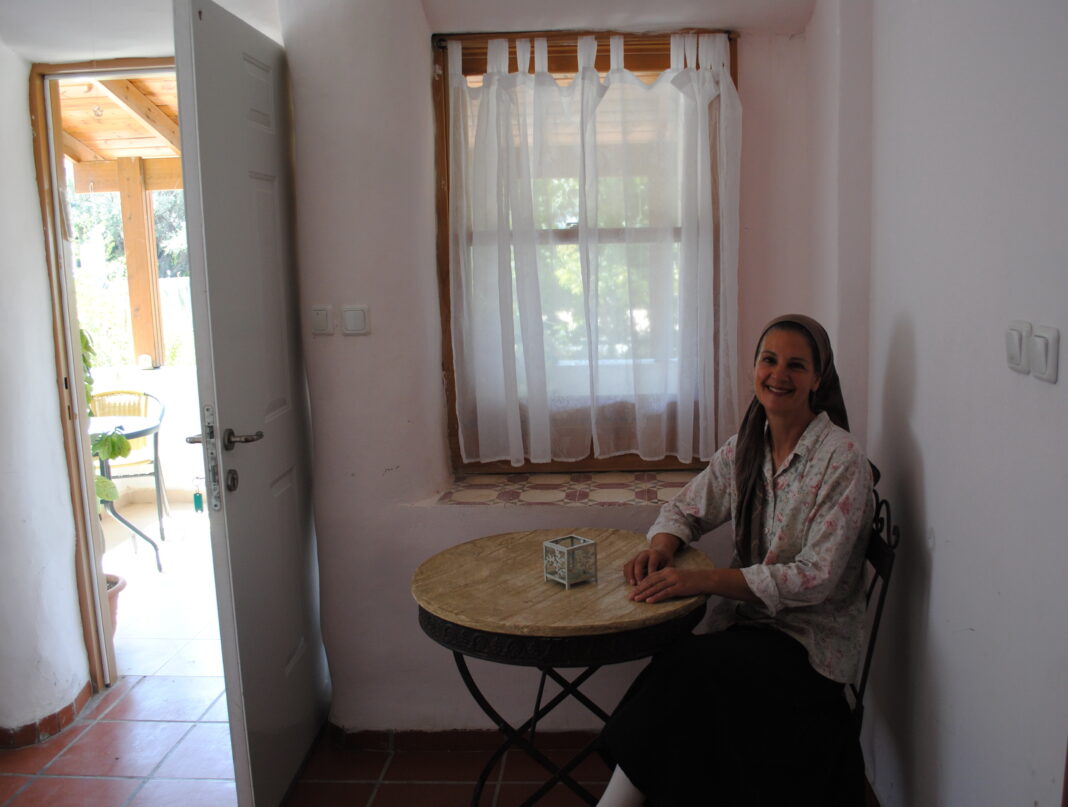

 Green Prophet interviews Sarah Kopp about why she built her straw-bale house in Israel.
A house made of straw and mud: sounds like the Biblical Jews enslaved in Egypt building cities with bricks that wouldn’t hold together. Yet Sarah Kopp built a house from bales of straw held together by chicken-wire, plastered with a mixture of mud, sand and chopped straw, resembling the renovations done at the Khan of the White Donkey, right there in Safed. How long can she expect this primitive-sounding structure to stand?
“One hundred years,” says Sarah, calmly. “If you’re talking about sustainable architecture, straw bale is the number one choice.”
In Nebraska, where in pioneer times straw-bale homes and dugouts were the only options, century-old straw bale houses are still standing. Her own has has withstood a recent earthquake without damage.
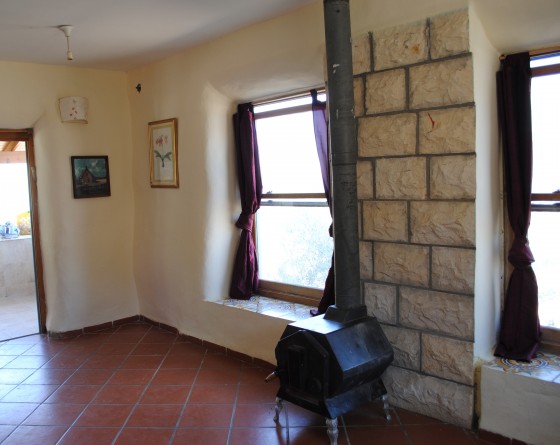
We visited the Kopp home in Safed, Israel this week. There was nothing primitive about the electricity, plumbing, spacious rooms with tiled floors, or shady porch. Nor in the green concepts behind the comfortable 2000-foot dwelling:- reportedly the first straw-bale house in Israel.
Dissatisfied with her modern cinder-block apartment, stay-at-home-mom Sarah Kopp dreamed of creating a house out of sustainable materials. She found support in an international organization of straw-bale builders on the Internet. Reading everything available on the topic and learning through experience, she has become one of Israel’s foremost authorities on straw-bale construction.
“I worked with the architect and engineer, and was the general contractor of my house. I taught the workers on site how to put up the straw bale walls, and did the interior earth-plastering myself. The roofers I hired refused to install the insulation on my roof; they said it was a waste of money. So I did it myself, standing on a ladder while they jeered from the ground. Modesty apart, the insulation works fine.”
GreenProphet: Sarah, what makes straw-bale buildings so sustainable?
Sarah: Ecologically, straw-bale housing is excellent. First, the basic material is almost non-processed. Then, it’s everywhere, almost free. It’s just a waste product of farming. Getting rid of straw is a problem for farmers. It’s against the law to burn it, and since it’s mostly cellulose, it’s no good for animal feed. But it makes ideal building material.
What advantages does straw bale have? Don’t vermin like to nest in it? How about fire safety?
Bugs and mice aren’t attracted because straw has no food value. And the plaster on the sides of the bales makes your walls almost fireproof. The one thing to look out for is leaking- the straw would get wet. That’s avoided with proper construction. As for stability – we had an earthquake measuring 4 points on the Richter scale in Safed, but no cracks appeared in the walls.
How long does it take to build a straw-bale house, and how do building costs compare with a conventional house?
A private individual might need up to six months to build a two-story house like ours. It could be done faster; it depends on how much disposable money he has at any time. The cost is about the same as building a conventional house. The straw bales themselves account for only about 13% of the building budget.
When we asked about the quality of life inside the house, Sarah said:
“My husband and I and our nine kids have lived in this house for nine years. It has completely justified our expectations of comfort and economy. One small wood-burning stove heats the entire structure in winter, and the ambient temperature is comfortable in summer, with no air conditioning. Another advantage is that straw bales absorb noise.”
“Cost isn’t the benefit. The benefit is the house itself.”
So it sure seems. (What we particularly liked about this kind of flexible building was how the owner can put big or little niches around the walls at whim. Niches wide as bookcases or small enough to hold the single book you’re currently reading in bed.)
How much interest is there in this kind of building in Israel?
The renovated Khan of the White Donkey here in Safed consulted me about earth plaster. I understand that sustainable building, including straw-bale, is taught on Kibbutz Lotan in the Arava. I’ve heard of one or two individuals building with straw bale. Most of all, people come from all over the country, all the time, to view my house and talk about straw-bale building.
Thank you, Sarah! Hopefully some of the folks you’ve talked to will be motivated to start their own straw-bale homes.
Sarah Kopp lectures on sustainable architecture and urban agriculture Israel, and may be contacted at [email protected]
More sustainable architecture:
700 Year Old Iranian Cave Homes
The Middle East’s “Glass Monsters”
A Visit With Bill and Athena Stein
Photos by Miriam Kresh