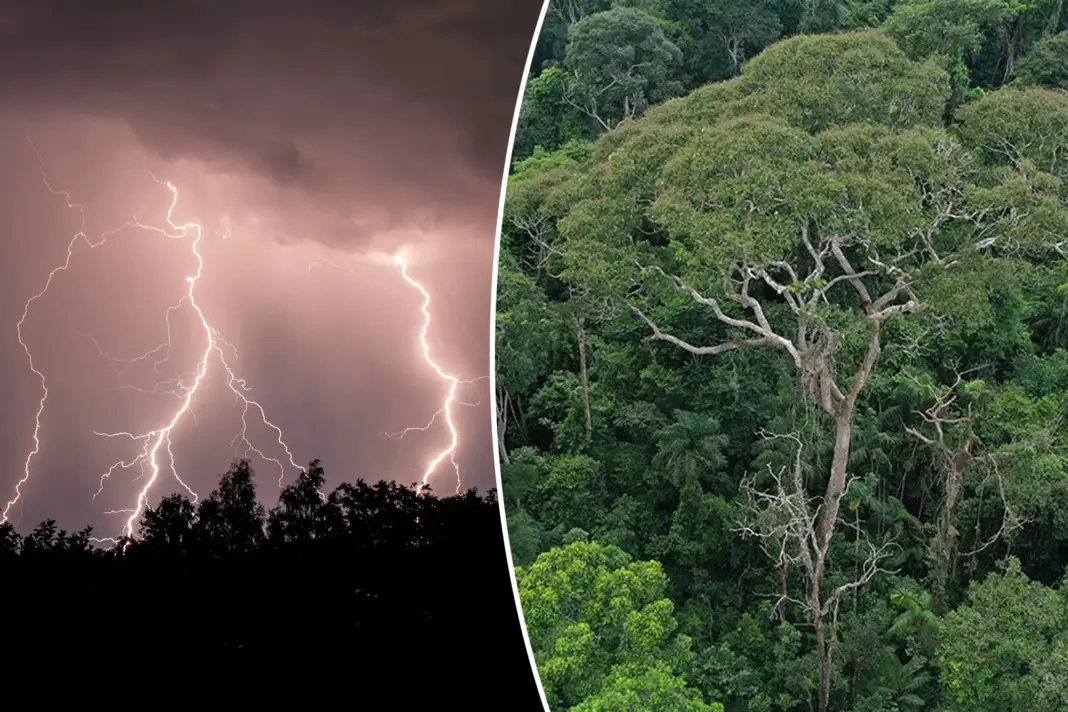


In the dense, storm-soaked rainforests of Panama, a new ecological mystery has been cracked open by lightning—and it’s pointing straight to the tonka bean tree (Dipteryx oleifera). A recent study reveals that these tall, unassuming trees might be using lightning as a secret weapon to wipe out nearby competition.

“Seeing that there are trees that get struck by lightning and they’re fine was just mind blowing,” Evan Gora recalled. Over time, the team encountered other D. oleifera trees thriving after getting hit, so they decided to take a closer look.
Published in New Phytologist, the research led by forest ecologist Gora of the Cary Institute of Ecosystem Studies shows that tonka trees can survive lightning strikes that kill surrounding trees and vines, giving them a competitive boost in the long game of forest survival. “There’s a quantifiable, detectable hazard of living next to Dipteryx oleifera,” said Gora in an interview with Science News.
How Does a Tree Survive Lightning?

Lightning is one of the leading natural causes of tree death in tropical forests. The raw voltage and heat from a strike can instantly boil sap, splinter wood, and reduce a once-living organism to charcoal. But not tonka trees.
Using a custom-built system of sensors and cameras, Gora and his team recorded 18 confirmed lightning strikes over a three-year period. Not only did D. oleifera often take the brunt of the strikes, it consistently survived, while neighboring trees and parasitic vines wrapped around its trunk perished.
This self-sacrificial behavior isn’t just a fluke—it appears to be a strategic evolutionary edge. Over a tonka tree’s lifetime, researchers estimate that its ability to outlive competitors via lightning could lead to a 14-fold increase in seed production. Read the full study in New Phytologist
Why This Is So Cool (And So Important to Science)

Evolutionary Ingenuity: This could be one of the first documented cases of an organism using a natural destructive force to its advantage, like an ecological superpower. It’s akin to a fire-adapted species, but with lightning as the fire.
New View on Forest Dynamics: Lightning is often overlooked in forest ecology. Gora’s work adds a new dimension to understanding tree mortality and regeneration in tropical ecosystems, where every inch of canopy matters.
Potential Applications in Climate Modeling: As lightning strikes are expected to increase with global warming (NASA study), understanding how trees respond could help model how rainforests may change—especially regarding species composition and carbon storage. Colin Price does this with lightning as well, using cell phones.
Smart Tree Strategy: While other trees avoid becoming conductors, the tonka might actually attract lightning by growing taller or modifying their structure to be more conductive—though more research is needed to confirm this behavior.
“This is a reminder that survival in the rainforest is about more than just growing fast or tall. It’s about playing the long game—even if that game includes dancing with lightning,” said Gora.
Tonka Beans: Vanilla Alternative with a Toxic Twist
Tonka beans, the seeds of the Dipteryx odorata tree native to South America, have long fascinated chefs and perfumers for their sweet, complex aroma. Rich in coumarin, a natural compound that smells like vanilla with hints of almond, cinnamon, and clove, tonka beans have often been used as a cost-effective substitute for vanilla, especially when vanilla prices soar. In culinary settings, just a small amount of grated tonka bean can flavor desserts, chocolates, and cocktails with an intoxicating scent.
However, the story of tonka beans carries a darker note. Coumarin, while naturally occurring, is toxic in high doses. Consuming large amounts can lead to liver damage and, in extreme cases, death. As a result, the United States banned the use of tonka beans in food back in 1954.
Despite this, tonka beans remain legal for use in perfumery and are still prized in gourmet circles elsewhere in the world, particularly in European fine dining, where Michelin star chefs use them carefully in small, regulated quantities.
Interestingly, the amount of coumarin one would need to consume to risk serious harm is far greater than what is typically found in a single dish. Still, because coumarin toxicity is cumulative and unpredictable among individuals, the FDA has maintained its strict stance.
Today, tonka beans occupy a curious niche: a forbidden ingredient that has gained a cult following among adventurous cooks, symbolizing both the allure and danger of natural flavors.
If the idea of trees using lightning to kill the competition blew your mind, check out these other wild, science-backed nature stories from Green Prophet:
Why Wombats Have Cube-Shaped Poop: Scientists finally figured out how wombats shape their poop into perfect cubes — it’s all in their intestines. Read it on Green Prophet
Plants Can Scream When They’re Stressed: researchers found that tomato and tobacco plants emit ultrasonic sounds when under stress. Read it on Green Prophet