Treehugger Friend to Sick Trees

oded yaffe treehugger treehugging friend

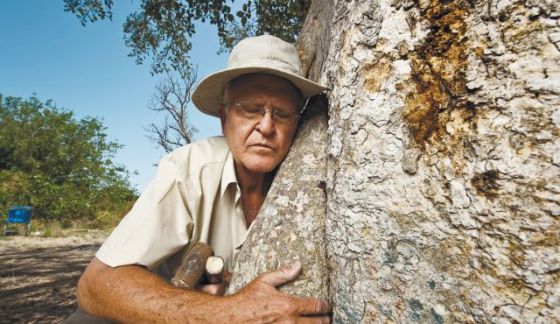
“Trees can sense that you’ve come to help them – Oded Yaffe: Photo by Ilya Melnikov

Helping to save and protect trees is an ongoing task in a small countries like Israel and Jordan that have been frequently plagued by wildfires. And by over development in Jordan. One dedicated person, Oded Yaffe who has devoted his life to saving sick and damaged trees is worth talking about. 
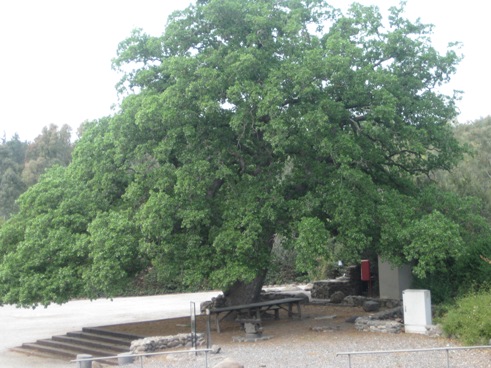
Ancient oak tree in Katzrin Talmudic Village: Another Oded Yaffe friend?

Yaffe is a product of the “old School” of concerned agricultural workers or agronomists who specialize in improving the quality of plants for use in food, feed, fuel and soil reclamation. Yaffe has taken this science one step further by specializing in plant physiology; especially that of trees. Yaffe’s homespun philosophy is told like this:

“When I come to a badly ailing and examine it for signs of life, I feel that it knows someone has come to take care of it. I feel that its response to my concern enables it to rehabilitate itself. If someone comes and just injects fertilizer into the tree, without soul, the tree won’t bee rehabilitated. Trees enjoy being treated like human beings,” he said in a recent Haaretz article.

Yaffe began working with trees back in the days when large scale tree planting was the norm all over the land of Israel, some of which is now within the confines of the Palestinian Authority. His tree saving expertise has become so well known that he has often been contacted by Palestinian farmers and agronomists who ask his advice on saving olive and other trees that have been damaged by either neglect or outright abuse – sometimes at the hands of Jewish settlers “who injected weed killer poisons into orchards.

“Dozens of Palestinians from Judea and Samaria as well as the Gaza Strip call me to receive advise, which I give them on the phone in a combination of Hebrew and Arabic. I’m a professional; anyone who wants help from me will get it.”

One particularly ancient  tree, a oak estimated to be at least 700 years old is  located in the West Bank Jewish town of Alon Shvut (Oak of Return). Yaffe took care of it by supporting braces with braces and injecting it with vitamins and medication. “I may be helping the same farmers here who have damaged Palestinian orchards, but this is part of my job,” he says.

The Tree Man is acutely aware of other regional locations where many old and even ancient trees are in danger due to neglect and new climate change realities, such as in the case of  the biblical cedars in Lebanon.

Yaffe, together with his son Uri Yaffe himself a professional agricultural researcher, travel about in a mobile laboratory to find more eco friendly ways to help preserve and sustain both agricultural crops and forests all over Israel.

One of their “green” projects involves the development of a non-toxic pest spray developed in the 1990’s by Dr. Samuel Gan-Mor, head of the department of agricultural engineering at the Volcani Institute, who developed a safe pest control spray made from various types of edible cooking oils.

Both Yaffes have been working together since 2006 on this project, experimenting with various types of oil mixtures until they found one best suited for regional crops. The spray was recently approved by Israel’s Agriculture Ministry, who say it may be one of the most innovative natural products to be developed in recent years.

“The spray is effective against a very broad range of pests and diseases. This saves both time and money, as utilizing the mixture takes lest time and is less expensive than conventional products,” says Yaffe.

He adds that since it is non-poisonous, farmers to not have to wait until harvest time in order to make sure that fruits and vegetables are safe to eat by humans.

But in regards to trees, Oded Yaffe’s primary love, he continues to go about the country taking care of old, sick and damaged trees. “Trees are like people in that we can’t prevent their death. What is most important is to keep planting healthy new ones to replace the ones who are no able carry on. This is best that we can do for them – keep planting new life to replace what can no longer survive.”

::Haaretz/Ilya Melnikov

Read more on trees:

After the Fire: Israel’s Carmel Forest Doesn’t Need Our Help

Kibbutz Recovers From Killer Forest Fires by Going Green

Jordan Reconsiders Deforestation Plans

Can the Cedars of Lebanon Survive Climate Change?

Maurice Picow
Maurice Picowhttps://www.greenprophet.com/
Maurice Picow grew up in Oklahoma City, U.S.A., where he received a B.S. Degree in Business Administration. Following graduation, Maurice embarked on a career as a real estate broker before making the decision to move to Israel. After arriving in Israel, he came involved in the insurance agency business and later in the moving and international relocation fields. Maurice became interested in writing news and commentary articles in the late 1990’s, and now writes feature articles for the The Jerusalem Post as well as being a regular contributor to Green Prophet. He has also written a non-fiction study on Islam, a two volume adventure novel, and is completing a romance novel about a forbidden love affair. Writing topics of particular interest for Green Prophet are those dealing with global warming and climate change, as well as clean technology - particularly electric cars.

Read More

3 COMMENTS
  1. Sick trees are increasing because of a sick planet from massive and growing tons of pollution dumped out into the land and pumped up into the sky by billions of people too busy to worry about the survival of the biosphere that feeds them. But the drought is putting a stop to it, probably forever.

TRENDING

Mona Khalil, Orange House Project founder, sea turtle protector killed in Lebanon

Mona Khalil spent decades protecting Lebanon's sea turtles and coastal ecosystems. Her death in the ongoing conflict between Israel and Hezbollah shines a light on a broader environmental tragedy unfolding across northern Israel and southern Lebanon. From damaged wetlands and disrupted bird migrations to threatened seed banks and endangered wildlife, the region's ecosystems are becoming casualties of a war with no clear end in sight.

5 Reasons Why You Should Save Seeds (and plant them)

Saving seeds from tomatoes, peppers, herbs and flowers helps preserve biodiversity, strengthen food security, and keep heirloom varieties alive. Even a small balcony garden can make a difference.

Dan Zaslavsky’s energy tower dream is rising again in Iran and China

The Energy Tower idea never made the leap from drawings and engineering studies to full-scale construction. But nearly two decades after most people stopped talking about it, the concept is quietly evolving in two unexpected places: China and Iran. The concept let dreamers dream and doers do - figuring out more pleasing designs and engineering.

A visit to Amirim, Israel’s first all-vegetarian village in the Galilee

Just 15 kilometers from Tzfat there is a moshav that was founded in the late 50s that was ideologically influenced by organic, vegetarian and vegan principles. My hostess at Ohn-Bar, the tzimmer where I stayed, explained that the people of Amirim were among the pioneers of Israel’s strong vegetarian movement.

Israeli Hydrogen Startup H2Pro Are Trying to Solve Clean Energy’s Hardest Problem

The company has attracted backing from major investors including Breakthrough Energy Ventures, the climate fund founded by Bill Gates, along with industrial partners such as Sumitomo, ArcelorMittal, and Temasek, a multi-billion dollar company that owns Singapore airlines. H2Pro has raised more than $100 million USD and is moving from pilot projects toward commercial-scale deployments.

Yerukim Forms a New Green Economy Where the Money is Really Green

The Yerukim members who pick up the recyclables get to keep the monetary reward, the public earns "green" bills that can be used in shops, and business owners get to be associated with environmentalism.

Choosing Riyadh over Dubai? What Investors Should Know

Saudi Arabia is deploying capital at unmatched scale to catalyze tourism and advanced industry while rewiring its power-and-water backbone. The investable frontier is widening—especially in renewables, grid storage, water efficiency/desal retrofits, and hospitality operating platforms. Prudent investors will insist on phased delivery, enforceable KPIs (energy, water, biodiversity), and RHQ/zone compliance—while pricing political-economy and reputational risks alongside growth upside.

Sell your cooking oil for biodiesel money

Want to make money on old french fry oil? Sell it.

Qatar Alternative Energy Summit Pairs Investors And Innovators

Alternative energy investors and innovators can meet n' greet in Doha, Qatar March 16 and 17.

Here’s How To Implement The Four Pillars Of Employee Engagement

If you throw a party for your work team and they are vegans, don't make it a barbecue. Know the sustainability values of your team to boost moral and retain good people.

Locals From Rishon Fight IKEA

Big Box stores are a pretty new concept in Israel, and thank God that not every Israeli city wants them in their backyard. A word from someone who has see the beautiful farmland around her hometown Newmarket, Ontario stripped and converted into vulgar strip malls of big box shops: they have no place in a healthy and sustainable town or city.

The Jewish National Fund Meets An Inconvenient Truth

According to the JNF, it has transformed thousands of acres of barren land into green forests in Israel. They state that each person emits about 23 tons of carbon per year, estimating that each tree planted can absorb one ton of carbon in its lifetime. That's a whole lot of trees you'd need to be planting. Could so many fit in Israel?

How to quiet noise from construction in your office

Streets need to be resurfaced in New York but the humming and grinding noise is unsettling. Noise is environmental pollution. 

Popular Categories