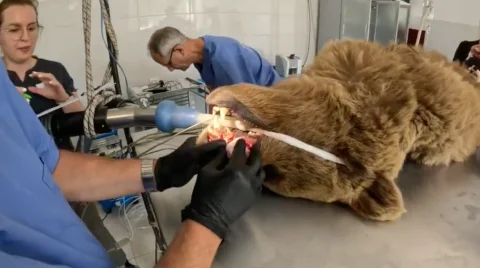
In May 2025, a shocking rescue in Yerevan, Armenia, brought global attention to a longstanding problem in the Caucasus: wild bears kept in cages as tourist curiosities, “pets,” or backyard mascots. Three Syrian brown bears – Aram, Nairi, and their daughter, Lola – were liberated after years of abuse in filthy cages. Their rescue, led by the Foundation for the Preservation of Wildlife and Cultural Assets (FPWC) with support from International Animal Rescue (IAR), revealed not just one family’s suffering, but a broader pattern that persists across the country.
For decades, bears in Armenia and neighboring regions have been captured and displayed in shocking conditions where It has been common for businesses to keep a bear chained in a small cage to attract diners or tourists. Wealthy or rural families sometimes treat bears as status symbols, confining them in sheds or cages without proper care. Adult bears are often bred, and their cubs sold into a cycle of captivity—sometimes to other private owners, sometimes abroad.
Alan Knight, President of International Animal Rescue, who was at the rescue, said: “These were some of the worst conditions I have ever seen. The stench, the filth, the sheer cruelty of locking these animals up in tiny cages and feeding them cola, it was absolutely horrific.”
Related: in Canada you can eat bears, here is how
This happens in Armenia not because of religious practice, but mostly from cultural tradition, economic motives, and weak enforcement of animal welfare laws. Bears in Armenia are iconic symbols of strength and survival, and some people wrongly believe they can be “tamed.” In reality, such captivity leads only to neglect, suffering, and the gradual decline of wild bear populations.
Tourists may unwittingly fuel the problem. When visitors stop at a roadside café to take selfies with a caged bear or when they “like” such photos on social media, it signals to owners that keeping bears is profitable. That’s why tourists can play a crucial role in stopping this cruelty. Don’t take selfies with bears!
What tourists can do when you see a bear or any wild animal like a drunk monkey or snake being exploited: Don’t dine, stay, or spend money in places where animals are caged for entertainment, even if the kids beg. If you see a captive bear in Armenia (or elsewhere in the region), take discreet photos or videos and share them with local animal welfare groups such as FPWC, IAR, or international NGOs. These tip-offs are often what trigger investigations and rescues. The links are below.
Visit or donate to ethical wildlife sanctuaries, where rescued bears live in naturalistic environments and receive proper care. And yes, thanks to local activists and global attention, progress is being made. Armenia has strengthened its wildlife protection laws in recent years, and NGOs have successfully rescued dozens of bears. Sanctuaries in Urtsadzor and beyond are giving once-abused animals safe new homes. But rescues remain expensive, slow, and dependent on public pressure and donations.
Brown Bears Can and Do Attack
While it is tragic to see brown bears caged and abused, it is equally important to remember that these are not domesticated animals. Brown bears are among the most powerful carnivores on Earth, capable of inflicting fatal injuries on humans when provoked or surprised. Their sheer size, strength, and unpredictability make them both awe-inspiring and dangerous.
An unforgettable account of this truth is told by the French writer and anthropologist Nastassja Martin in her memoir In the Eye of the Wild (Croire aux fauves). In 2015, while conducting fieldwork on the Kamchatka Peninsula in Siberia, Martin was attacked by a brown bear. The bear crushed part of her skull and jaw in a brief but violent encounter.
Martin survived — but her story is not just about survival. The book, translated into English by Sophie R. Lewis, weaves memoir, anthropology, and philosophy into a haunting reflection on what it means to live through trauma. She explores not only the physical scars but also the metaphysical dimension of her experience, suggesting that encounters with wildness force us to rethink the boundaries between humans and animals, nature and culture, fear and reverence like the forthcoming book Bearland, by Karin Kloosterman.
A Global Problem of Tourist Sideshows
Sadly, Armenia is not alone. Around the world, wild animals are drugged, chained, or mutilated to entertain tourists.
In Thailand we have seen monkeys are often drugged and forced to perform tricks, take photos with tourists, or ride bicycles in “shows.” Behind the scenes, they live in chains and suffer permanent trauma.
In Morocco (Marrakesh) we have seen snake charmers display cobras and vipers in public squares, often with their fangs removed or mouths sewn shut. The snakes slowly starve or die from infection, replaced by more animals taken from the wild.
In Europe and the Middle East birds of prey are tethered for selfies, and lion cubs are illegally traded as exotic pets.
::Foundation for the Preservation of Wildlife and Cultural Assets