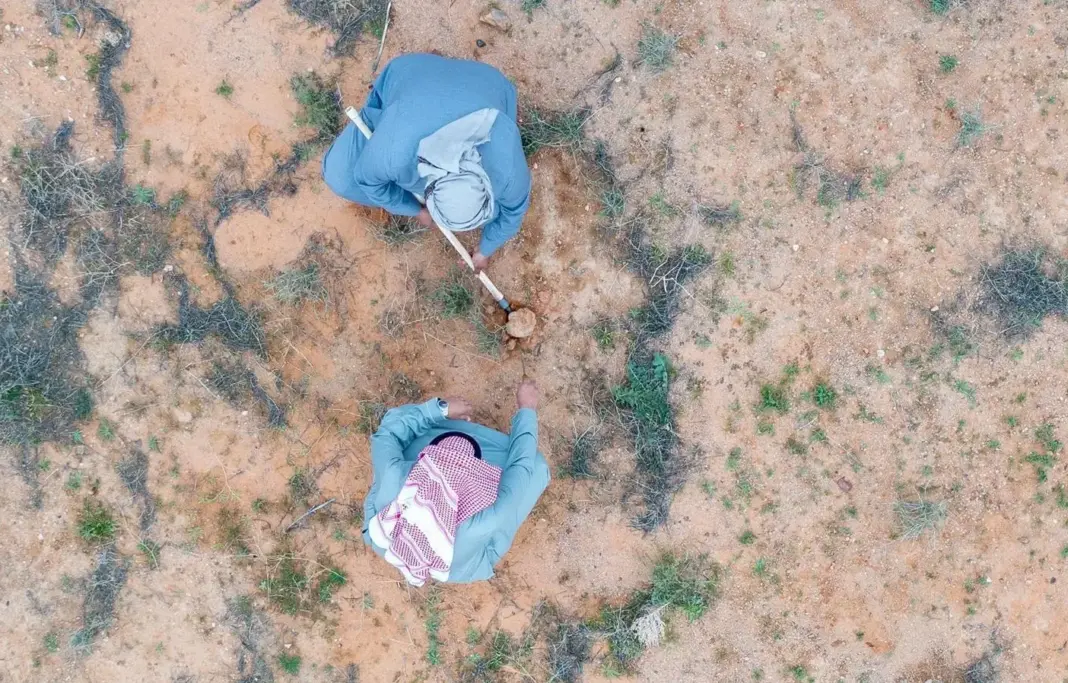
In the volcanic highlands of northern Jordan, north of Amman engineers are mining a natural resource not for energy, but for agriculture. The material: crushed volcanic rock, now also processed into a mineral-rich soil that may hold the key to reducing water and fertilizer demand in arid regions.
The project is led by Watad, a Jordanian company founded in 2019. The firm processes volcanic rocks such as zeolite, basalt, and pozzolana into what it calls “volcanic soil”—a porous, salt-resistant substrate that improves water retention and plant growth in dry climates.
“There’s zeolite, like the one we have in the mine here. There is zeolitic tuff in one of the other mines we have. There are basalt and pozzolana,” said Ibrahim al-Manaseer, a mine engineer at the site near Mafraq in an interview with Reuters. “All of them are volcanic rocks that formed thousands of years ago.”
Watad currently produces around one million tons of volcanic soil annually, and its CEO, Mohannad al-Manaseer, says the company could scale up rapidly. al-Manaseer said the goal is to replace conventional fertilizers and soil additives with a more durable and environmentally stable alternative.

Early field reports suggest volcanic soil may reduce irrigation needs by up to 60% and cut fertilizer use by 80%. That could have significant implications for Jordan, which ranks as the second most water-scarce country in the world, with per capita water availability under 100 cubic meters per year, well below the UN’s threshold for extreme water stress.
When we visited Jordan we learned that hotels and homes get fresh water shipped to reservoirs weekly. Some people keep second hidden reservoirs to avoid running out.
Related: Jordan’s leading ecological organizations
While long-term studies are still needed to assess environmental and agronomic impacts across diverse ecosystems, the use of volcanic material in soil enhancement is not new. Zeolites, in particular, have been studied for decades due to their ion exchange and adsorption properties.
What’s novel is the scale—and the urgency. In a region where desertification, rising temperatures, and resource stress are converging, Jordan’s push to mine its volcanic past could represent a rare alignment of geology and necessity.
Jordan has been working with water cooperation with Israel and the Palestinian Authority over the last couple of decades through Friends of the Earth, Middle East – Ecopeace. They are working to broker small-scale local projects in education, but also are working on larger water for energy swaps. The October 7 terror attack changed the political outlook for Israel and Jordanian cooperation, two countries that have a signed peace treaty.
Time for water cooperation?
The Wadi Araba Treaty established cooperation between Jordan and Israel on various matters, including water sharing. In November 2022, both Jordan and Israel signed a declaration of intent at the UN climate conference to rehabilitate and protect the Jordan River, aiming to reduce pollution and restore water flow.
A 2013 agreement involved developing a desalination plant in Aqaba, with potable water shared between Israel and Jordan, and increased water releases from Lake Tiberias to Jordan. But in November 2023, Jordan announced it would not sign a proposed water-for-energy deal with Israel, citing Israel’s actions in Gaza as the reason.
Jordan is currently advancing its own water security through the Aqaba–Amman Water Desalination and Conveyance Project, aiming to produce about 300 million cubic meters of clean drinking water annually. Jordan is landlocked except for a small strip of the Red Sea, where it is bordered by Israel and Saudi Arabia.
The Abraham Accords which is creating a peace treaty and regional cooperation between countries such as Saudi Arabia, and the United Arab Emirates, will likely lead to water cooperation for a very dry Jordan.
::Wated