
Talk about an amazing science fair opportunity! A multidisciplinary team of undergraduate students led by the University of New Hampshire designed and built a mini satellite, known as a CubeSat, that will launch into space to gather data in collaboration with NASA’s Interstellar Mapping and Acceleration Probe (IMAP) mission. Satellites, power grids, GPS, and communication systems can be ruined by solar storm damage. The orbiting “loaf” will help collect data for better predictions.
The small-but-mighty satellite is set to launch on a SpaceX rocket from Vandenberg Space Force Base in California no earlier than Nov. 10, 2025 at 10:19 a.m. PST. It will head to the outer reaches of the atmosphere to study the solar wind which will help scientists in their quest to improve space weather forecasting and better protect technology in space and on Earth—such as communication networks, power grids and GPS—from potentially damaging large solar flare events.
Selected as part of NASA’s CubeSat Launch Initiative, once it is launched, the satellite will travel to the Earth’s upper atmosphere, known as thermosphere, which is the same region where many other satellites and the International Space Station orbit around Earth. It will take measurements of the atmosphere density (single oxygen at this altitude) and electron precipitation from space onto the upper atmosphere, which can cause disturbances in communication signals and lead to changes in the ozone.
Data from the mission will be collected by the students and analyzed in combination with data from IMAP and will help advance the understanding of how the thermosphere in the auroral and cusp regions responds to particle precipitation and varying conditions associated with solar wind.
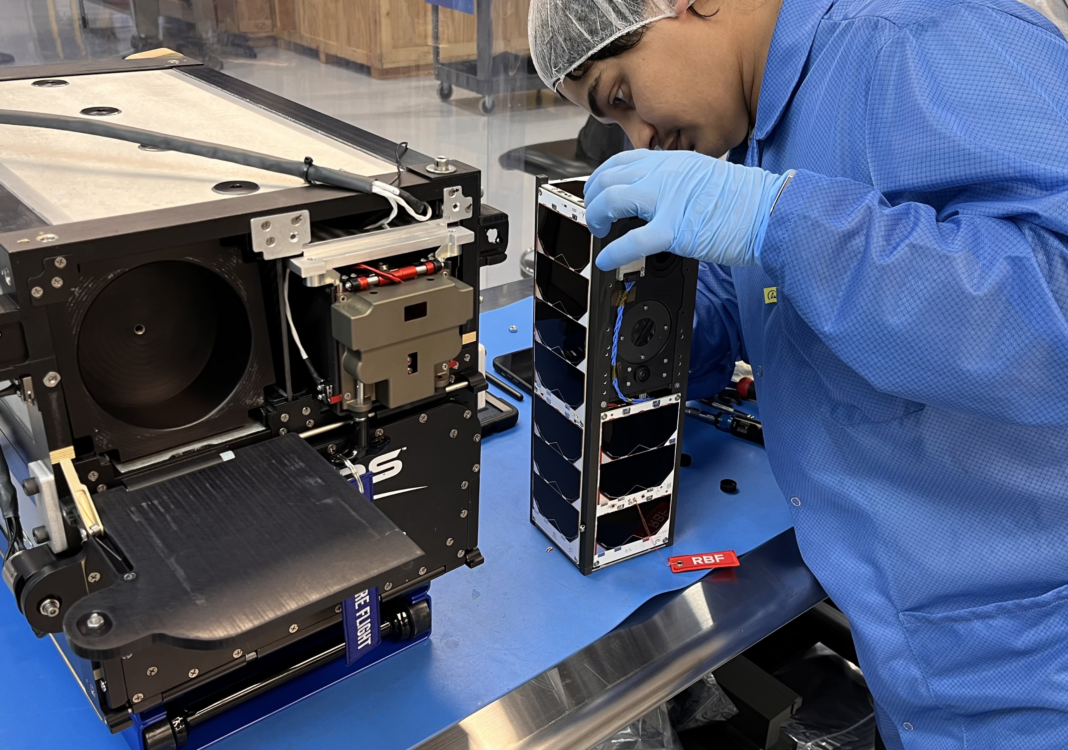
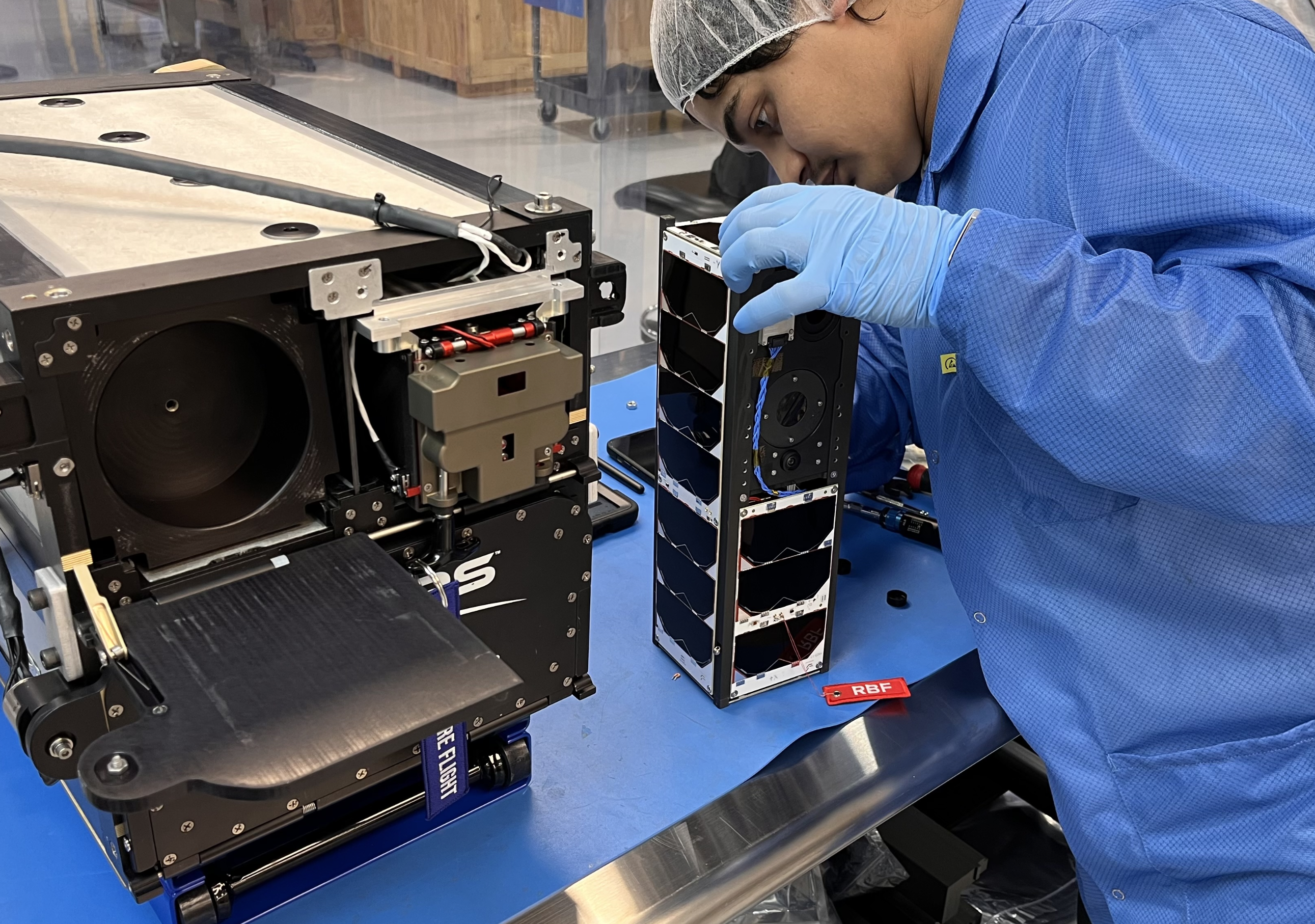
CubeSats are a specific subset of satellites that are small and standardized and provide a cost-effective way to study space science. It is about the size of a loaf of bread and offers a simpler way to start building and operating than larger satellites, making it an ideal piece of equipment for students to hone their skills outside of the classroom.
The 3UCubed satellite was fully assembled at UNH and the two payload instruments that are a part of its structure were built, tested and calibrated at UNH. The students worked for five years on the satellite, performing a variety of tasks ranging from creating the software code that controls the 3UCubed to soldering the wires during the physical build. Students with mentorship from professors and staff engineers, performed trade studies, orbit analyses, selected vendors for different subsystems, oversaw budgets for various mass, power, link and telemetry jobs and developed the framework for the flight software and operations.
“At the time, I had a keen interest for the aerospace industry and saw this as a great opportunity to get valuable experience working with industry professionals,” said Alex Chesley ’22, who studied mechanical engineering at UNH and was a part of the 3UCubed mission team. “It was fascinating to learn about so many new subjects about space science and instrumentation that I had never studied before.”
The hands-on experience is meant to introduce, inspire and prepare students for a successful career in a related field like space science, computer science, engineering or science education. Chesley designed the initial CAD model of the satellite and also helped create the detailed specification list for the CubeSat’s altitude control system. He now works as a configuration engineer at STS Aerospace in Laconia, N.H., where he helps develop fluid distribution systems for customers in the space, aeronautics and defense industries.
“The experience with the 3UCubed mission helped with my professional growth, and it was definitely valuable to have, no matter what industry you end up working in,” said Chesley.