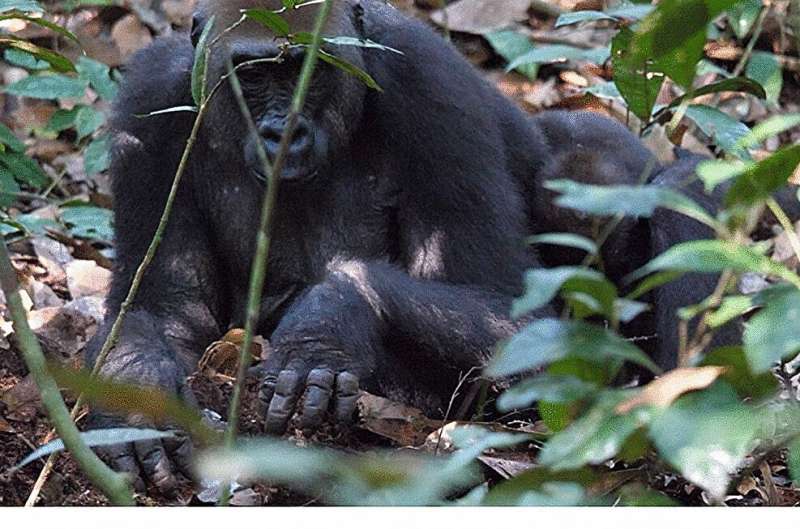
A scientific paper recently published reveals that soil scratching by gorillas in Congo’s Nouabalé-Ndoki National Park is a foraging strategy to access a species of deer truffle, identified as Elaphomyces labyrinthinus, and not insects, as long assumed.
These findings were developed by Gaston Abea, who became the first Indigenous Person in Ndoki to become the lead author of a peer-reviewed scientific paper.
This truffle gorilla foraging behavior seems to have social implications: While not all gorilla groups engage in it, some individuals may give it up or resume it when they migrate from one group to another, allowing for more insights into their social structure.
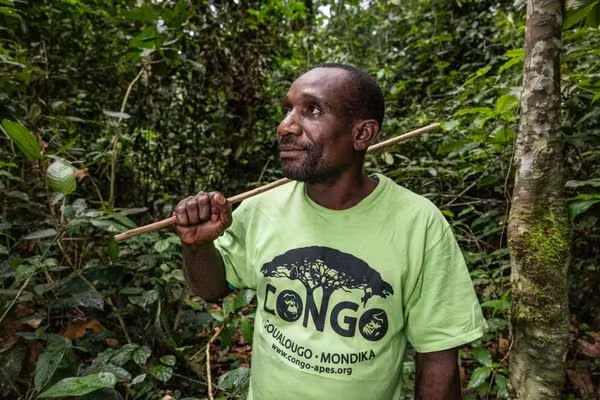
Abea drew on his traditional knowledge and tracking skills to document this behavior in detail. After a decade of observations, Abea and research teams at Mondika and Goualougo field stations were able to eventually collect specimens of the food item foraged by the gorillas scratching the ground for taxonomic identification. Ultimately, this research led to the recent publication in Primates.
“My people’s traditional knowledge of these forests is endangered by modern lifestyles but is proving invaluable in continuing to study and preserve these ecosystems,” said Abea.
Abea is one of a 100+ Congolese Research Assistants trained at Ndoki since 2005, a growing number of whom come from neighboring villages, and from Indigenous Ba’Aka communities.
Related: have you tried a desert truffle?
“Our ancestors used to hunt gorillas, now we protect them, and I hope to inspire other Ba’Akas to do the same,” said Abea.
Born in Bomassa, the closest village to the park, Abea is of the semi-nomadic Bangombe people. He has been working for the park since 2000 in various capacities. His dedication and eagerness to learn led him to progress steadily and become co-author of seven peer-reviewed scientific papers.
“This is Gaston’s first article as lead author, a milestone for his career, and for our capacity-building efforts: he is the first research assistant of Indigenous People’s origin to become first author, in the Ndoki landscape,” said WCS partnering conservationist David Morgan of the Lincoln Park Zoo, researcher at both research sites involved in the findings.
The article was part of a Special Issue of the journal Primates, dedicated to “Twenty-five years of primate research in the Ndoki forest.” Abea’s efforts identifying key areas for gorilla truffle feeding at Mondika prompted to shift the potential locations of tourism-related infrastructure to safeguard this behavior.
Most significantly, his findings were included in an ecological impact assessment of the Djéké Triangle, where the Mondika Research Station is located, which provided the evidence for the land management decision-making process that resulted in the inclusion of the Djéké Triangle in the Nouabalé-Ndoki National Park in 2023.
Said Morgan: “This is an exciting finding for our understanding of gorilla foraging behavior, and we found indications of social implications of soil scratching within groups. For example, an adult female emigrated from one gorilla group where this behavior was rare to one where it was nearly a daily occurrence, and modified her habits.”