


Save money and make yourself sugar wax at home with only three ingredients. All you need is granulated white sugar, water, and lemon juice. Sugar wax is less painful than traditional hot waxing because it does not remove hair follicles. Sugar wax is an excellent alternative for people with sensitive skin.
My roommates and I decided to try sugar waxing, and to our delight, we successfully pulled it off using ingredients readily available in our apartment. The experience turned out to be enjoyable and surprisingly efficient. In just 30 minutes, we completed the entire process, saving both time and money compared to visiting a salon.
Not only was the home sugar waxing less painful than a salon treatment, but it also left our skin feeling incredibly smooth and with a delightful fragrance. Overall, it was a fantastic and rewarding experience that we would definitely repeat in the future.
Sugar wax originates in the Middle East and is fully biodegradable ! Though the exact origin of sugaring is hard to determine, most historians concur that this ancient hair removal method was already in use during the old civilizations of Mesopotamia, Egypt, and Greece around 1900 BCE.
It was known as “sukkar” in the Middle East and “moun” in Persia. Since sugar was limited to the regions near Persia until 1,000 after CE honey served as the primary sugaring agent to create the waxing paste during that era.
Is sugar wax better than regular waxing?
Sugar wax is made of ingredients that break down easily when thrown away. Synthetic waxes are not biodegradable and are more harmful to the environment.
Sugar wax can be made at home and uses inexpensive and common home ingredients instead of visiting a salon or using cosmetic waxing kits found at the store.
Ingredients
- 1 cup (200 g) granulated white sugar
- ⅛ cup (30 ml) lemon juice
- ⅛ cup (30 ml) warm water
Making your sugar wax
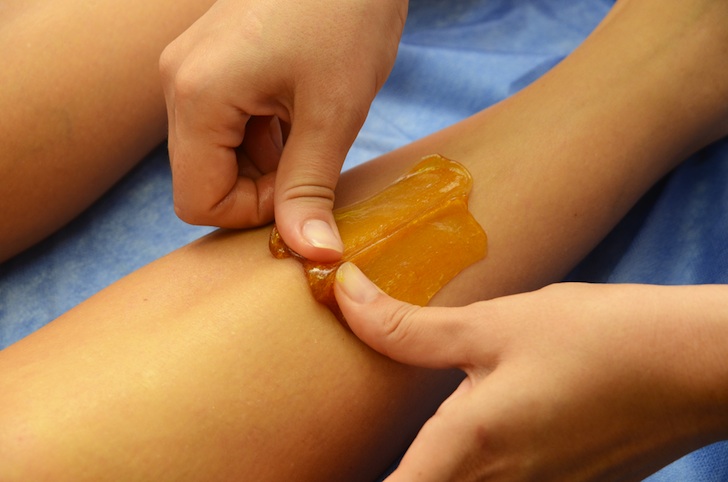
Put a medium-sized pot on your stove and add white sugar, lemon juice, and warm water.
Mix frequently and bring the mixture to a boil over high heat.
Turn the heat down to medium once the mix is boiling and bubbling. If the blend keeps bubbling, turn it down to low heat.
When the mix becomes golden brown, remove the pot from the stove. Continue to mix the golden brown mix until it becomes smooth and has a deep brown color.
The consistency should resemble hot syrup; if it appears thick, like honey, it must be heated for longer.
Pour the mix into a bowl or a jar and let it cool for 30 minutes. Sugar wax should be used at room temperature, unlike traditional hot wax.
Applying your sugar wax
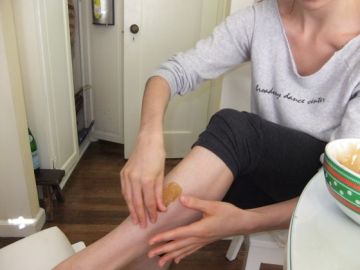
Scoop a small amount of warm wax with your fingers and roll it into a ball.
Put the wax onto a small skin area opposite to hair growth. Spread the wax to create a layer that is about 0.6 cm thick. Work on small sections, limiting their length and width to just a few inches.
Pull!
Swiftly remove the wax in the opposite direction of hair growth, similar to pulling off a bandage. Make it quick to limit the pain. There is an option to apply paper strips on top of the wax to smooth it out and pull it off.
Apply the wax in small sections until finished.
All leftover mix can be refrigerated and used at a later time. Use it within 4 to 5 weeks.
Prepping your skin for sugar wax
- Wash your skin with soap and water and use warm water to open your pores and to risk your chance of infection
- Exfoliate up to two days before waxing to make the sugar wax stick better
- Moisturize the night before, not the day off, because you want to wax with clean skin
Post-wax aftercare
- Moisturizer with natural oils, body butter, or serum to keep your skin soft and avoid ingrown hairs
- Wait two days to exfoliate again to prevent ingrown hairs and continue to do so every 2-3 days
- Do not use products that might irritate your skin
Risks of sugaring
Sugaring when done correctly does not have a lot of risks. People who have sunburns in areas they want to wax or have moles, warts, or varicose veins in places they want to wax should avoid waxing in total. Also people with preexisting skin conditions should speak with a doctor before sugaring.
Any type of waxing presents risk of side effects such as It is also worth noting that any form of waxing can cause side effects such as:
Ingrown hairs: When hair grows back and curls back into the skin, causing raised and itchy spots.
Folliculitis: Inflammation in hair follicles, leading to tender bumps on the skin. It can occur anywhere on the body where hair grows, either on the surface or deep within.
Post-inflammatory hyperpigmentation: Darkening of the skin after an injury. Even though sugar waxing is gentler, it can still cause some skin trauma, resulting in inflammation and possible discoloration. People with darker skin tones are more likely to experience this.
Infection: If sugar waxing is done incorrectly or with poor hygiene of the waxing tools and area, it can lead to skin irritation and infection.