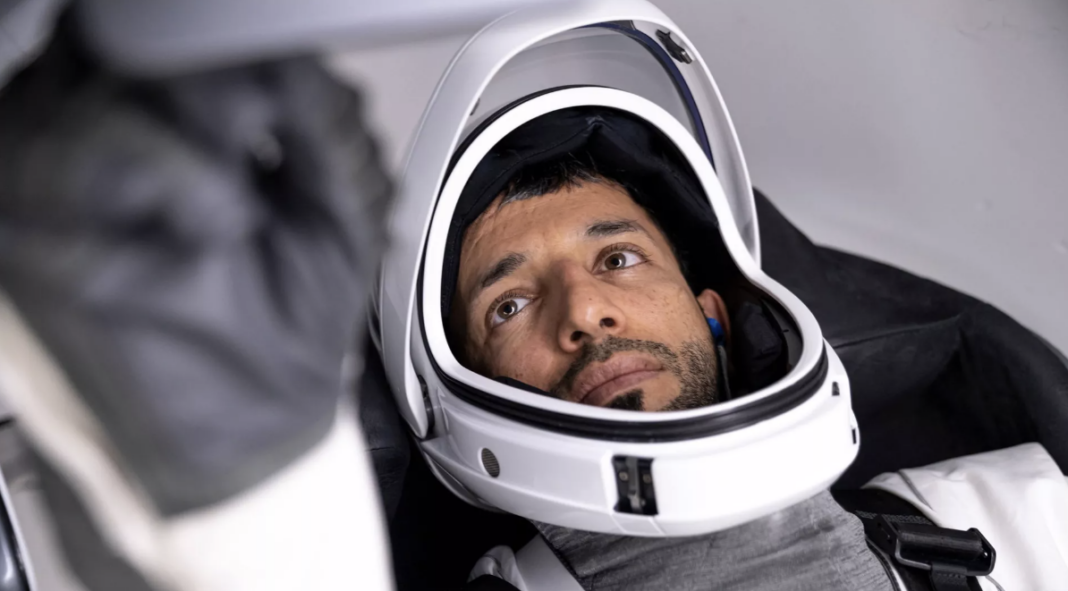


Crew-6’s Muslim astronaut flew to space this morning. Sultan Al-Neyadi is the second from the United Arab Emirates to go to space and he’s the first Arab to go on an extended mission to space.
HIs journey will coincide with the Islamic holy month of Ramadan (March 22 to April 20), where adherents are expected to fast during the daylight hours. Al-Neyadi noted that as a space traveler on a special mission, he is required to keep eating normally during the first six-month excursion to the International Space Station (the ISS) and the first time an Arab had stayed in space for an extended journey.
Al-Neyadi told reporters while livestreaming from NASA’s Johnson Space Center in Houston that all astronaut’s need to keep a relatively consistent meal schedule during the mission, and that he is not able to do any kind of activity “that can jeopardize the mission or maybe put the crewmember in a risk.” If the schedule permits, he may fast for Ramadan on some days: “We’ll see how it goes,” he said.
A couple challenges to time-observant religious acts aboard the international space station: for one, you experience 16 sunrises and 16 sunsets so counting days can only be in a 24 hour time frame. On top of that, we met an astronaut in Jaffa a month ago, who talked about eating in space: American astronaut Randolph Bresnik has been on several missions to space, including long-term stays on the international space station.
Because of the lack of gravity, “you never feel hungry in space,” Bresnik explained. That would be a bonus for someone planning to fast, but unsafe if you need to stay fit and alert on a long-term mission in challenging conditions.
Bresnik also explained how daily exercise is necessary to stay fit, and the most exciting to the kid and adult crowd was how the space crew gets rid of human, solid waste. While urine is recycled, solid matter is put into a special garbage container which incinerates when it hits earth’s orbit.
Bresnik was in Jaffa, Israel giving a talk to children at the Dajani Science Center, a new educational hands-on center in the center of the city, reaching out to a diverse population of Arabs and Jews in Israel.
Bresnik once carried a peace flag with him from Jerusalem’s YMCA and told a crowd all about the challenges of eating in space. He told us how important space journeys (and staying on the ISS) are for international cooperation and prospects of peace. People from diverse backgrounds and countries get to live together and cooperate on a global scale, sharing science, dreams and daily rhythms of life where each part is dependent on the other. But the work starts on earth where teams train intensively together for years before they launch.
Al-Neyadi is now part of that international club and is expected to stay in space for 6 months. He is only the second Emirati to travel into space, following Hazza Al Mansouri’s eight-day stay on the ISS in September, 2019.
Al Neyadi, a father of 6, spoke from inside the Dragon capsule once it reached orbit on March 2: “Allow me to say a few words in Arabic first… As-Salamu ‘Alaikum wa Rahmatullahi wa Barakatuhu,” he said. “Thank God, we made it to space. I would like to thank my mum and dad, and our distinguished leaders.”
Al Neyadi will carry out 16 science experiments for universities and will be taking part in about 200 experiments designed by NASA. He will also be involved in maintenance work on the ISS, and might even go on a spacewalk.
How heart tissues beat in space will be one of his experiments: “This is something like a cutting edge technology that one day, when we start 3D printing organs, this is really important to see how the structure is built in microgravity,” Al Neyadi said. “So this can give us a really good insight how these tissues are built.”
Like Elon Musk, of SpaceX, the UAE has dreams of colonizing Mars one day. In 2017, the Emirates revealed plans to build cities on Mars. In 2014 we reported that the Emirates wanted to send a mission to Mars by 2021, and they did it on their first try. Go UAE!