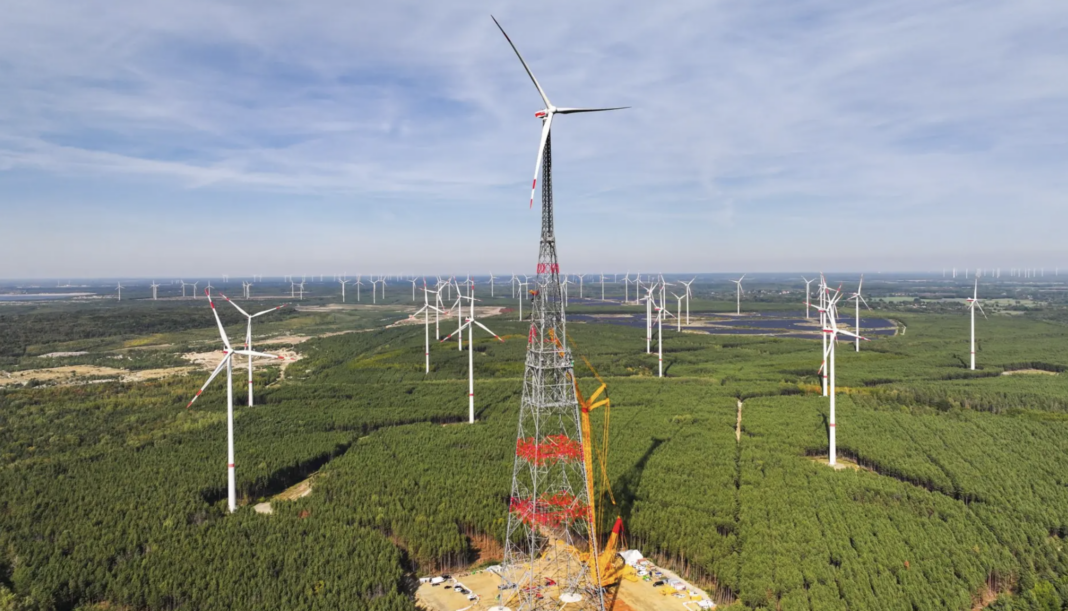

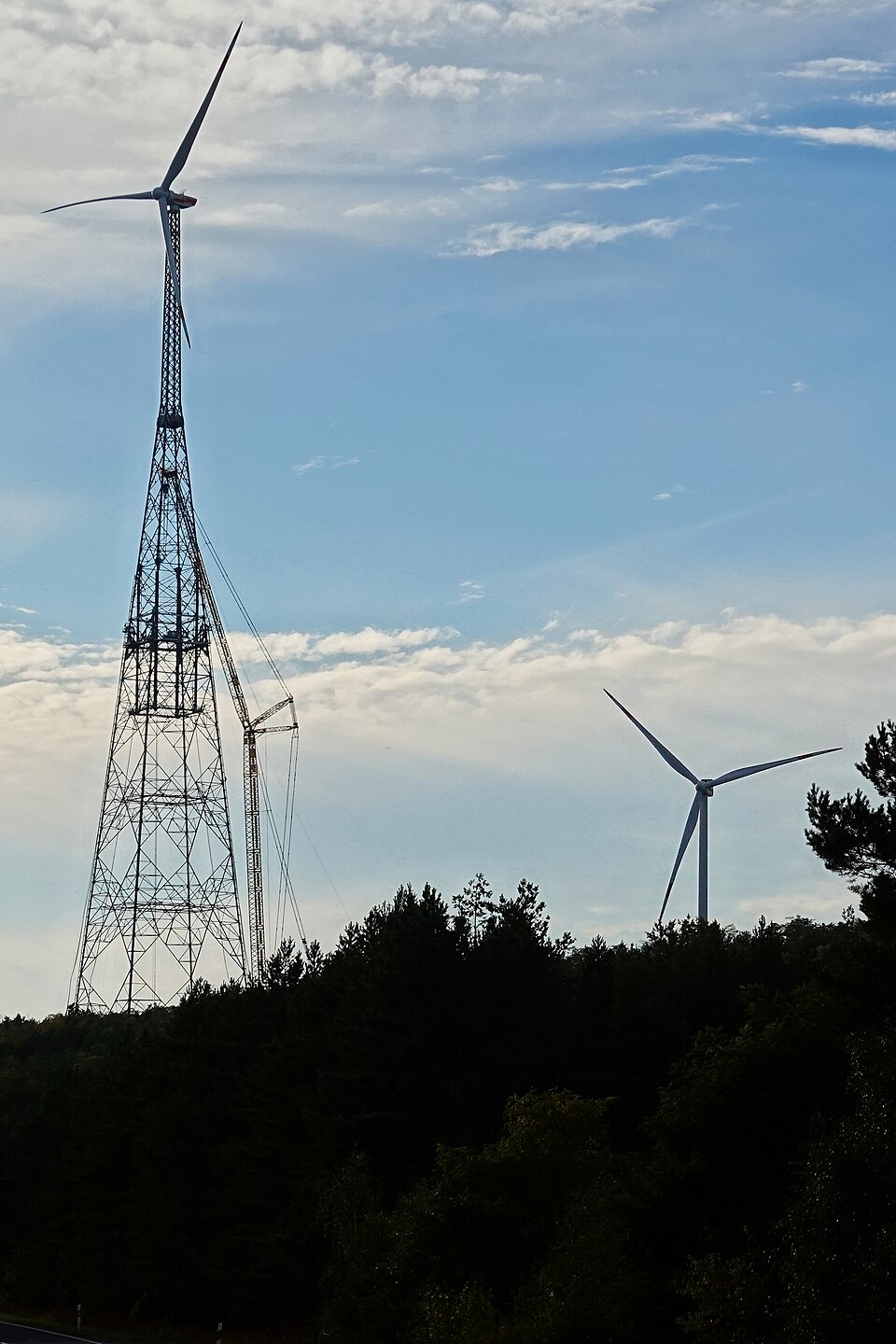
Germany has just pushed wind power into skyscraper territory. Not exactly Burj style, but close. A new wind turbine in Schipkau, in the eastern German region of Lusatia, has reached a total height of 365 meters, or about 1,198 feet, making it the tallest wind turbine in the world.
For perspective, that puts the turbine almost level with the roof of New York’s Empire State Building, which stands 1,250 feet to the roof. It is taller than the Eiffel Tower, which is about 330 meters including its antenna.
The extraordinary turbine was developed by Dresden-based engineering company GICON as a pilot project idea commissioned by Germany’s Federal Agency for Breakthrough Innovation, SPRIND. Its hub sits 300 meters above the ground. GICON says the idea is simple: go higher to reach stronger and more consistent winds.
Why build a wind turbine this tall?

Wind generally becomes stronger and less turbulent as you move farther above the ground, away from trees, buildings and terrain. That matters enormously because the amount of energy available in wind increases roughly with the cube of wind speed. A relatively modest increase in wind speed can therefore produce a much larger increase in available energy.
GICON says that a commercial version of its high-altitude tower could produce roughly twice the annual electricity of a conventional turbine using the same rotor diameter. That figure remains a developer projection to be demonstrated by the pilot plant, which is scheduled for commissioning soon, in November this year.
The concept could also create what GICON describes as “two-storey” wind farms: very tall turbines harvesting higher-altitude wind while conventional turbines work the air below them. If it works, more power could potentially be extracted from an existing wind-energy area without simply spreading turbines across more land.
What does 1,200-foot wind power mean for birds and bats?

Taller does not automatically mean more dangerous to wildlife, but it changes which part of the atmosphere is occupied by the rotating blades. Research suggests the effect is highly species-dependent. A study of 811 turbines in Ontario found that fatalities increased with turbine height for several bat species and for purple martins and tree swallows, while mortality actually decreased for some other bat species. Other research has shown that high-flying bats can enter the rotor zone while many lower-flying species spend much less time there.
That makes pre-construction wildlife surveys especially important as turbines move into previously unused layers of airspace. Operational measures can help too. Researchers have found that temporarily stopping turbines during low-wind nights when bats are particularly active can dramatically reduce collision risks with relatively small losses of electricity.
A 365-meter structure is also a serious aviation obstacle. Germany’s air-navigation authority, DFS, reviews tall structures and can require height restrictions, daytime markings, warning lights or even reject projects where aviation risks cannot be adequately managed. Structures above 100 meters are placed on aviation charts for low-flying aircraft such as rescue helicopters and small personal aircraft and private jets.
For residents, aviation lights have historically been one of the most irritating parts of living near wind farms. There is also the whooosh of the blades. Germany now requires most turbines to use demand-controlled night lighting: instead of blinking red through the entire night, the warning lights activate when aircraft approach.
Height also makes turbines visible from much farther away, increasing their landscape impact, an annoyance if you are living in nature and want to enjoy it. Noise, however, is not simply proportional to tower height. German wind projects above 50 meters require environmental approval and must comply with national noise limits. Shadow flicker, which must be irritating if you had a wind turbine blocking the sun into your room, and visual impact also remain as planning considerations.
Do wind turbines even need three blades?
The industry’s familiar three-blade silhouette may not be sacred either. In recent news, engineers at companies like Envision Energy have been revisiting two-bladed turbines, particularly for very large offshore machines. Properly designed two-bladed rotors can achieve aerodynamic performance close to equivalent three-bladed machines while removing an entire giant blade, cutting weight and materials.
Research on large turbine designs has found only a small aerodynamic efficiency penalty in some configurations, although two-bladed turbines face additional vibration, loading, rotational-speed and noise challenges. In other words, the future wind farm may look rather different from the one we know today: taller towers, perhaps fewer blades, and turbines operating in several layers of the atmosphere.
Germany’s giant energy experiment
The turbine also arrives at an extraordinary moment for Germany’s energy policy. Germany has decided to discontinue nuclear energy and its final three reactors — Emsland, Isar 2 and Neckarwestheim 2 — were shut permanently on April 15, 2023, completing a phase-out whose political roots stretched back decades.
There is now unmistakable regret in parts of German politics. Chancellor Friedrich Merz said this year that he regretted the decision, while also calling the shutdown effectively irreversible as dismantling proceeds. His government has meanwhile stopped opposing nuclear power receiving equal treatment with other low-carbon technologies at the European level.
But Germany’s renewables buildout has continued. Renewables supplied about 59 percent of domestically generated electricity in the first half of 2026, with wind the country’s largest single electricity source. The geopolitical argument for producing energy at home has also become harder to ignore. It might have made sense back in 2023, but with Russia’s invasion of Ukraine forcing Germany to rapidly abandon its dependence on Russian pipeline gas and construct LNG import terminals, Germany has a problem.
Related:The Houthis have taken mocha – what that means for your coffee
Today Norway is Germany’s largest gas supplier, while most LNG landed directly at German terminals comes from the United States. Conflict involving Iran has disrupted energy markets around the Strait of Hormuz, while Houthi attacks and instability around the Red Sea and Bab el-Mandeb have demonstrated how quickly shipping lanes can become strategic energy vulnerabilities.
Germany itself does not depend heavily on Persian Gulf LNG, but it still feels global price shocks. A 1,200-foot wind turbine isn’t just an engineering stunt. It represents something Germany increasingly values almost as much as carbon reduction: energy that doesn’t have to pass through a pipeline, a tanker route, the Strait of Hormuz or anybody else’s war.