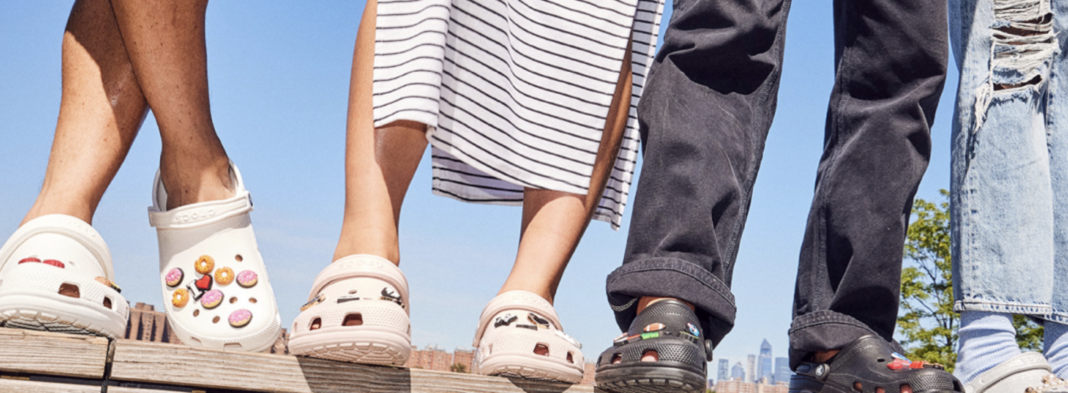

Crocs are the shoes everyone loves to hate, and apparently, everyone loves to wear. The colourful, hole-filled clogs have conquered hospitals, kitchens, gardens and fashion runways. Now Crocs wants us to think about what happens when these seemingly indestructible shoes finally wear out.
On November 4, Colorado-based Crocs announced that its iconic Classic Clog had achieved Cradle to Cradle Certified Circularity Gold Version 5.0. The Classic Clog now contains an average of 29% recycled material, according to the company. The Bae Clog contains 36%, while the limited-edition Keep It Going Classic Clog reaches 42%. These figures use mass balance accounting, meaning recycled inputs are allocated across production rather than necessarily appearing in those exact proportions in every individual shoe.
Approximately 31% of Crocs shoes globally now carry this circularity certification. “Innovation has always been at the heart of the Crocs brand, and this achievement highlights how innovation can extend beyond comfort and style and into circular systems for positive impact,” said Deanna Bratter, Chief Sustainability & Compliance Officer at Crocs.
That’s progress. But does adding recycled material to a plastic shoe make it truly sustainable?
What does Cradle to Cradle actually mean?
The expression “Cradle to Cradle” is credited to Swiss circular-economy pioneer Walter Stahel, who began developing the concept in the late 1970s and early 1980s. It was later developed and popularized by American architect William McDonough and German chemist Michael Braungart in their influential 2002 book, Cradle to Cradle: Remaking the Way We Make Things. This book has informed every sustainable designer in this world since.

The idea is deceptively simple. Instead of making something, selling it and eventually sending it to a landfill, manufacturers design products so their materials can safely return to nature or circulate continuously in industry. Waste becomes food for another process. Biological materials return safely to biological systems. Technical materials are recovered, reused and recycled without becoming hazardous waste.
Real circularity means planning for a product’s next life before its first life even begins. It isn’t simply attaching a recycling symbol to something and hoping for the best. Crocs has introduced its Old Crocs. New Life. collection program in 345 stores across 10 countries. Returned shoes can be reused or processed into a material called Crocs Shred for other applications.
It’s a worthwhile effort, although the certification does not mean Crocs are biodegradable or that every discarded pair will actually be recovered.
Balena is pushing the clog into another dimension


While Crocs is finding ways to reuse conventional footwear materials, Israeli materials innovator Balena is developing alternatives that could change how shoes are manufactured in the first place.m Its BioCirFlex3D material is flexible, 3D-printable and made with 50% to 85% certified bio-based content. Balena which works with sustainable fashion icon Stella McCartney says the material is recyclable and industrially compostable. It can be used to print footwear components and other flexible products, opening possibilities for customized clogs manufactured closer to where they’re needed.
Imagine printing a pair of shoes that can be recycled or processed in an appropriate industrial composting facility at the end of their useful life. Industrial compostability isn’t permission to toss shoes into the forest. Collection infrastructure, suitable processing conditions and responsible design still matter. But companies like Balena are asking the right questions before another billion plastic products enter circulation.
The Seychelles didn’t order all those flip-flops

Consider the beaches of the Seychelles, where discarded flip-flops, plastic bottles and Styrofoam wash ashore. A 2024 scientific study of 53 beach cleanups found plastic debris originating from both local littering and distant sources. Those flip-flops aren’t all souvenirs abandoned by tourists after a swim. Some have travelled across the Indian Ocean, carried by currents, ultimately becoming someone else’s environmental problem.
Who pays to collect them? Who pays for the damaged ecosystems, the cleanup crews and the pollution left behind? Certainly not every company that profited from selling them.
This is where Jeffrey Hollender, co-founder of Seventh Generation and author of the 2026 book Built for a Better World, enters the conversation. He sent me the book this year (it’s signed, thanks!). His work challenges the idea that a successful business can be measured by profits alone, without accounting for its effects on people and the environment.
The argument should go further. Companies need to account for the pollution they generate, including the environmental costs that never appear on their balance sheets.
Please, people. If you build a company, build a product or bring another clever idea into the world, take responsibility for it from beginning to end. There is no more room for businesses that privatize the profits while the public and the planet pick up the bill. Crocs deserves credit for moving toward circular design. But the true test of Cradle to Cradle isn’t a gold certification. It’s whether the products we manufacture can have a useful next life without leaving someone else to clean up the mess.