
Earth. Energy. Everything next.

NASA scientist spends 378 days on “Mars” growing food. What can Earth learn?

Matthew Montgomery spent more than a year inside NASA’s simulated Mars habitat growing vegetables with hydroponics, recycling resources and learning to live within limits. The experiment brings back an old startup ambition: growing food on Mars to help save Earth.

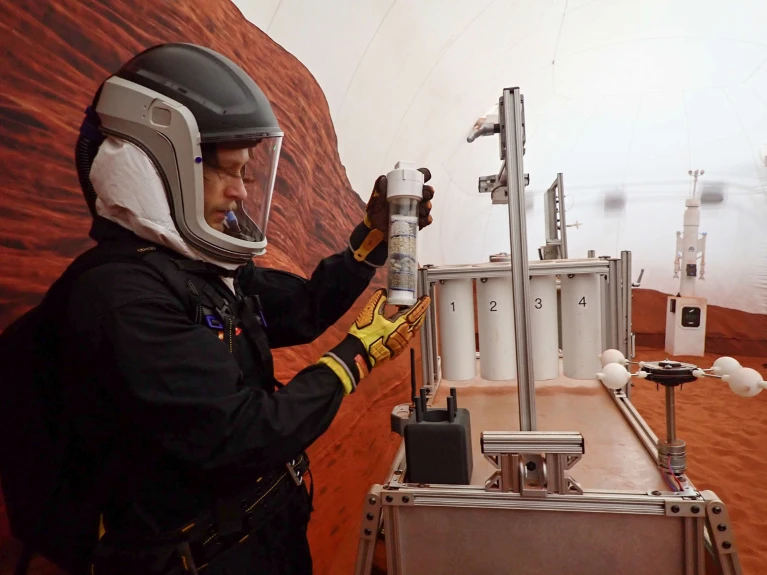
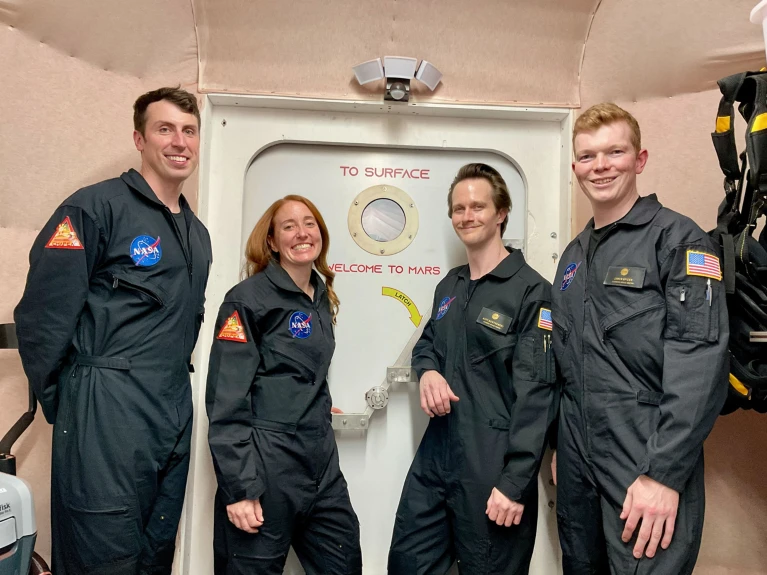
Imagine spending 378 days without opening a window, hearing a bird sing or walking outside to feel the rain. Your world is a 158-square-metre habitat. Every drop of water matters. Every calorie, every watt of electricity and every seed has to earn its place. On October 31, 2026, four engineers emerged from NASA’s Mars Dune Alpha habitat in Houston, Texas, after completing the agency’s second yearlong simulated Mars mission.

One of them, science officer Matthew Montgomery, had spent much of his time growing vegetables. I was particularly interested in his experiments because growing food on Mars was one of the early ambitions behind flux, an agricultural technology startup I co-founded more than a decade ago.

At the time, people thought we were a little crazy. We were building a machine-learning system called Eddy to help farmers understand what their plants needed, particularly in hydroponic farms. We even organized a gathering of future Mars farmers in Jaffa in 2016.

The thinking was simple. If you can grow a tomato on Mars, where every resource is limited, perhaps you can learn to grow one more intelligently in Tel Aviv, Toronto or a drought-stricken village in Jordan.

Growing vegetables without Earth
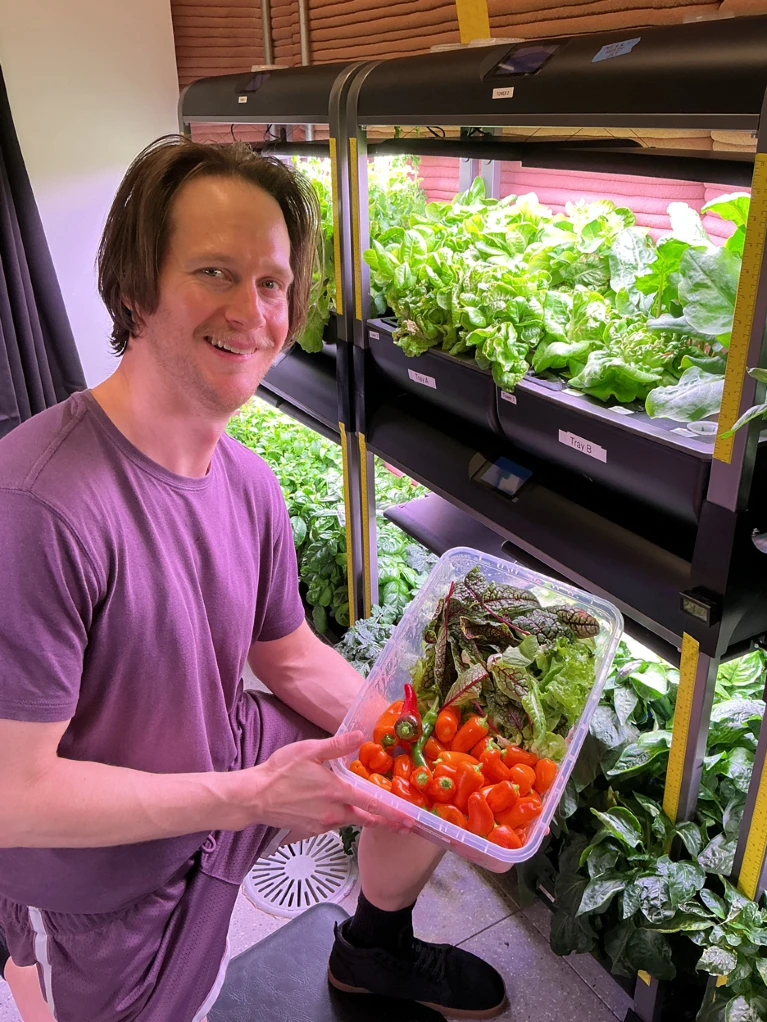
Growing food on Mars: NASA science officer Matthew Montgomery displays peppers and leafy greens cultivated hydroponically inside the Mars Dune Alpha habitat during a 378-day simulated mission. Credit: NASA.

Montgomery arrived at NASA with experience in controlled-environment agriculture, including studying how LED lighting affects crop growth. Inside the simulated Martian habitat, the crew cultivated vegetables in a hydroponic system, growing plants without conventional soil by delivering nutrients through water.

NASA photographs show peppers, leafy greens and other crops thriving under artificial lighting. Montgomery also investigated seed germination using simulated Martian soil, comparing results with a control experiment. But growing food was never simply about nutrition.

In an interview with Nature, Montgomery described the psychological benefit of tending living plants. Even on a simulated Mars mission, a patch of green connected the crew to the world they had temporarily left behind.

In NASA’s own post-mission account, he offered another observation: “It’s really the people that make exploration possible.”

A greenhouse is a spaceship

Hydroponics sounds wonderfully futuristic, but anyone who has operated a system knows how quickly things can go wrong. Water pumps fail. Nutrients fall out of balance. Fungi arrive uninvited. Plants get stressed. Electricity bills become astronomical.

This is why our earlier explorations of Martian food systems were never really just about Mars. We wanted to understand the engineering of survival. A greenhouse is a little spaceship. It has inputs and outputs. Water, light, nutrients, oxygen, heat and human labour have to be managed. When we examined the Emirates Mars ambitions, including concepts for pressurized biodomes and solar-powered settlements, the same question kept returning: how do you create a habitable environment where nature doesn’t provide one for free?

Montgomery and his crewmates confronted a version of that question daily. Their communications with mission control were delayed by up to 22 minutes each way. During a planned two-week blackout, they had to operate without ordinary contact with Earth. There was no calling someone to troubleshoot a broken pump in real time.

Earth is our original Mars habitat
Lessons for Earth: NASA's Mars farming experiments offer a glimpse into the future of sustainable agriculture, where every drop of water, watt of electricity and nutrient must be carefully managed. Credit: NASA.
Lessons for Earth: NASA’s Mars farming experiments offer a glimpse into the future of sustainable agriculture, where every drop of water, watt of electricity and nutrient must be carefully managed. Credit: NASA.

The most compelling lesson from NASA’s experiment isn’t that humans might someday colonize another planet. It’s that we already live inside a closed and extraordinarily fragile system. Earth has an atmosphere, abundant life and a water cycle that makes our existence possible. Yet we behave as though its resources are infinite.

On Mars, nobody would dream of wasting drinking water (even their pee!), throwing away nutrients or designing a food system that consumes more energy than it can reasonably support. (Remember when I went to Brain Bar in Budapest and talked about pee-ponics?)

Why do we tolerate those inefficiencies here?

Our reporting on Martian farming experiments has repeatedly returned to closed-loop systems, where materials are recovered, reused and valued rather than discarded. More recently, research into closed-loop aquaponic systems demonstrated how recovering nutrients and improving water circulation can reduce waste and energy consumption in food production.

These technologies won’t solve every agricultural problem. Artificial lighting and climate control consume energy, and hydroponics is not automatically greener than farming in healthy soil. The challenge is to measure the entire system and make intelligent choices about where resources go. Perhaps that is the real gift of Mars research.

By imagining ourselves stranded on another planet, we begin to understand the miracle of the one we already inhabit. We don’t need to move to Mars to learn how to live within planetary limits. We need to bring that Mars discipline home.


Karin Kloosterman
Karin Kloostermanhttp://www.greenprophet.com
Karin Kloosterman is an award-winning journalist, innovation strategist, and founder of Green Prophet, one of the Middle East’s pioneering sustainability platforms. She has ranked in the Top 10 of Verizon innovation competitions, participated in NASA-linked challenges, and spoken worldwide on climate, food security, and future resilience. With an IoT technology patent, features in Canada’s National Post, and leadership inside teams building next-generation agricultural and planetary systems — including Mars-farming concepts — Karin operates at the intersection of storytelling, science, and systems change. She doesn’t report on the future – she helps design it. Reach out directly to [email protected]

Read More

TRENDING

The Early Believers: Investors Who Backed SpaceX Long Before Its Record IPO

SpaceX’s 2026 IPO didn’t just mint billionaires—it revealed the many forms of conviction behind one of the most doubted bets in venture history.

Mysterious metal space balls wash up on Australian shore

Mysterious metallic spheres dubbed "space balls" washed ashore on Forrest Beach in Queensland, Australia. The objects were identified by the Australian Space Agency as pressure vessels from a space launch vehicle that re-entered Earth's atmosphere, and crews successfully removed the safe debris.

Monitoring farmers’ tillage patterns from space

Tillage is one of the clearest signals of how a farm treats its soil. Intensive plowing can degrade structure, release carbon, and increase erosion. Conservation practices—no-till, cover cropping, minimal disturbance—do the opposite. They build soil, retain water, and support biodiversity. But until now, measuring these practices at scale has been slow, expensive, and often self-reported.

Why we might be missing messages from aliens

Alien signals might be getting scrambled near their own stars before they reach Earth, so scientists searching for perfectly clear signals could be missing them.

Elon Musk to create Mars base station on the Moon

For those unaware, SpaceX has already shifted focus to building a self-growing city on the Moon, as we can potentially achieve that in less than 10 years, whereas Mars would take 20+ years.

Why Bronwyn Finnegan Chose the Nonprofit Sector Over Politics or Corporate Life

Bronwyn Finnegan could have pursued a career in politics or corporate leadership. Instead, she chose the nonprofit sector, where she focuses on financial sustainability, governance and helping mission-driven organizations build the capacity to survive and grow.

Scientists make lead-free perovskite solar cells that can weather the elements

Scientists have developed a “raincoat” for lead-free tin perovskite solar cells, helping them withstand air, moisture and heat while maintaining high efficiency.

The Essential Guide To Sustainability in Project Management

Sustainability is an approach where businesses and individuals balance the environmental, social, and economic aspects of a project such that current and future stakeholders are not overburdened with the impacts of the project in future.

Yerukim Forms a New Green Economy Where the Money is Really Green

The Yerukim members who pick up the recyclables get to keep the monetary reward, the public earns "green" bills that can be used in shops, and business owners get to be associated with environmentalism.

Choosing Riyadh over Dubai? What Investors Should Know

Saudi Arabia is deploying capital at unmatched scale to catalyze tourism and advanced industry while rewiring its power-and-water backbone. The investable frontier is widening—especially in renewables, grid storage, water efficiency/desal retrofits, and hospitality operating platforms. Prudent investors will insist on phased delivery, enforceable KPIs (energy, water, biodiversity), and RHQ/zone compliance—while pricing political-economy and reputational risks alongside growth upside.

Sell your cooking oil for biodiesel money

Want to make money on old french fry oil? Sell it.

Qatar Alternative Energy Summit Pairs Investors And Innovators

Alternative energy investors and innovators can meet n' greet in Doha, Qatar March 16 and 17.

Here’s How To Implement The Four Pillars Of Employee Engagement

If you throw a party for your work team and they are vegans, don't make it a barbecue. Know the sustainability values of your team to boost moral and retain good people.

Popular Categories