
Artificial intelligence is changing the world faster than most people imagined. It helps us diagnose disease, help cancer researchers develop new cures, and through a concept called digital twins, helps companies that deal with real world pumps and pipes, use AI to test theories to make processes more efficient.
With digital twins you need a lot of energy, and the leading AI company Nvidia has just featured Eco Wave Power (NASDAQ:WAVE) in a case study in its ability to deliver clean energy from the power of tidal energy.
As part of London Climate Week 2026, NVIDIA is publishing a corporate feature highlighting Eco Wave Power and the company’s use of NVIDIA accelerated computing, AI technologies, and Omniverse-powered digital twins to optimize wave energy generation and infrastructure planning.
Related: Fujitsu creates digital twin to save the sea
“The NVIDIA feature explores how wave energy, AI-powered optimization, predictive analytics, and digital twins can work together to support future energy infrastructure and help address the growing power requirements of AI factories,” says Eco Wave in a press briefing they sent to Green Prophet.
We’ve written about Eco Wave Power over the years, and have visited their pilot site in Jaffa, reminding us that the future of AI may depend less on software and more on energy.
AI factories consume enormous amounts of electricity, even more than servers do for blockchain and Bitcoin mining. As demand for clean, and carbon-free energy rises, governments and tech companies are searching for clean and reliable sources of power. Until we solve fusion, getting an abundance of clean energy from water, we need to reply on a number of solutions from wind, solar, geothermal, and even wave power.
Wave energy is sometimes called wave power. Unlike solar power, which only works during daylight hours, ocean waves move continuously as the sea shifts along with the moon and the tide. This makes wave energy a potentially valuable addition to renewable electricity systems.
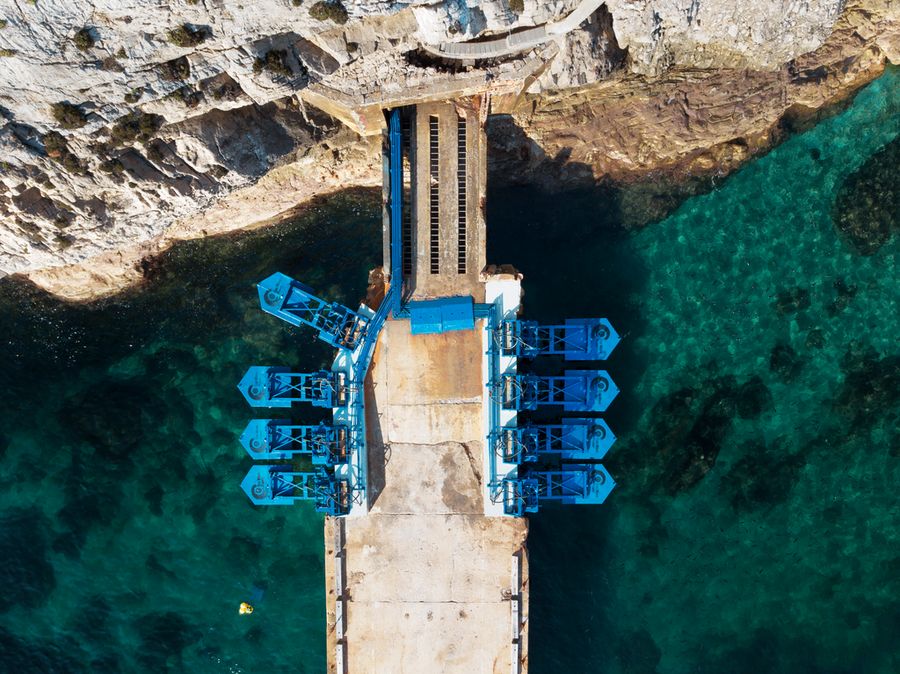
Companies such as Eco Wave Power are developing technologies that convert the natural movement of waves into electricity. Their systems are attached to existing coastal infrastructure rather than requiring massive offshore installations. In some ways the systems even offer a protective layer as waves batter the port, as they do in the coastal Mediterranean Sea city of Jaffa.
The company already operates a grid-connected wave energy power station at the Port of Jaffa, Israel, developed in collaboration with EDF Power Solutions and the Israeli Ministry of Energy. I jog by there several times a week.
“The Jaffa installation is indeed a proof-of-concept project,” a company rep tells Green Prophet, “but it is also a grid-connected power station that generates electricity. It is designed to produce power when wave conditions are suitable, generally when wave heights exceed approximately 0.7 meters.”
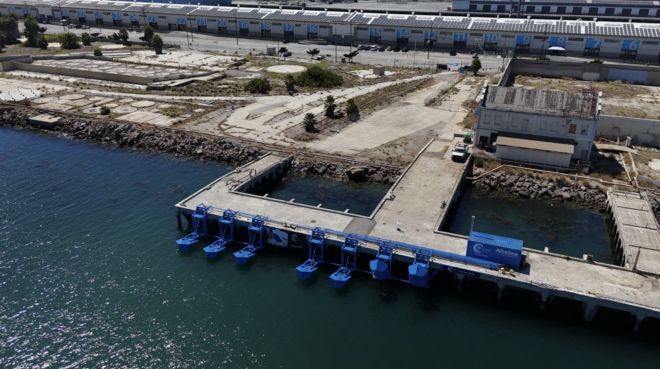
The company has completed another US-based wave energy pilot project at the Port of Los Angeles, California, developed in collaboration with AltaSea and Shell Marine Renewable Energy.
Related: Seanergy pulls energy from buoys at sea
Researchers have explored different marine technologies over the years, including oscillating water column systems. An oscillating water column uses the rise and fall of seawater to compress air and drive a turbine. It remains one of the most studied approaches in marine renewable energy. And we’ve also covered those systems on Green Prophet.
Wave energy is also closely related to tidal hydropower, another ocean-based renewable technology. While tides are driven by gravitational forces and waves are driven by wind, both offer opportunities to generate clean electricity from the sea.
Artificial intelligence may help accelerate this transition. Digital twins, predictive analytics and advanced simulations allow engineers to model wave conditions, forecast maintenance needs and improve system performance before equipment is deployed in the field. By combining AI with ocean power technology, developers hope to improve efficiency and reduce costs.