Morflora’s Plant “Vaccine” Boosts Food Production Without Using GMOs

morflora team plant vaccineA new seed treatment could stop the use and need for GMOs.

Even though organic agriculture and sustainable farming practices are on the rise, feeding a hungry world demands that commercial farmers rely on genetically engineered (GMO) seeds to boost production and fend off diseases. But environmentalists fear that GMO crops are a sort of Frankenstein with unknown future consequences.

The Israeli company Morflora now has an alternative seed treatment in the works that is so revolutionary it is short-listed for Best Novel Agricultural Biotechnology in the 2012 international AGROW awards, and recently won a Red Herring business award in the Top 100 Europe category.

The trademarked product, TraitUP, will be on the market in 2013.

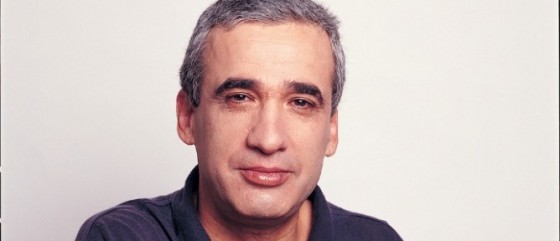
“Our technology is an innovative trait delivery platform. We can deliver any genetic trait to any seed, and the delivered gene does not transform the genome of the treated plant,” Dotan Peleg, CEO of Morflora told me.

“We will not have any moral issues that the GMO community faces. We keep the plant intact so that the next generation of seeds of the plants will look totally unchanged. It is a paradigm shift.”

The Morflora TraitUP solution, in testing in Israeli fields and international seed developers, has the potential to immediately transfer desirable plant traits without any of the side effects or risks of GMOs, Dotan tells ISRAEL21c. It could protect vegetable seeds from infestation, fungus, bacteria and drought. Like a vaccine for plants Recently, Dotan saw for himself the effect of severe drought on cornfields in Nebraska.

Soy crops had better defenses and were able to survive. Could a hardy soy gene be inserted into corn seed to achieve a similar effect? “Once gene trait discovery companies will find this drought-tolerant gene in soy they will have a new way to apply it instead of creating a transgenic crop,” says Dotan. “They can use Morflora to apply these traits via seed treatment, bypassing all the breeding cycles and going straight to enhancing a product already ready for shipment.”

The company is working to create a platform for trait discovery companies to test their prospects.

The technology is like giving the seed a vaccine, inoculating it from foreseeable challenges, with new genetic information that gets erased in any subsequent generation –– just like a mumps or measles shot in humans. Nor does it affect the soil.

The seed treatment would be applied by the commercial seed producer according to each customer’s needs, with no additional steps necessary at the farm level. In the future, Morflora technology could be expanded to the forestry and orchard business to protect trees from specific fungal, insect or bacterial attack. It will also allow the recirculation of old heritage seeds, since new traits can be added that can let them be competitive with the newer treated seeds.

Bringing wild seeds back to life The technology is based on the work of leading agronomists from Israel’s most successful agri-biotech university, the Hebrew University of Jerusalem.

“Forty percent of the biotech research in Israel is coming from the Hebrew University,” says Dotan, pointing to the cherry tomato, long shelf-life tomatoes and other globally licensed products that generate $2 billion in sales annually, he says.

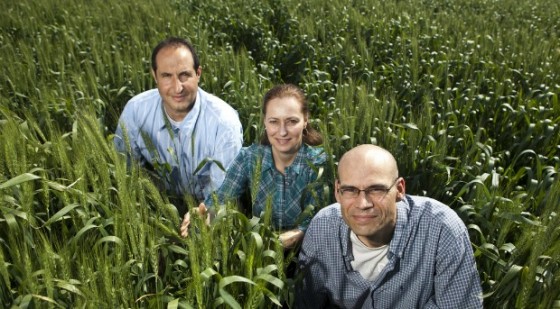
Among the company’s scientists are Prof. Haim Rabinovich, the former dean of the university, who was connected to the company Hazera; and Prof. Ilan Sela, who was involved in the bee vaccine company Beeologics, which was sold to Monsanto. The 10-person Morflora, based in Sharshoret in the Negev Desert, was founded in 2008 with private investment and a license to commercialize the technology from Yissum, the tech transfer arm of the Hebrew University.

This story was first published on ISRAEL21c – www.israel21c.org

Karin Kloosterman
Karin Kloostermanhttp://www.greenprophet.com
Karin Kloosterman is an award-winning journalist, innovation strategist, and founder of Green Prophet, one of the Middle East’s pioneering sustainability platforms. She has ranked in the Top 10 of Verizon innovation competitions, participated in NASA-linked challenges, and spoken worldwide on climate, food security, and future resilience. With an IoT technology patent, features in Canada’s National Post, and leadership inside teams building next-generation agricultural and planetary systems — including Mars-farming concepts — Karin operates at the intersection of storytelling, science, and systems change. She doesn’t report on the future – she helps design it. Reach out directly to [email protected]

Read More

1 COMMENT
  1. Please leave Soy out of any implantation or procedure. It has been found that soy should NOT be used as food. It causes hormonal changes in people and probably animals. It has probably caused much health problems for humans and animals that has not yet been found. It has been proven to cause homosexual traits. China uses a lot and is probably promoting it for food, especially for babies. They do not want young to be born -their one child policy.—-

TRENDING

Who Owns the Farm Robot? A State of Jefferson Startup Takes on Carbon Robotics

In California's self-proclaimed State of Jefferson, a small agricultural technology company is challenging the dominant laser-weeding business model. Laudando & Associates believes farmers should own and repair their AI-powered weeding tools rather than pay ongoing subscription fees. The approach has put the company on a collision course with industry leader Carbon Robotics, sparking a patent dispute that has pushed the Jefferson startup toward overseas markets while raising broader questions about ownership, right-to-repair, and the future of farm automation.

Regenerative Wool or Greenwashing? Zentera Responds to Critics

Zentera responds to questions about ZQ wool, animal welfare, regenerative farming, ethical fashion and the fallout from PETA's New Zealand investigation.

Dan Zaslavsky’s energy tower dream is rising again in Iran and China

The Energy Tower idea never made the leap from drawings and engineering studies to full-scale construction. But nearly two decades after most people stopped talking about it, the concept is quietly evolving in two unexpected places: China and Iran. The concept let dreamers dream and doers do - figuring out more pleasing designs and engineering.

A visit to Amirim, Israel’s first all-vegetarian village in the Galilee

Just 15 kilometers from Tzfat there is a moshav that was founded in the late 50s that was ideologically influenced by organic, vegetarian and vegan principles. My hostess at Ohn-Bar, the tzimmer where I stayed, explained that the people of Amirim were among the pioneers of Israel’s strong vegetarian movement.

Israeli Hydrogen Startup H2Pro Are Trying to Solve Clean Energy’s Hardest Problem

The company has attracted backing from major investors including Breakthrough Energy Ventures, the climate fund founded by Bill Gates, along with industrial partners such as Sumitomo, ArcelorMittal, and Temasek, a multi-billion dollar company that owns Singapore airlines. H2Pro has raised more than $100 million USD and is moving from pilot projects toward commercial-scale deployments.

Yerukim Forms a New Green Economy Where the Money is Really Green

The Yerukim members who pick up the recyclables get to keep the monetary reward, the public earns "green" bills that can be used in shops, and business owners get to be associated with environmentalism.

Choosing Riyadh over Dubai? What Investors Should Know

Saudi Arabia is deploying capital at unmatched scale to catalyze tourism and advanced industry while rewiring its power-and-water backbone. The investable frontier is widening—especially in renewables, grid storage, water efficiency/desal retrofits, and hospitality operating platforms. Prudent investors will insist on phased delivery, enforceable KPIs (energy, water, biodiversity), and RHQ/zone compliance—while pricing political-economy and reputational risks alongside growth upside.

Sell your cooking oil for biodiesel money

Want to make money on old french fry oil? Sell it.

Qatar Alternative Energy Summit Pairs Investors And Innovators

Alternative energy investors and innovators can meet n' greet in Doha, Qatar March 16 and 17.

Here’s How To Implement The Four Pillars Of Employee Engagement

If you throw a party for your work team and they are vegans, don't make it a barbecue. Know the sustainability values of your team to boost moral and retain good people.

Locals From Rishon Fight IKEA

Big Box stores are a pretty new concept in Israel, and thank God that not every Israeli city wants them in their backyard. A word from someone who has see the beautiful farmland around her hometown Newmarket, Ontario stripped and converted into vulgar strip malls of big box shops: they have no place in a healthy and sustainable town or city.

The Jewish National Fund Meets An Inconvenient Truth

According to the JNF, it has transformed thousands of acres of barren land into green forests in Israel. They state that each person emits about 23 tons of carbon per year, estimating that each tree planted can absorb one ton of carbon in its lifetime. That's a whole lot of trees you'd need to be planting. Could so many fit in Israel?

How to quiet noise from construction in your office

Streets need to be resurfaced in New York but the humming and grinding noise is unsettling. Noise is environmental pollution. 

Popular Categories