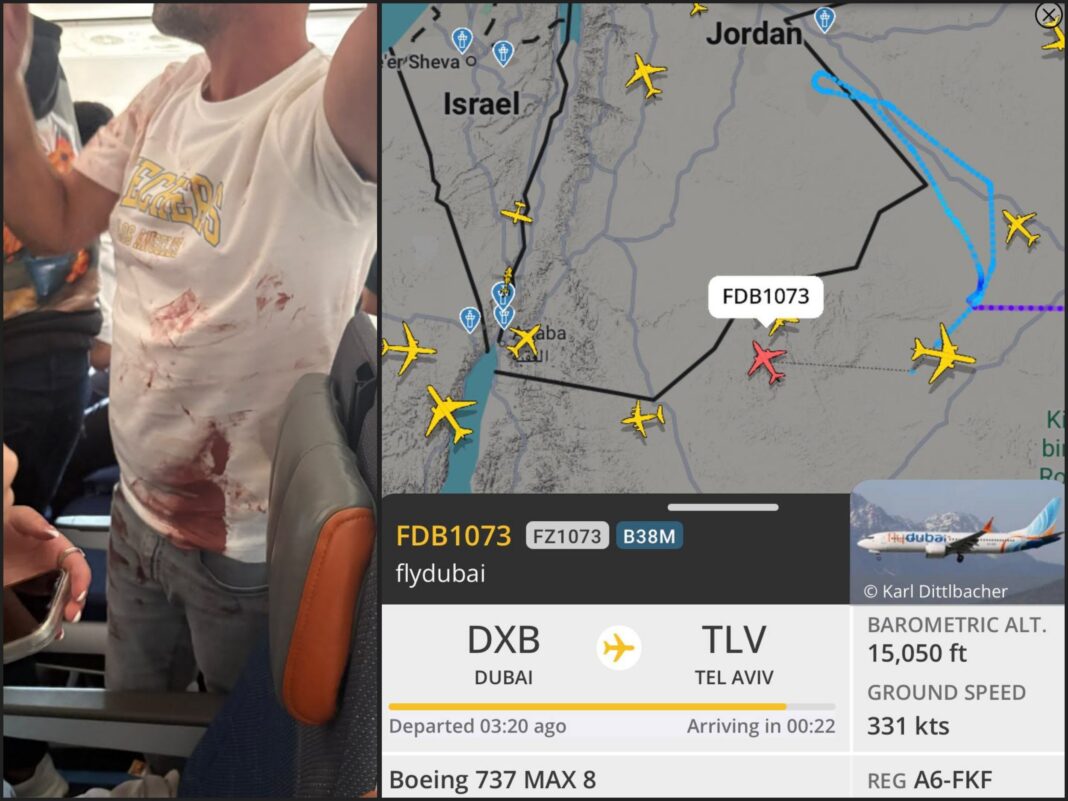

What happened inside the cockpit of flydubai Flight FZ1073 on Wednesday morning is still under investigation, but the story has become considerably more disturbing since the first reports of a “fight between pilots.”
The Boeing 737 MAX 8 had taken off from Dubai for Tel Aviv on September 30 with more than 150 passengers aboard. Ynet, an Israeli outlet, reported 174 passengers, including 27 children. The flight departed Dubai at about 7:05 a.m. and was expected at Ben Gurion Airport around 9:30. Then the aircraft began behaving strangely.
According to flight-tracking data and Israeli reports, the crew first transmitted squawk code 7700, the international code for a general emergency. It then transmitted 7500 — the code used to discreetly signal unlawful interference or a hijacking — before returning to 7700.
The plane turned away from Israel and rapidly lost altitude. Reuters reported that it descended roughly 14,000 feet in less than 30 seconds before ultimately landing safely at Tabuk in northwestern Saudi Arabia. Israeli fighter aircraft were scrambled, and Prime Minister Benjamin Netanyahu and Defense Minister Israel Katz convened an urgent security consultation as Israeli authorities tried to establish whether they were confronting a hijacking.
All the passengers survived. So what happened aboard the plane? At first, the explanation seemed almost absurdly mundane considering the response: the two pilots had apparently become involved in a physical fight and one stabbed the other with a pen knife.
But by midday Wednesday, Israeli reporting was pointing to a much darker possibility that the captain of the plane, suspected as having a Russian or Ukrainian and Omani nationality, may have been trying to crash the plane as a form of terror. Ynet reported that senior figures in the Israeli aviation industry had not ruled out a security incident and were examining the possibility that one pilot had tried to cause the aircraft to crash and that the second pilot, reportedly with assistance from passengers, a couple who were plain clothed pilots, prevented him from doing so.
Either way, this story is terrifying. Local news in Israel are reporting that investigators believe it was a terror attack. There are also reports in Israeli media, not yet confirmed by Saudi, Emirati or flydubai authorities, that the copilot was Omani, the captain may have also been Emirati, and that the copilot attacked or stabbed the captain before allegedly trying to crash the plane.
So many details cannot be confirmed. Witness accounts seen on X, describe screaming from the cockpit and a man with a knife forcing one of the pilots down; evidence of blood was also reportedly seen by the Israelis who busted into the cockpit to subdue the attacking captain of the plain. But crucial details, including who wielded the weapon and precisely what took place inside the cockpit, remain under investigation and may be held secret until after the passengers return home.
Flydubai itself has so far described an “incident” aboard the aircraft and confirmed that its passengers were safe. Saudi authorities, where the Israelis landed, have been questioning the crew. Israel and Saudi Arabia have no formal peace agreement or established relations and neither are allowed in most circumstances to travel to the other’s nation. Israeli Muslims for instance, need to pay a hefty sum to get a temporary Jordanian passport into to travel to Mecca on an annual Hajj pilgrimage.
“We were attacked on this plane. They tried to murder the pilot,” an Israeli witness says, recounting the horror on board.
That leaves two very different scenarios on the table: an attempted act of terrorism against an aircraft carrying a large number of Israelis, or an extreme personal or psychiatric crisis involving a pilot. Both situations are intensely frightening.
A pilot deliberately bringing down an aircraft is extraordinarily rare, but there are precedents. The best known is Germanwings Flight 9525. On March 24, 2015, copilot Andreas Lubitz waited until the captain left the cockpit, locked the reinforced door and deliberately commanded the Airbus A320 into a descent toward the French Alps. All 150 people aboard were killed.
French investigators later established that Lubitz had a history of severe depression and was experiencing symptoms consistent with a serious psychiatric episode before the crash. The BEA concluded that he intentionally altered the autopilot and prevented anyone from re-entering the cockpit.
Two years earlier, LAM Mozambique Airlines Flight 470 crashed in Namibia, killing all 33 people aboard. Investigators concluded that the captain, left alone in the cockpit after the first officer went to the lavatory, deliberately changed the Embraer 190’s altitude setting from 38,000 feet to a height below the surrounding terrain. The first officer could be heard trying to get back inside as the aircraft descended.
Then there is the remarkable case of Richard Russell. Russell was not a pilot at all. He was a Horizon Air ground-service employee at Seattle-Tacoma International Airport who, on August 10, 2018, gained access to an empty Bombardier Q400, moved it into position and simply took off.
For more than an hour he flew over Puget Sound while military F-15s followed the aircraft and air-traffic controllers tried to persuade him to land. Russell ultimately crashed on Ketron Island and died alone. Federal investigators concluded that he acted alone. The episode is particularly unsettling because it demonstrated that the human security problem in aviation is not limited to trained pilots: a trusted employee with aircraft access can become an insider threat.
Research into aircraft-assisted suicide has found no single psychological profile that explains these events. Documented factors have included depression and other psychiatric illness, relationship breakdown, legal or financial crises, occupational conflict, substance abuse and acute negative life events. A systematic review of aviation murder-suicides stresses that suicide and homicide-suicide are also not the same phenomenon and should not simply be lumped together as “pilot suicide.”
And the phenomenon is exceptionally rare. One review of thousands of fatal American aviation accidents calculated aircraft-assisted pilot suicide at roughly one third of one percent. Yet, this is important when considering the flydubai incident. A mental-health crisis is possible, but “mental health” should not become a convenient explanation before investigators know what actually happened.
If investigators are considering terrorism, they will need to establish things such as whether the Tel Aviv destination and Israeli passengers were deliberately targeted; whether there was prior planning; whether the suspect expressed ideological motives; whether communications or digital evidence point toward radicalization; and whether the alleged attempt to crash the aircraft was intended as a political act rather than an act of personal violence or suicide.
If evidence eventually shows that a crew member tried to destroy an Israel-bound passenger jet because the people aboard were Israeli or Jewish, the terrorism designation would follow from that intent, not from the man’s passport.
The distinction matters particularly in the Gulf, where flydubai’s Tel Aviv route is itself a product of the extraordinary changes in regional aviation following the Abraham Accords. Reuters notes that flights between the UAE and Israel routinely use Saudi and Jordanian airspace, routes that would have been politically difficult to imagine only a few years earlier. I have flown on FlyDubai and found it to be a convenient and fast way to travel to Thailand. Will I wonder before booking my next flight on this carrier? One-hundred percent. If mental illness or terrorists are an “inside job” we need to start holding airlines accountable for the people they entrust with others’ lives.
Commercial aviation has become astonishingly safe partly because almost every mechanical failure imaginable has been anticipated, documented and engineered around. Germanwings led regulators to reconsider medical confidentiality, psychiatric screening and the risks created when a single pilot is left alone behind an impenetrable security door. Researchers since then have also warned that pilots may conceal psychological difficulties if asking for help threatens their medical certificate and career. Better safety may therefore require not simply tougher psychological screening, but systems in which pilots can seek treatment early without automatically losing their livelihoods.
There is an environmental dimension to this story, although it should not overshadow what happened aboard FZ1073.
Green Prophet has followed the recent opening of shorter aviation corridors through the Gulf because direct routes mean less fuel burned, lower emissions and fewer unnecessary hours in the air. Regional cooperation can make aviation both more efficient and less carbon intensive. But those efficiencies depend on something more fundamental: trust. What happens when Israelis land in Saudi Arabia?
Reports on the ground show that do to a supersonic dive the plane lost part of its rudder.
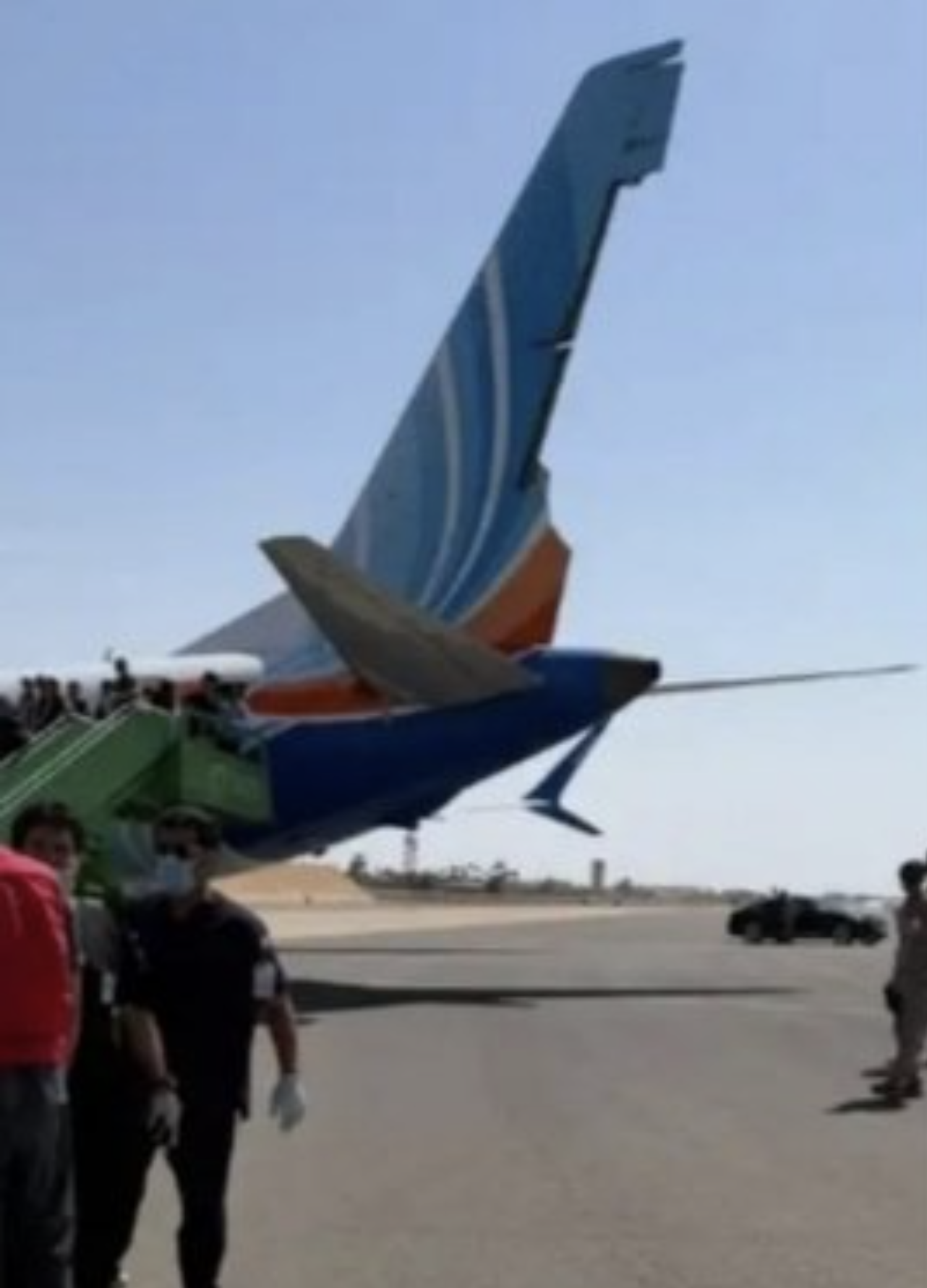
For the moment, that successful landing is the one fact that is not disputed. What happens next will be on the tip of everyone’s tongues as we commemorate 911 and the harm caused by murderous, savage people who work in the west to destroy it from within.
Breaking: a second flight from Dubai has been diverted to return to Dubai. According to reports on X, flydubai flight (FZ1081) from Dubai to Tel Aviv has been diverted and has announced that it is returning to Dubai. The reason is currently unknown.