


Since October 7, 2023, attacks on shipping have left vessels burning, oil spreading across the Red Sea and Persian Gulf, and sensitive marine habitats under threat. Are environmental organizations doing enough?
An oil tanker burns in the Strait of Hormuz. Another leaks crude near endangered whales off Oman. Oil washes onto Iranian beaches. In the United Arab Emirates, authorities close beaches as pollution spreads toward sensitive coastal ecosystems and desalination plants.
Since Hamas attacked Israel on October 7, 2023, the conflict has spread across the Middle East. Iran-backed Houthi militants began attacking commercial shipping in the Red Sea, followed by direct military confrontations between Iran, Israel and the United States.
The environmental consequences have been enormous. Ships have sunk, fuel has leaked, sailors have died and fragile marine ecosystems have been exposed to pollution.Where are the environmental protests? Where is the sustained international outrage?
In October 2026, the Panama-flagged crude tanker Gem No. 2 was reportedly struck by an unidentified projectile off the UAE coastline, causing a fire. By late October, satellite imagery showed an oil slick estimated at approximately 160 square kilometres. Authorities closed beaches around Umm Al Quwain, while neighbouring Sharjah closed Al Hamriyah Beach as a precaution.
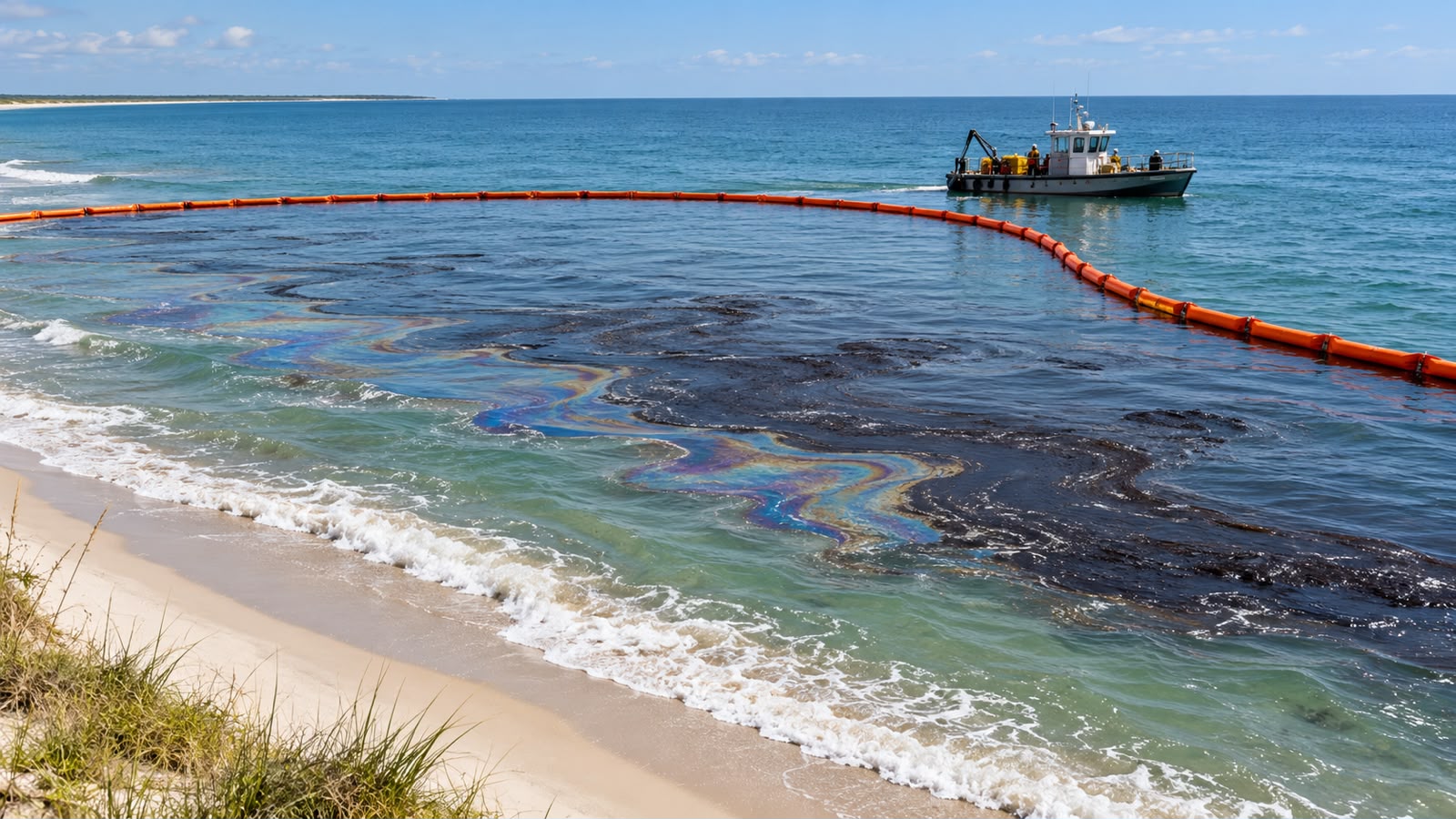
The pollution also raised concerns about seawater desalination infrastructure, which supplies much of the UAE’s drinking water.
Oil threatens Oman’s endangered humpback whales
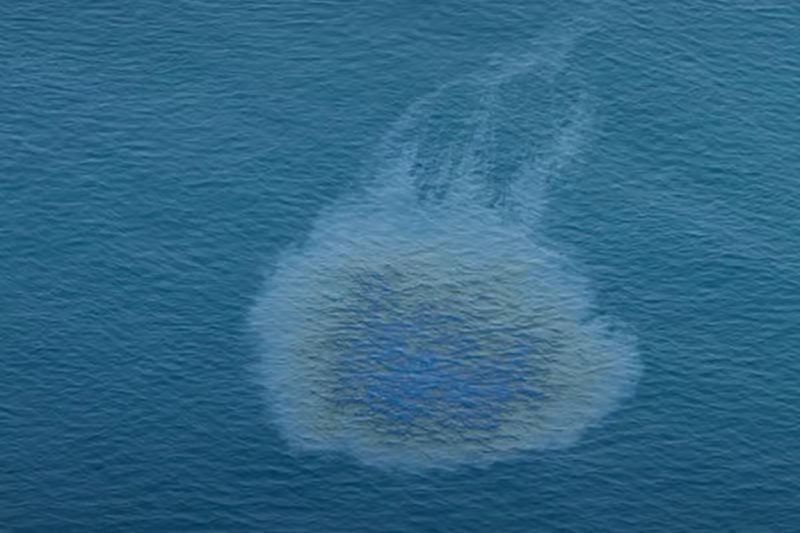
The Caroline Bezengi, carrying nearly one million barrels of Russian crude, leaked oil near Oman’s Hallaniyat Islands Nature Reserve during the summer of 2026. The protected waters support one of the world’s rarest humpback whale populations, as well as sea turtles, coral reefs and seabirds. Reuters reported that the spill had continued for more than two months, with estimates of the slick ranging from approximately 390 to 600 square kilometres. Nothing seems to be being done about it.
In August 2026, oil pollution reached Iran’s Qeshm Island after an attack on the bulk carrier Minoan Pioneer near the Strait of Hormuz. Satellite images showed a spreading slick, although investigators could not establish every detail of the contamination.
Qeshm’s mangrove forests, coral habitats and marine wildlife make it particularly vulnerable to oil pollution.
Houthis set a tanker carrying one million barrels of oil on fire
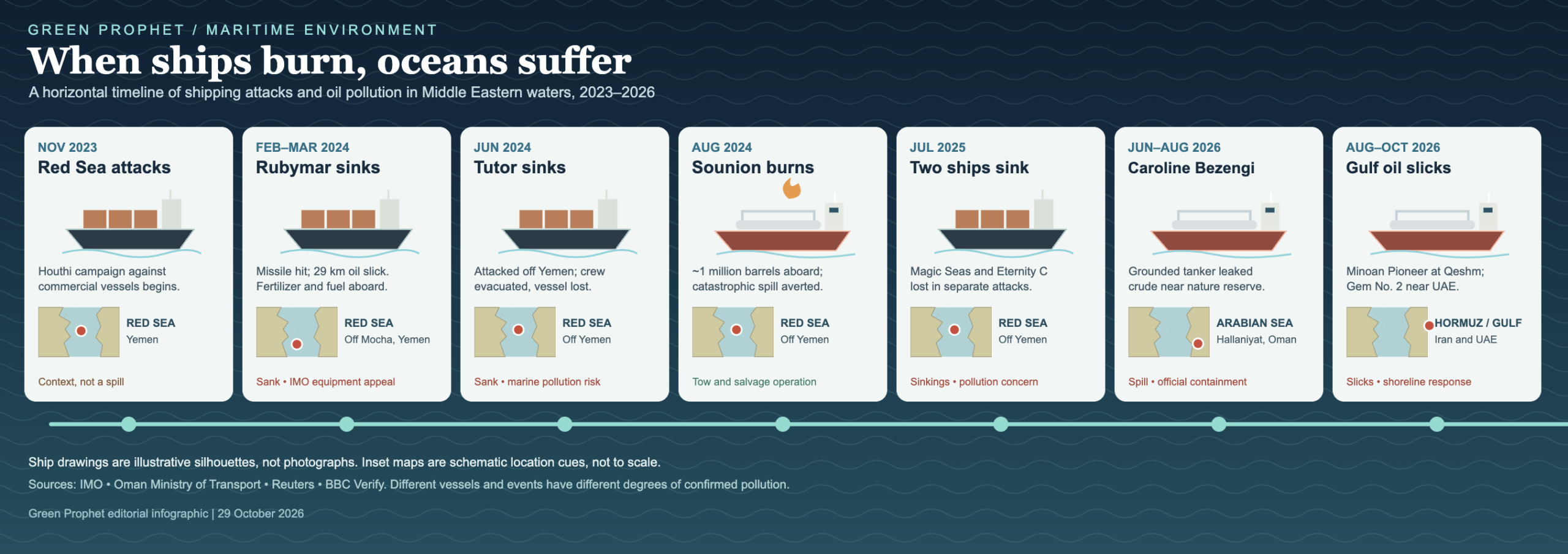
In August 2024, Yemen’s Iran-backed Houthis attacked the Greek-flagged Sounion in the Red Sea. The tanker was carrying approximately one million barrels of crude oil. Fires broke out across the vessel after repeated attacks. The International Maritime Organization warned of potentially catastrophic environmental consequences.
European naval forces eventually helped secure and tow the tanker to safety, preventing a major spill. The Red Sea escaped a disaster that could have devastated its coral reefs, fisheries and coastal communities. Following the recent attack on the MV Sounion in the Red Sea Mr. Arsenio Dominguez, Secretary-General of the International Maritime Organization (IMO) said:
“I am extremely concerned about the situation regarding the tanker MV Sounion which was targeted while transiting the Southern Red Sea. The tanker is carrying some 150,000 tonnes of oil on board, that is approximately one million barrels of crude oil.
“This is yet another unacceptable attack on international shipping, putting the lives of innocent seafarers at risk. I am grateful to all those involved in the rescue efforts for ensuring the seafarers have now all been safely evacuated.
“The risk of an oil spill, posing an extremely serious environmental hazard, remains high and there is widespread concern about the damage such a spill would cause within the region.”
Rubymar sinks with fertilizer and fuel
Not every environmental disaster involved a crude-oil tanker. In February 2024, Houthi militants struck the cargo ship Rubymar. It sank in the Red Sea on March 2. The ship carried approximately 22,000 tonnes of fertilizer, 200 tonnes of heavy fuel oil and 80 tonnes of marine diesel. According to the International Maritime Organization, the damaged vessel left a 29-kilometre oil slick. The remaining fertilizer and fuel posed further risks to the biologically rich Hanish Islands. There was no outrage from Greenpeace.
More ships sink in the Red Sea
The Greek-owned coal carrier Tutor sank following a Houthi attack in June 2024. Evidence of oil was reported near the wreck. In July 2025, Houthi attacks sank two additional cargo vessels, Magic Seas and Eternity C. According to the IMO, satellite imagery showed a large oil slick near the last known position of Magic Seas.
Human Rights Watch described the attacks on the two ships as apparent war crimes. Yet no one seems to be campaigning against these acts on college campuses or in the UN. Why is that?
Where is Greenpeace?

Greenpeace has not ignored the situation entirely. In March 2026, Greenpeace Germany documented more than 85 large oil tankers trapped in the Persian Gulf and Strait of Hormuz, carrying at least 21 billion litres of oil. Its researchers modelled the potential consequences of tanker spills and warned about threats to coral reefs, mangroves and seagrass habitats. Greenpeace Middle East, however, has been inneffectual and I guess it’s because they are HQed in Lebanon and are captured by the Hezbollah.
Meaningless “warnings” are not the same as sustaining an international campaign. Environmental organizations have spent decades demanding accountability from oil companies for spills, pipeline leaks and offshore drilling accidents. Shouldn’t deliberate attacks on commercial vessels carrying oil and hazardous materials provoke equally forceful environmental campaigns? Why do quiet?
Shouldn’t the Houthis be held accountable for the environmental risks created by their attacks in the Red Sea? Attacks on Mocha and holding sinking ships full of oil accountable? Shouldn’t Iran’s military actions and those of every other party be scrutinized for marine pollution?
When a tanker burns because of a missile strike, the ecological consequences can be just as serious as those of an industrial accident. Why should the identity or political sympathies of those responsible influence the environmental response?
The Red Sea’s coral reefs cannot take sides
The Red Sea contains remarkable coral reef ecosystems, including populations that scientists are studying for their unusual tolerance to high temperatures. The Persian Gulf and Gulf of Oman support mangroves, seagrass meadows, fisheries, sea turtles and rare marine mammals such as the rarest whales.
All were already under pressure from climate change, coastal development, industrial pollution and oil production. Now they face burning ships, oil slicks, unexploded weapons and hazardous cargoes resting on the seabed.
Greenpeace and other environmental organizations are right to campaign against fossil fuel pollution and the environmental consequences of war. But those principles must apply consistently, whether the damage occurs in Israeli, Iranian, Yemeni or Emirati waters.
Environmental organizations should demand transparent investigations, emergency cleanup funding and accountability for those who deliberately put civilian shipping and marine environments at risk.
An oil slick cannot distinguish between an Iranian missile, a Houthi drone or a negligent oil company. Luckily Green Prophet is here to call them out. When the next tanker goes up in flames, the environmental movement should be among the first to demand answers.