
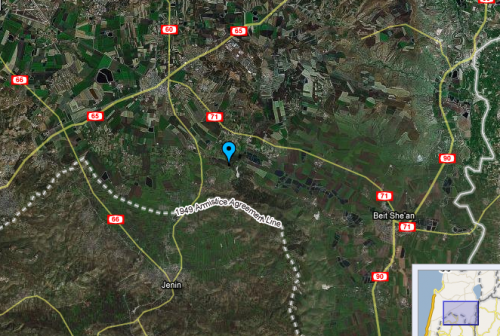


(Map of Nurit, from Google Earth)
It’s one thing to adopt environmentally conscious behavior, such as recycling, taking public transportation, and saving water or electricity. But that’s not enough for the future residents of the now developing community of Nurit. They plan to live green.
That’s because the Mt. Gilboa town of Nurit is set to be the first planned, eco-friendly community in Israel, with infrastructure and services designed not just to encourage, but to actually enforce environmentally responsible behavior. If you’re planning on living in Nurit, says Danny Atar, chairman of the Gilboa Regional Council, you’re by definition willing to go out of your way to save water, avoid excess waste, and in general reduce your carbon footprint. “Otherwise, Nurit is not for you,” he says.
The idea for Nurit stemmed from discussions conducted by Gilboa Regional Council officials nearly a decade ago, as they were seeking to build tourism in the area, as well as comply with new government requirements to introduce environmentally responsible educational programs and activities.
“We are also considering putting up a new town to attract more residents here from the center of the country, and the whole project just sort of made sense,” Atar tells ISRAEL21c. “Thus was Nurit born.”
First homes ready in a year
And, after intense study and consultations with environmental experts around the world, the town is ready for prime time; work has begun on infrastructure, and the first 100 homes will be ready next year. By 2012, there will be 400 families living in Nurit, Atar says.
Located on Mt. Gilboa itself, Nurit will take advantage of the mountain’s wind and sun to generate power, and will install dozens of wind turbines and photovoltaic (PV) solar panels, enough to provide electricity for all the public buildings in Nurit – and then some.
“We recently got approved for a program by the Israel Electric Company, where residents and public buildings will be able to mount solar PV units on their roofs and sell the electricity to the IEC,” says Atar.
“Together with turbines to generate electricity from wind, we expect that the electricity we generate will be enough to light most of the schools, offices, streetlights, and park lights in Nurit – as well as save homeowners money on their energy bill, since they can get credits for the power their roof PV systems generate that they don’t use, selling it back to the IEC.” Atar says.
The regional council has a program that provides loans for residents to buy and install the PV panel setup, or residents can design the systems into their construction plans, he adds.
Trees as cooling canopy
Residents will also be asked to grow tall, leafy trees around their homes, creating a natural “cooling canopy” that will help cut down on the need for artificial cooling and heating systems, “saving electricity and reducing pollutants in the atmosphere,” Atar says. And, residents will be asked to build their homes using effective insulation systems, to further reduce the need for air conditioners or heaters. “We hope to be able to limit the use of artificial heating and cooling solutions to the hottest or coldest days of the year,” Atar says.
Nurit residents will be required to save water – naturally. “In theory, Israel gets more than enough rainfall, but much of the rain is lost to evaporation or runs off to the sea,” Atar says. “We are requiring all residents to build rain collection systems and mini-reservoirs to store rainwater. The water will then be funneled into the town reservoir, allowing us to cut down significantly on our use of water from Mekorot, which is drawn from either the Kinneret or Israel’s underground aquifers.”
With the Kinneret [the Sea of Galilee] at an all time low, and Israel scrambling to build desalination plants to make up for projected water shortages, Nurit’s efforts could serve as a model for other, non eco-friendly communities as well.
Saving rainwater is important, but saving “gray water” is even more important, say many environmentalists – and Nurit is requiring all homeowners to install a gray water collection system, which will store waster water from dishwashing, bathing, and other non-sewage (“black water”) sources.
The storage of gray water entails building a separate drainage system, which funnels the water into a tank – and is then used for a variety of purposes, such as watering gardens, decorative fountains, etc. “No one in Nurit will be permitted to use fresh water to water his or her lawn,” Atar says. “Residents will use gray water to water their lawns and run watering systems for plants or orchards.”
Unfortunately, Nurit won’t be able to encourage its residents to trade in their cars for commuting by train, because there is no Israel Railways line in the area, at least for now. But the town will have a complete complement of local and inter-city bus service for those who need to travel. Actually, it is expected that most of Nurit’s residents will work in the area, either at home businesses, in tourist-oriented services such as bed and breakfasts or restaurants, or at one of the industrial zones in the area.
“Many of the homes have been zoned for use as businesses as well, so a resident can operate a small business in their backyard,” Atar says. “There is an industrial zone three minutes out of town, mostly with light manufacturing or agriculture industry allied services. And tourism in this region is expected to skyrocket when regular horse racing begins at the Afula Hippodrome, only a few minutes from here,” he adds.
Nurit is open to anyone willing to live by the town’s eco-friendly ethos – and many Israelis are willing, apparently, because there is already a long waiting list for lots.
“We’ve already got about 700 families who have made a deposit to get into the lottery for a chance to buy a plot, with more signing up all the time,” Atar says. “The lots, which will have extensive infrastructure to support the gray water drainage and reservoirs system, cost $120,000 to $150,000 – not particularly high for people coming from the center of the country, where many of the Nurit hopefuls come from, and certainly not expensive, when you consider the cost of the infrastructure.”
Most applicants are from big cities – Tel Aviv, Jerusalem, Haifa and its suburbs. A few people from the kibbutzim in the area have signed up as well, but the majority are new to the lower Galilee. Which already makes Nurit a success, as far as Atar is concerned. “This is a beautiful part of the country to live in, and thanks to Nurit, hundreds of families are going to get the opportunity to find out just how beautiful it really is,” Atar says.
(This article was printed with permission by ISRAEL21c – www.israel21c.org)



We need to be careful when new communities deign to call themselves “eco” despite the fact that they are building entirely new suburbs in heretofore undisturbed natural areas. The residents of Nurit can live without refrigerators, but living in an ecological paradise away from other already built towns will make them dependent on their cars and will require huge amounts of energy, raw material, and open space to be consumed for the measly 400 families who choose to go green – in this case, a very very light shade of it.
Beyond the near criminal consumption of open space at a time when Israel is facing real land shortages is the issue of how places like Nurit are exclusive upscale communities that tend to attract well-off, mainly Ashkenazi Jewish families at the expense of Israel’s medium sized cities.
Last year another “eco” community was slated to go up in the Western Negev. Read a scathing review of it here. http://www.haaretz.com/hasen/spages/841397.html
We are a company, which contact you about the newest of
technology of solar energy.
We would like to get with you in order to realize Israel first
eco friendly town.
Please contact us. We have a lot of experiences in Germany, Italy
and Spain.
We can get a financing of a project with very low interest.
I’m looking forward to get in touch with you.
Your’s sincerly
Eitan Katz
office-Invest