
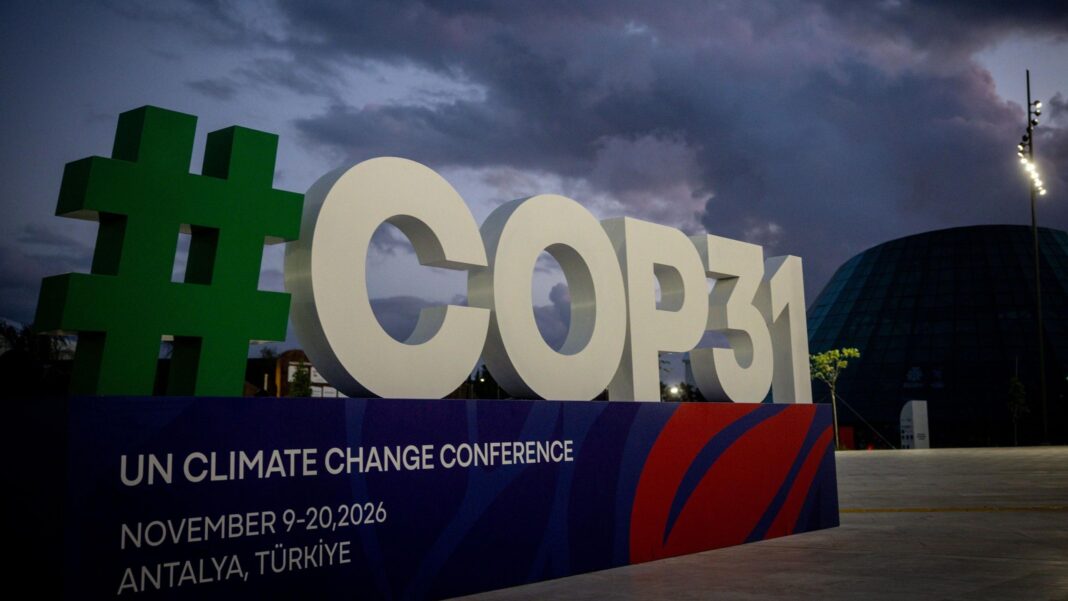

Seventeen years after the Copenhagen climate summit collapsed into disappointment, world leaders have once again failed to agree on how to confront the main cause of global warming.
The United Nations COP31 climate conference in Antalya, Turkey, ended on November 22, 2026, without an overarching agreement after nearly 200 countries spent two weeks negotiating the future of the planet. The United States was absent from the formal negotiations, having withdrawn from the Paris climate agreement. The sticking point was astonishingly familiar: countries could not agree on language calling for a transition away from fossil fuels.
The last time a UN climate summit failed to produce its central political agreement was in Copenhagen in 2009. At the time, Green Prophet reported on the Middle Eastern response to the Copenhagen summit and the competing interests of countries whose economies depended heavily on fossil fuels. Our coverage of the disappointing COP15 outcome reflected the frustration surrounding a summit that had promised a historic breakthrough.
Seventeen years later, atmospheric carbon dioxide concentrations have continued to climb, temperatures have broken records, and governments are still arguing over whether oil, coal and gas should be explicitly named in a climate agreement.
In 2010, British scientist and Gaia theory pioneer James Lovelock reflected on the failure of Copenhagen, telling The Guardian: “I don’t think we’re yet evolved to the point where we’re clever enough to handle a complex a situation as climate change.”
Seventeen years later, his observation seems painfully relevant.
What happened at COP31?
The European Union, Britain, Pacific island nations and other countries rejected the proposed Antalya Pact because the final draft failed to explicitly mention fossil fuels. Saudi Arabia and other oil-producing nations had resisted stronger language, despite the scientific consensus that burning coal, oil and natural gas is the principal driver of human-caused climate change.
The failure was particularly awkward for Turkey, which hosted the talks while continuing to develop its own energy infrastructure, including the Russian-built Akkuyu nuclear power plant, and maintaining a substantial dependence on fossil fuels.
Yet COP31 was not entirely without progress. A voluntary initiative supported by more than 90 countries sought to increase electricity’s share of global final energy consumption to 35% by 2035, up from roughly 23% today. Expanding electric transport, industrial electrification and modern power grids could reduce dependence on fossil fuels, although the climate benefits depend heavily on how that electricity is generated.
Carbon dioxide removal also emerged as a significant subject of negotiation. Proposals to expand carbon capture, storage and technologies that remove CO2 already in the atmosphere reflected growing recognition that emissions cuts alone may not be enough to bring temperatures back down after the world exceeds 1.5°C of warming. Critics warned, however, that reliance on expensive, unproven removal technologies at scale could provide another excuse to delay reducing fossil fuel consumption.
There was also a more sobering shift in the conversation. The prospect of temporarily overshooting the Paris Agreement’s 1.5°C threshold was increasingly treated as a reality that governments must confront, rather than a distant possibility. That is not the same as abandoning the Paris goal, but it reflects how far the world has drifted from the pathway envisioned in 2015.
The frustrations are hardly new. Following the Copenhagen collapse, Green Prophet reported that the 2010 Cancun climate summit ended on a slightly more hopeful note, with progress on climate finance, forest protection and carbon capture. But even then, the negotiations struggled to produce binding commitments strong enough to confront the scale of the problem.
Five years later, the world celebrated a breakthrough in Paris. The 2015 agreement established the goal of holding global warming well below 2°C while pursuing efforts to limit it to 1.5°C. Yet as Green Prophet asked in its coverage, what did COP21 in France actually conclude? The agreement depended largely on countries voluntarily setting and strengthening their own emissions targets.
Climate finance remained another major source of disagreement at COP31. Wealthier countries faced demands to provide more assistance to developing nations struggling with drought, floods, rising seas and other consequences of a warming planet. The summit adopted some narrower decisions but failed to settle its central political disputes.

There was also the familiar contradiction of fossil-fuel-dependent countries hosting climate negotiations. In 2024, Green Prophet examined how Azerbaijan hosted COP29 while suppressing climate activists and journalists. Two years later, Turkey’s role as host again raised questions about how countries building or maintaining fossil fuel infrastructure can lead negotiations intended to move the world away from it.
Meanwhile, temperature records offered their own verdict. Berkeley Earth estimated a 97% chance that 2026 would become the hottest year on record, although other climate monitoring agencies offered more cautious projections. Either way, the past 12 years are set to be the warmest in recorded history.
The next UN climate conference, COP32, is scheduled for Addis Ababa, Ethiopia, in November 2027.
Green Prophet has been reporting on these negotiations since the early days of the Copenhagen summit. Back then, we were asking whether the Middle East could move beyond its dependence on fossil fuels and whether the world’s biggest emitters would accept responsibility for their emissions.
Seventeen years later, the technologies are better, renewable energy is cheaper, and the scientific warnings are louder. What has not changed nearly enough is the political will.
The world has moved beyond pretending climate change is not happening. It has yet to agree on what to do about the fuels driving it.