

Saudi Arabia is planning on building the world’s largest cities, 15-minute cities like the linear city The Line and The New Murabba in Riyadh and plans to do all this building sustainably. How will people living in these urban centers be fed fresh salad greens, tomatoes and cucumbers on demand? Hydroponics or soilponics as it is mainly done in Israel, feeds just the roots of the plants a nutrient-laden water.
This hyper-efficient way of growing food is how you grow fresh food in the desert while minimising resources. It also works in space – I was interviewed by Fast Company about it. Of course regenerative organic farming would be the goal for humanity: it’s a practice where you nourish the soil and the environment, but we don’t have time for that: until 1 in 20 people want to become farmers, we need to compromise with hydroponics and on a large-scale. And that’s where Saudi Arabia is headed.
RedSea, a Saudi AgTech business built by immigrants, just made a MoU deal with the Saudi Downtown Company (SDC) – a fully-owned subsidiary of the Public Investment Fund (PIF). PIF is owned by the Saudi Government. The new partnership aims to invest in, build and operate RedSea greenhouses at SDC locations.
This is obviously great news for RedSea and its ability to develop its greenhouse business across Saudi Arabia.
RedSea has attracted $18.5M USD in strategic investment so far because it takes a fortune to scale a tech and farm business. The company has just rebranded from being a farm company to being a tech company. There are two separate websites.
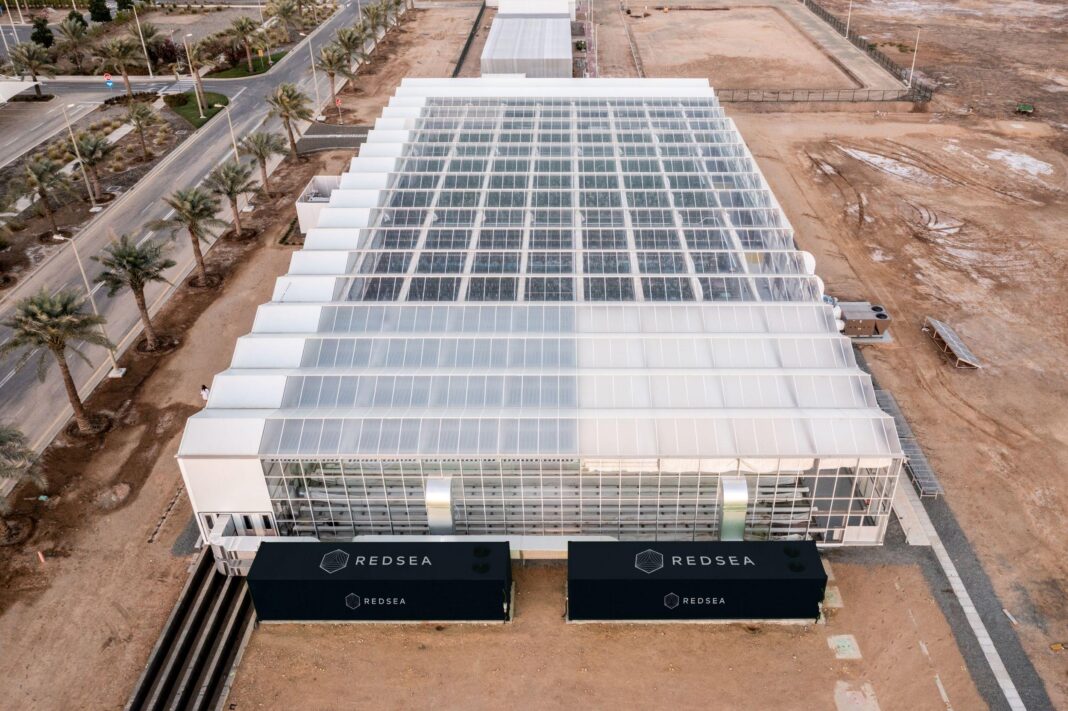
RedSea uses science to design sustainable agriculture technologies for very hot climates. RedSea’s technologies span from the roots of the fruits and vegetables to the roof of the greenhouse and have been proven in its 6-hectare facility near Riyadh and its research and development facility in KAUST, the King Abdullah University of Science and Technology. See the image above.
The Red Sea is also the major body of water that surrounds Saudi Arabia on the west.
The aim is for these greenhouses is to provide a platform to enhance the quality of life and promote economic growth across 12 Saudi cities. Hydroponics is very labor intensive so no doubt RedSea will be hiring.
The partnership, according to RedSea, will help highlight the rich culture and traditions of each area. I know that greenhouses growing food in Harlem, New York City have helped women connect to food in a personal way. As for RedSea, its greenhouses aim to become attractive destinations for visitors in their own right through their creative experience and culinary-driven offerings.
New job and training opportunities for locals can be expected in the horticultural management, juice bars and cafes.

America’s desert agriculture engineer Ryan Lefers, now the CEO and a co-founder of RedSea, said: that “the facilities themselves are designed as experience centres for community visitors whilst also providing agriculture education as well as economic advantages.”
RedSea now has its technology deployed in seven countries and is currently delivering produce to over 100 retail locations across Saudi Arabia, under the Red Sea Farms produce brand. This partnership is part of the portfolio of high-profile sustainable farm facilities RedSea is building, including RedSea Global and Silal.
Downsides of hydroponic farming no one wants to talk about
Hydroponics and greenhouse agriculture is often celebrated as being without a doubt “sustainable” but it still relies heavily on added nutrients from petrochemical industries.
Water is still needed for the processes and the actual amount is usually under-reported. The ultimate solution for desert greenhouses is building them near the sea and providing water from desalination using solar panels nearby the greenhouses. See seawater greenhouses in Abu Dhabi and Qatar. ReaSea is also using seawater in its processes.
Lighting and cooling, when used intensively like in cannabis farming, is not sustainable. Saudi Arabia gets enough sunlight year-round so that won’t be their problem.
Plastics rule the industry in sheets on the sand or in pipes and trays that hold the plants and where the water flows. The food we eat may then carry trace amounts of plastics and questions arise on the life-cycle of these plastics. See a story on tires in your lettuce.
Size, scale and location next to urban centers is critical for any hydroponics business model to work. I’ve spoken with people in the business who say that urban farmers running single-family container farms is a sham (email me for names), and buying into them makes it impossible to recoup investments – unless you are a growing a high-value crop like cannabis or wasabi.
We see that smaller-scale hydroponics like Infarm didn’t scale correctly or had a flawed business model and laid off half its staff in December. Consider this: if you have 100 small farms in a city like Berlin a lot more can go wrong in terms of quality control and management than if you run one large farm that supplies 100 shops in Berlin.
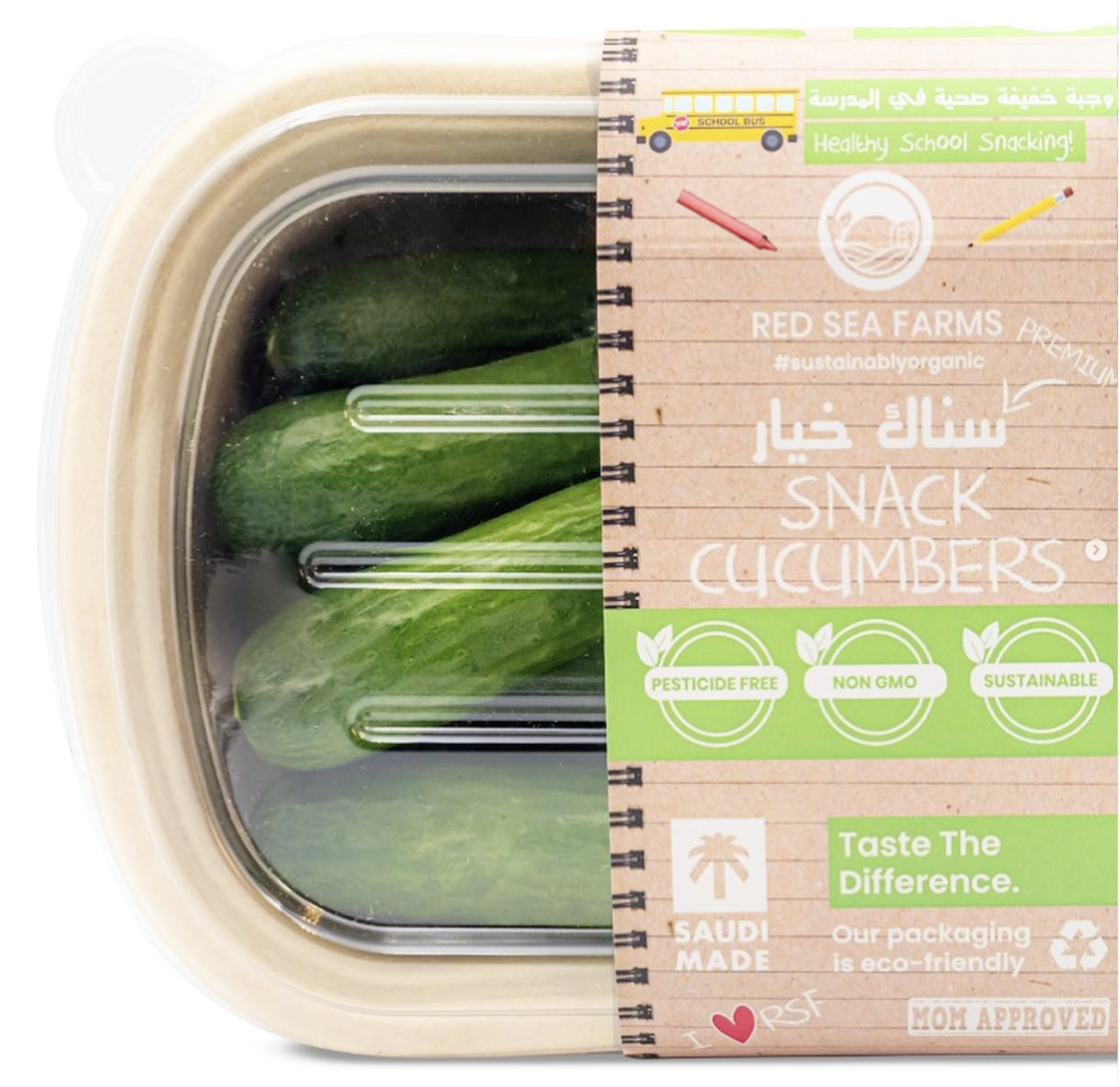
Plastics in packaging also rule the vegetable industry when it comes to hydroponics. I’ve seen produce in Canada shipped in individual plastic boxes. A regular head of lettuce grown in the soil isn’t given so much honor. Red Sea Farms have announced that they use sustainable packaging.
I think the RedSea venture is an exciting one for the Middle East. This region can avoid the mistakes of large-scale commercial farming being made in the United States and with round-the-year sun teach the world something better about desert farming. No doubt it will be a draw and a big learning opportunity for the Dutch, Canadians and Israelis who already excel at hydroponics. The Dutch for their stubbornness and excellence in growing in greenhouses. The Canadians who finessed hydroponics when cannabis was not legal.
The ancients in the Middle East always managed somehow.
Tech advances developed by RedSea
RedSea has proprietary technologies including a transparent nano-material which allows visible light through while absorbing the heat. They have built a smart enterprise remote monitoring and control system enabling higher yields and sustainability for agriculture producers in hot climates globally. RedSea’s goal is not just growing food but developing agricultural technologies for hot environments.
::RedSea