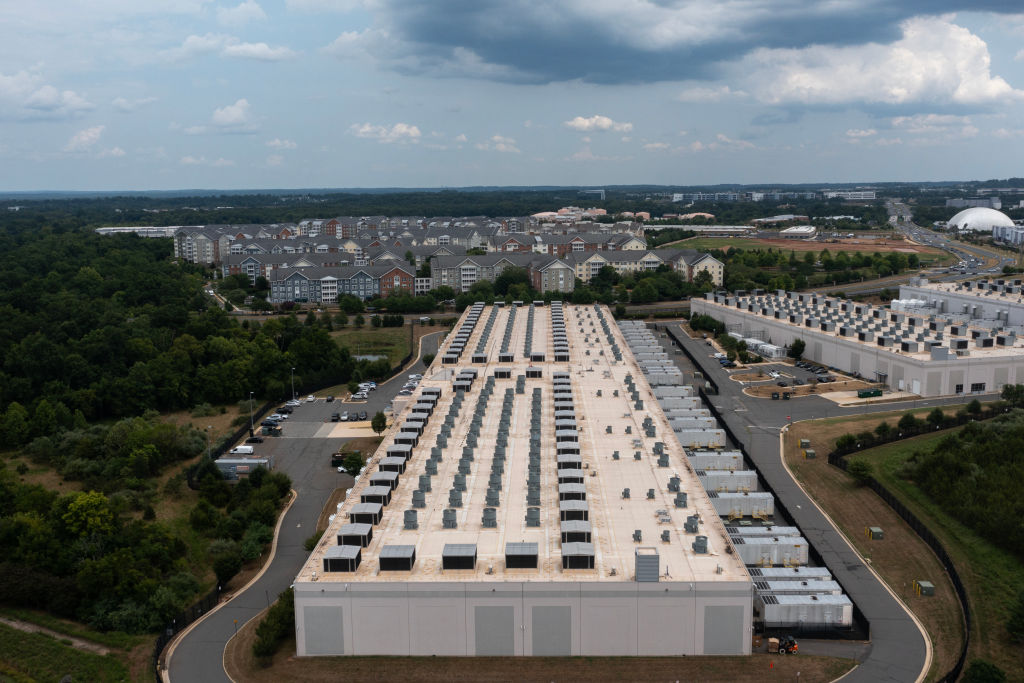

Northern Virginia is the largest data center market in the world. It also leans heavily on diesel.
Sierra Club Virginia counts roughly 10,500 backup generators in the region, with combined capacity close to 27 gigawatts, plus a smaller number of on-site gas turbines. Most of the time they sit silent. They are tested regularly, though, and they fire up in earnest during grid-stress events, when demand across the region spikes at once.
That timing is the catch. Routine testing happens on a schedule, but a heat wave or a grid emergency can push many units to start together. Emissions that are easy to overlook from one generator look different when dozens run within a few miles of homes and schools.
For residents of Loudoun and Prince William counties, the question is simple: what comes out of those stacks, and how often?
Three pollutants, one yardstick
Diesel generators give off a familiar mix of pollutants. Three get the most attention from regulators and public health researchers:
- Nitrogen dioxide (NO2) – Linked to short-term respiratory effects, particularly for people with asthma
- Carbon monoxide (CO) – Tied to short-term cardiovascular strain, especially for people with heart conditions
- Fine particulate matter (PM2.5) – Small enough to lodge deep in the lungs and associated with longer-term cardiovascular and respiratory risk
The EPA’s National Ambient Air Quality Standards give the yardstick:
- NO2 – 100 parts per billion over one hour
- CO – 35 parts per million over one hour
- PM2.5 – 35 micrograms per cubic meter over 24 hours
Any new monitoring data in Loudoun County gets measured against those numbers.
Where a monitor sits matters as much as what it measures. Pollutant concentrations tend to be highest close to a source and fall off with distance, so a monitor placed a mile from a generator yard can tell a very different story from one near the fence line. The choice of sites in a network like this deserves as much scrutiny as the readings themselves.
Inside Virginia’s monitoring pilot
In February 2026, the Virginia Department of Environmental Quality (DEQ) began answering that question directly, with funding from the EPA. The network rests on a few key choices:
- Seven monitors in Loudoun County – Chosen from a list of 22 candidate sites
- A validation point – One monitor sits at Broad Run High School in Ashburn, co-located with DEQ’s existing regulatory station so readings can be checked against an established reference
- An airport site – Another sits near Dulles International Airport
- Calibration first – Each unit went through a seven-day calibration period before data collection began in March
The monitors are Kunak AIR Pro units, sensor-based monitoring stations made by Spain’s Kunak Technologies, which has published a case study on air quality monitoring near data centers covering the pilot. DEQ runs the project. Kunak supplied the equipment.
Phase two moved into Prince William County in June 2026. Phases three and four, which would add a mobile reference station, only happen if the first two turn up elevated levels.
The co-location at Broad Run High School is the detail worth watching. Placing a sensor-based monitor next to an established regulatory station lets DEQ compare the two sets of readings side by side. If they track each other, confidence in the rest of the network goes up. If they drift apart, that is a flag to investigate before anyone draws conclusions.
What the data shows so far
Through May 2026, DEQ’s readings stayed under the federal standards at every site:
- NO2 – Hourly levels never rose above 35 ppb, against a 100 ppb standard
- CO – Stayed below 2.6 ppm, against a 35 ppm standard
- PM2.5 – Never exceeded the 35 µg/m³ standard at any site
A quick look at the headroom helps. At most, hourly NO2 reached about a third of its one-hour standard, and CO stayed under a tenth of its limit. PM2.5 is harder to read. All we have is a ceiling of 35 µg/m³, which says it stayed within the standard, but not how much room there was.
That invites an easy headline. It also needs a caveat.
This is a screening network, built to flag where closer attention might be needed. The results are preliminary and cover a single spring. They do not yet capture summer peaks, or simultaneous generator runs during a major grid-stress event.
A clean spring does not settle the question for a hot August afternoon.
Monitoring expands as permitting transparency shrinks
The pilot is running against a political backdrop that pulls the other way. Diesel backup generators were a top concern heading into Virginia’s 2026 legislative session, Virginia Mercury reported in January, and lawmakers were still debating how to regulate them in February.
Then, in July, the EPA proposed removing public participation and transparency requirements from minor-source air permits, the category that covers most data center generators.
Sierra Club Virginia’s July 9 reaction called it an exemption deal for data centers. A hearing took place July 22, and comments closed August 21.
Environmental and community groups point to the contrast: more public monitoring in Loudoun County, just as oversight of the generators themselves is pared back at the federal level.
The permit category matters here. Minor-source permits cover most data center generators, and the public comment step is often how neighbors learn what is being built nearby and raise questions before it runs. Take that step away and communities may get less warning, at the same moment a sensor network is giving them more data. Those are the critics’ arguments, and the EPA’s own stated rationale is worth reading alongside them.
A template before the complaints arrive
Northern Virginia is not the only place racing to build AI infrastructure. The UAE and Saudi Arabia are developing large AI campuses of their own, with different climates and different pressures on air quality.
Hot climates, fast-growing grids and a rush of new campuses mean backup power will matter there too. Building monitoring in from the start means there is a baseline to compare against once the campuses are running.
The Virginia model of continuous monitoring, co-location with a reference station and public data is a template regulators elsewhere can adopt before the complaints start, not after.
For communities near a growing cluster, the pilot suggests a short list of asks:
- Siting near people – Monitors close to homes and schools, not only at site boundaries
- Validation – Co-location with a reference monitor so the numbers can be trusted
- Near real-time publication – Public data, not an annual summary
None of that answers whether the air in Loudoun County holds up across a full year of generator testing and grid-stress events. It does mean there is now a public record to check.