
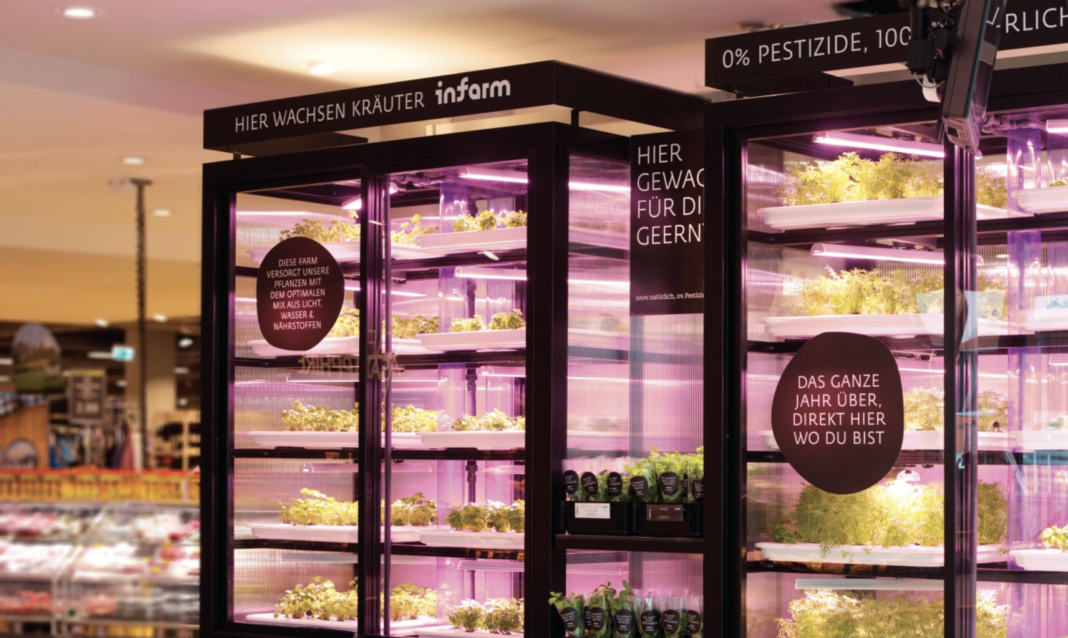


They were the darlings of Europe: an Israeli team planted in Berlin turning the city’s food source from unsustainable to super local. They were building grow chambers in supermarkets for fresh herbs and lettuce and the idea spread like wildfire. Like most and maybe all urban farming projects that rely on hydroponics – growing food in water, with nutrients added, unless you are selling cannabis products (medical marijuana), vertical farming is yet to make much sense beyond education and as a social project.
I know because I had a venture in this space (using IoT and robotics) for about 5 years and time and time again I heard from urban farm owners how difficult it was to turn a profit. Some also told me that no urban farming container project would ever make money. The amount of labor and energy inputs, not to mention set-up costs were prohibiting profitable businesses. Unless, of course, you were using the grow containers to grow weed, making it VERY profitable. The cost of weed per ounce versus the cost of lettuce? You do the math.
Back to this story: in 2020 with Covid fears for food security abounding, InFarm raised millions ($170 million USD to add “farms” to cities). The startup had farms in about 1,800 retail stores in 11 countries. Well we know they aren’t really farms because real farms have dirt and hard manual labor and manure.
Infarm also raised about $604.5 million from the Qatar Investment Authority, Lightrock and others. Like Amazon, Twitter and Meta, Infarm grew faster than it could sustainably handle.
The penny dropped in a recent letter to employees called “Infarmers”. About 50% of the staff would be let go. Could it be that cash-strapped Europeans are now buying non-organic or less local produce as they look to save money on rising fuel costs? No doubt rising fuel costs in Europe amount to higher costs for a venture that relies on electricity for food.

Here’s part of the letter the team sent to their staff. It is abridged.
Infarmers: In our current setup, we recognise that Infarm cannot withstand the challenging market conditions, particularly with regards to escalating energy prices and tough financial markets. We have to adapt our ambitious growth targets and increase our efficiencies to make our business profitable, and continue the pursuit of our long-term mission.
The tough reality is that this shift and the reduction of our production sites will have a significant impact on people. Exact numbers are still to be determined, but current proposals mean that over half the workforce (around 500 employees) will leave the company.
Recently, some critical market factors have worsened, these directly affect our industry and our operations. Energy prices have escalated (doubled across Europe), which puts a lot of additional pressure on our business and seriously impacts our cost of production in affected markets. This is in addition to inflation, supply chain disruptions and rising material costs. Economically, this is a difficult period across the globe and many people and businesses are impacted.
What Infarms are working
- Frankfurt (Germany), Copenhagen (Denmark), and Toronto (Canada) will stay. In these markets, we have established strong retailer relationships and secured contracts of significant volume and can therefore achieve profitability in 2023. In addition, we will open our Growing Centre in Baltimore (Maryland, US) to serve the tri-state area,” the letter states.
- We are proposing to downsize our operations in the UK, France and the Netherlands.
- We will optimise our InStore farming network to key clusters.
- Further, by prioritising our high-yield industrial scale farming units (ACREs) we will continue to reduce production costs and resource use resulting in better-priced and more sustainable produce for consumers. We have already achieved yields of more than 100 kg/ m2/year for herbs, 150 kg for lettuce and have record breaking harvest performance of more than 95%.
- We will relocate our modular ACRE farming units to the newly defined core markets.
- In Japan, we are reviewing our operations.
Urban farming downturn
Infarm is just one of a series of indoor farming companies to announce layoffs and/or shutdowns. Also in November, the Netherlands-based Glowfarms stopped all activities, and the US vertical farm Fifth Season closed shop. The indoor farm robot startup Iron Ox laid off 50% of its staff and Texas’ AppHarvest reported it’s running out of cash.
Cannabis operations or the growing of high-value nutraceutical crops may save tech greenhouses made for food at least until we have free, sustainable energy. But the move needs to happen fast.


, vertical farming is yet to make much sense beyond education and as a social project. )