
In a time where it seems like we need to choose light or dark, fear and hope, building or destruction, some stars and models lend their voices and faces to a solution to what appears to be the world’s biggest challenge right now: climate change. They have played a part in making a movie that explains regenerative agriculture and it’s called Kiss the Ground.
We humans call it climate change, and the problem might not be a problem at all but a clarion call for a bigger reset, the way Covid-19 retested some of our personal goals, family-life orientation, and how we spend our time and with whom. The movie will help us take some steps.
The big catchphrase in the ecosphere – which to many is a spiritual place for understanding what we want to build on this planet – is regenerative agriculture. If you plan on hanging out with conservationists or anyone who speaks the language of a future viable planet, this is what they are talking about. Rewilding (by bringing nature back to what it should be) sometimes goes along with that but not exclusively.
Regenerative agriculture is a method of farming (read about this regenerative farm in Saudi Arabia of all places) which swings way back to the way our great-grandparents would have farmed. This is systems-thinking farming, considering the whole, not the parts, and brings in animals, plants, soil, and people into equal parts, minus heavy machinery, mono-crop thinking and commercial fertilizers (mined from places like the shrinking Dead Sea).
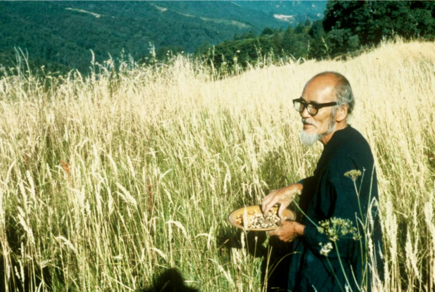
One of the early proponents of this new-old way of farming was a Masanobu Fukuoka. He was born into a wealthy family in Japan, and against what everyone was expected to do at the time, he listened to his inner compass, and became a renowned farmer and philosopher celebrated for his natural farming and re-vegetation of desertified lands. He died in 2008, but before then crossed the planet many times missionizing his approach to farming for body, mind and soul.
Fukuoka (shown below) was likely inspired by the ancient Japanese “Walden” called Hōjōki, translated as The Ten Foot Square Hut – a popular short work of the early Kamakura period in Japan by Kamo no Chōmei. This philosophy of living simply (bare minimum) and with nature in mind, is later expounded by Henry David Thoreau in America in the late 1800s. You know him as Walden and the pond he lived at for a couple of years. He grew his own food, and lived simply as one educated man could at the time.
Consider that traditional farming depletes the soil and releases carbon dioxide into the atmosphere. We don’t want that. But it’s not “new” science. Decades ago, an Indian scientist named Rattan Lal, born in 1944, helped start a movement based on the idea that carbon could be put back into the soil — a practice known today as “regenerative agriculture.” And it’s having a moment.
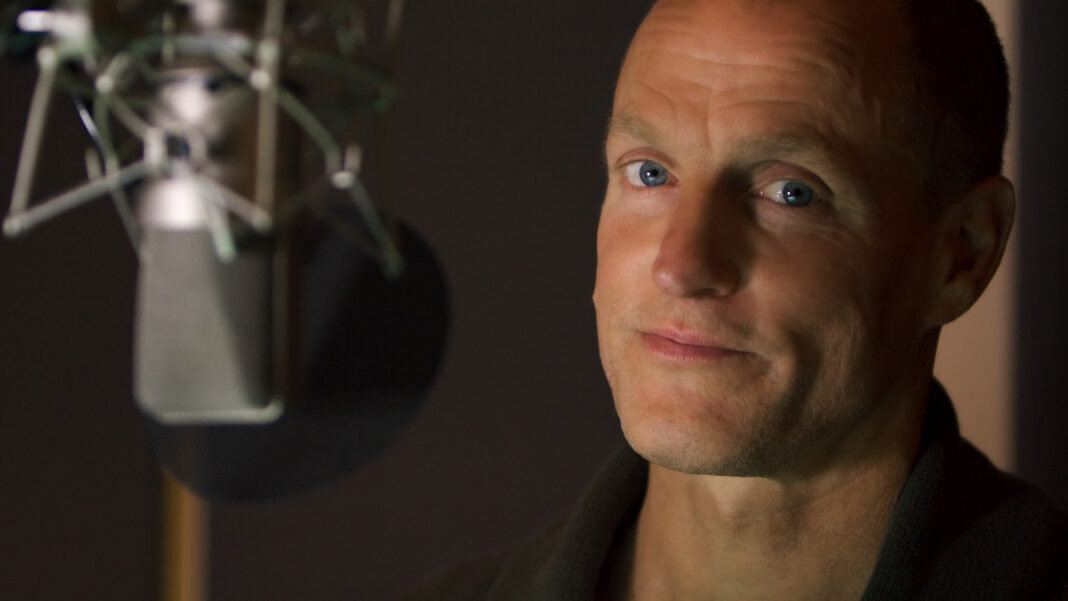
Building on what was before now, a new film narrated by Woody Harrelson offers a solution to the pickle we are in – or the pickle we think we are in. There is a solution: (it’s not necessary to suffer the foibles of going Into the Wild) but it’s something tangible we can work towards toward healing the world, healing ourselves. We can do it in cities and even from our home offices.
In a time when farming is absolutely romanticized (some meanly say fetishized) and working the land an antidote to our online addiction, the new film Kiss the Ground explains to the everybody how we can build a blueprint for stabilizing Earth’s climate, restoring lost ecosystems and creating abundant food supplies. The trailer is below.
Al Gore gave us the problem we know we needed to solve. Does Kiss the Ground give us the handbook on making it work? Stars of the film include Harrelson (who narrates), Ian Somerhalder, Gisele Bündchen, Jason Mraz, David Arquette. Producers are Rebecca Tickell, Josh Tickell, Bill Benenson, Ryland Engelhart and Darius Fisher.
I heard the expression Kiss the Ground, not from the mouth of a cute Woody Harrelson, but from my friends in Venice, LA who like to learn about how they can be part of the solution. There is an NGO there in Venice with the mission to “awake” the woke with activities that include participation in the story of regenerative agriculture, mostly hard to do if you live in an apartment and spend your waking hours at WeWork.
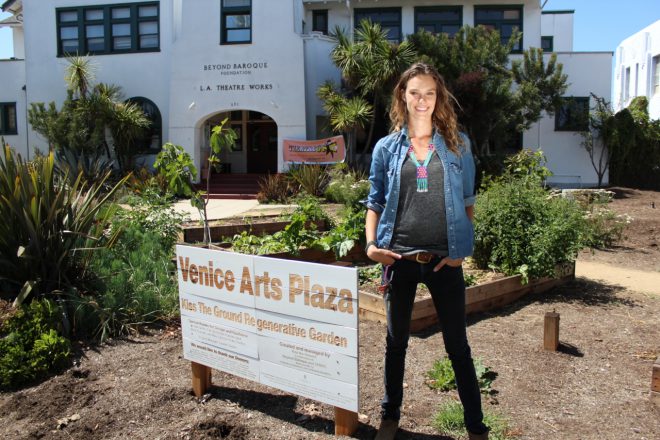
Kiss the Ground, founded by Ryland Engelhart and Finian Makepeace, says they have educated and activated millions through through short films, mini-docs, a podcast, branded collaborations, and other content they produce. They also work locally in Venice, a neighborhood in LA, to start hyper-local, urban farms.
In more central LA (south central) you have Ron Finley, considered a “guerilla gardener. He talks about food deserts and other problems of the disenfranchised, which if we think too hard is none of us or all of us. We are sort of all in this boat together. 😉 I remember my dad dying of cancer in Toronto and I couldn’t find a fresh apple near the hospital. There was coffee, doughnuts, plenty of fast food. Fresh food? I walked 20 minutes in frigid winter to find a grocery store.
If you haven’t already started gardening during the Covid-19 lockdown, don’t worry. You won’t miss the boat. There is still plenty of room to grow: The movie is now available on Netflix. The link is here.
Before the movie, download our Victory Garden handbook from the 40s. It was a great initiative to get all of America and Europe farming again.
Read more on regenerative and urban agriculture: