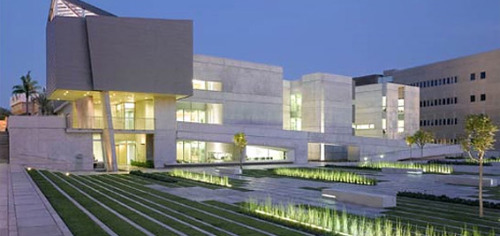
 With a strong environmental flavor to its courses already, it’s no wonder that Ben Gurion University is embracing the Green Campus label with such enthusiasm.
It may not be the first, or the only, university campus in Israel to receive the “Green Campus” label from the Ministry of Environmental Protection, (Haifa reduced their energy consumption by 22%) but Ben-Gurion University (BGU) in the country’s Negev desert can be singled out for having the most passionate and involved administration.
BGU is going green with gusto, says Gil Yaacov, who represents Green Course, Israel’s 6,000-member, nationwide student activist group, that’s leading the fight for environmental issues at 23 of the country’s colleges and university campuses. Yaacov says the Green Campus label represents a commitment to live up to, rather than a passing grade.
BGU’s academic staff boasts one of Israel’s most famous environmentalists – environmental lawyer and activist Dr. Alon Tal, founder of some of Israel’s most prominent green NGOs – and solar energy pioneer Prof. David Faiman, who is leading the way in exploring solar energy as a viable, commercial, renewable energy source. The university is also responsible for intensive research in desert agriculture, and has an entire research center dedicated to water.
Education, academia and community
University president Prof. Rivka Carmi says that the Green Campus initiative at BGU began more than a year ago, in an effort “to make the university deeply rooted in environmental responsibility in all aspects.”
Established by Green Course in 2005, the Greening Campuses Project is endorsed by the Ministry of Environment. The goal is to encourage academic institutions to adopt environment-friendly management policies. Campuses that qualify receive a Green Campus label – plus bragging rights.
Declaring their intention to become a Green Campus links researchers to practices that students can implement in their daily lives on campus: “[Ben Gurion University has been] fighting desertification, [working] in energy, primarily solar energy, but also in alternative energies – water and managing water resources. We must also be leaders in environmental involvement and responsibility,” Karmi tells ISRAEL21c.
Heading the Green Campus efforts is Prof. Dan Blumberg, chair of the Department of Geography. “In order to promote awareness toward the environment within the university’s boundaries, we’ve been working on three main levels – education, academia and community,” he tells ISRAEL21c, noting that the campus has already set up collection services to recycle bottles, tins, paper, batteries and electronic equipment. It also uses special homegrown sensors for turning lights on and off.
Special solar water heaters have been installed in the dorms, to maximize the ‘hot’ tap when hundreds of students are vying for a shower, and energy-saving light bulbs are standard. Working with the campus maintenance teams, the grounds staff takes note when energy is being wasted and is quick to find solutions. Scholarships dedicated to projects such as compost heaps on campus, are bringing delight to students who are eager to actively join the worldwide green movement.
Environmental branches in most departments
“We probably have the largest environmental set of programs in the country, with several departments focused on the environment, from management, to geography, and environmental engineering. We are also working extensively with the administration of the university to turn it into [an] energy efficient [campus] with a lot of outreach to people in the surrounding communities such as Beersheva, and the kibbutzim,” Blumberg relates.
Among the programs set up by BGU is an education program at a nearby Bedouin school, where the university students and teachers have created a gardening area made with recycled materials: “It’s not only teaching awareness,” says Blumberg, “but understanding about environmental issues.”
As for green research at BGU, it’s already well established, with an environmental branch in nearly every department, and the school has also developed a starter fund to generate more research and proposals concerning the environment.
It’s too early to talk about halving energy costs or providing hard statistics, but Blumberg notes that every building has a receptacle for collecting batteries and used electronics. “The maintenance unit is putting up maps showing where the facilities are, and their main partners are the students. The students are helping us set this up.”
The idea to go a deeper shade of green originated with the Ministry. Yaacov from Green Course tells ISRAEL21c that BGU is in good company, joining Haifa University and the Technion – Israel Institute of Technology, both of which already have Green Campus labels.
Richer environmental “flavor”
Tal, BGU’s environmental star, lectures on topics such as desertification and public policy, and climate change and public policy. He says he’s impressed by the vision of the university’s current and prior presidents. He stresses community service as one of the three necessary pillars (the other two being teaching and research) to successfully teach environmentalism on campus. Examples are a park that BGU has helped build in the poor Bedouin city of Rahat, where 60 percent of the population is under the age of 18. It was their first park. The university also offers green scholarships to students from Jordan and the Palestinian Authority.
Tal lauds BGU’s past president, Avishay Braverman, for committing funds to build a dedicated university train station, so students without cars could commute. Over the last couple of years at BGU, “the environmental flavor has taken a dramatic upswing,” he tells ISRAEL21c. In my mind, ‘environment’ at BGU – it’s not just a department – it’s a commitment for the university.”
Yaacov is pleased with the progress made at BGU, but admits that no campus in Israel is truly green yet, although many are on their way. Green Course should receive some of the credit for fueling this change from the bottom up, as it engages students who have the energy and passion for environmental activism.
“We work with them one step before their mortgage and family and commitments in life. This is when they have time and energy to act as activists,” he says, adding that 13-year-old Green Course is something like America’s student chapters of PIRG – the US Public Interest Research Group.
In addition to the group’s local and national achievements, its main contribution is the activism tools it has made available to the public, that have helped those seeking to protest the establishment of a new coal power plant, or to build a new public transportation network in their community.
Tipping his hat to BGU, Yaacov concludes that the campus is a “good example of how you can take leadership on the management level, and create a budget for improving issues.”
:: Israel 21c
More Green News From Israel: